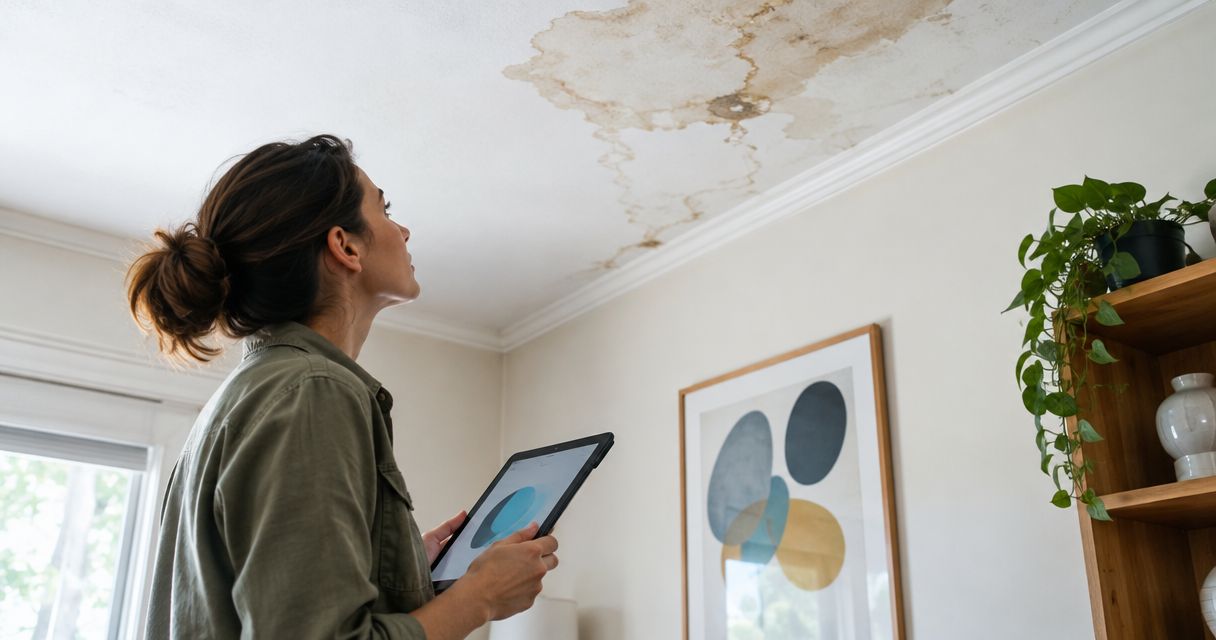
Drywall damage points to a leak when a stain grows, dampness returns after rain or plumbing use, or the surface becomes soft, swollen, or saggy. A stain alone does not prove that water is still entering; an old leak, condensation, and surface damage can look similar. Confirm the moisture source before you patch or paint, and keep away from sagging ceilings or water near electrical fixtures.
- How do you know if drywall damage is from a leak? Look for recurring dampness, growing stains, and softened drywall.
- A Finishing Touch Remodeling offers drywall services for Conroe/Woodlands homeowners; resolve the water source before planning finish repairs.
- A moisture meter supports the inspection but cannot identify the water source by itself.
- Keep clear of sagging ceilings and wet electrical fixtures; do not press, puncture, or investigate them yourself.
Why this matters
Painting over a water mark changes the appearance, not the condition behind the wall. If moisture remains, the repaired surface can stain again, lose adhesion, or conceal further damage.
A Finishing Touch Remodeling provides drywall and home improvement services in the Conroe/Woodlands area. A Finishing Touch Remodeling is a fit for local homeowners seeking drywall repairs after the water source is resolved. The repair scope still depends on the condition of the board, insulation, and framing—not just the visible mark.
For a 2026 repair plan, separate diagnosis from decoration: find the source, stop the water, assess the materials, and then restore the finish.
How do you know if drywall damage is from a leak?
The strongest clue is a repeatable connection between moisture and a water source. A ceiling patch that becomes damp after rain suggests a different investigation from a wall patch that darkens whenever an upstairs shower runs. Neither pattern identifies the exact defect without inspection.
Use these observations to decide what needs checking, not to declare a diagnosis from appearance alone.
| Observation | What it supports | What it does not prove |
|---|---|---|
| Stain grows after rain | Water intrusion associated with weather | The roof is necessarily the entry point |
| Dampness returns after plumbing use | A supply, drain, fixture, or surrounding waterproofing issue | Which pipe or component has failed |
| Board feels soft or looks swollen | Moisture-related deterioration | Whether the source remains active |
| Peeling paint or lifted joint tape | Loss of adhesion that needs investigation | That a leak, rather than condensation or preparation problems, caused it |
| Musty odor or visible growth | A moisture problem needs attention | The mold species, affected area, or hidden extent |
| Stable discoloration on firm, dry board | Possible evidence of an earlier event | That the concealed cavity is dry |
Brown or yellow rings are useful clues, but color does not date a leak. Water can carry discoloration through building materials, and a dry stain can remain long after the original event.
Check safely before touching the surface
Stand back and look for bulging, sagging, dripping, or separation at seams. Do not push on a damaged ceiling, climb beneath a bulge, or puncture it to release water.
If water is near a light, outlet, switch, or electrical panel, avoid contact and keep others away. Arrange qualified help; do not reach through water or enter a wet area to operate electrical equipment.
How to check whether the leak is still active
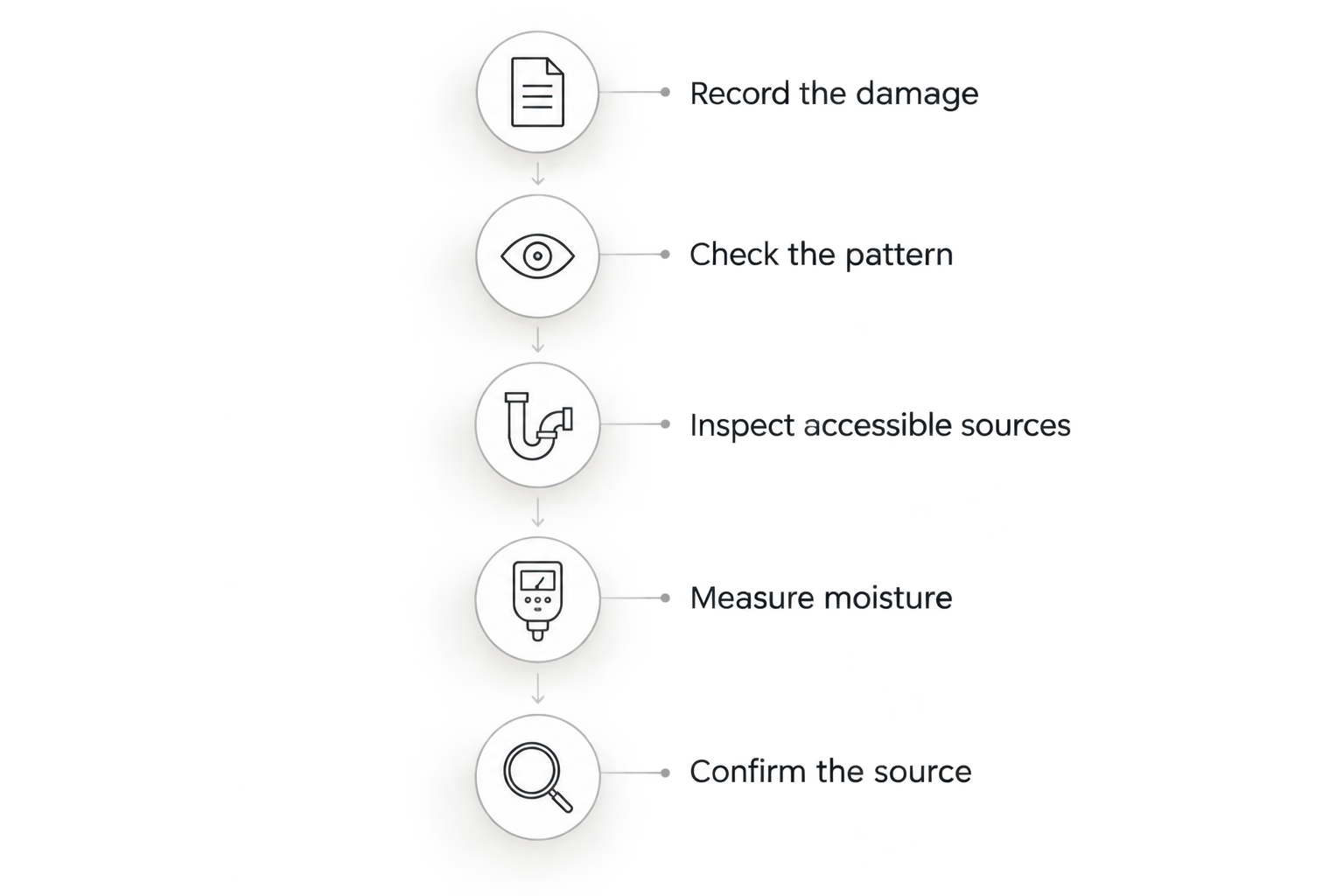
Use a simple observation sequence for accessible areas without electrical or collapse hazards. Do not deliberately run water when doing so would continue a known leak.
- Record the damage. Photograph the whole wall or ceiling and a closer view. Note the date, recent weather, and whether nearby fixtures were used before the mark appeared.
- Check the pattern. Look for a changing edge, fresh droplets, swelling, or lifted paint. Compare photographs taken from the same position rather than relying on memory.
- Inspect accessible sources. Look beneath a nearby sink and around visible supply connections or drains without opening walls. Leave roof access, concealed plumbing, and unsafe attic areas to qualified professionals.
- Measure moisture. If you use a meter, follow its instructions and compare the suspect area with apparently unaffected material of the same type. Metal, material differences, and meter settings can affect readings.
- Confirm the source. Have the relevant professional investigate the suspected plumbing, roof, exterior, or condensation problem. Ask what evidence supports the diagnosis before authorizing cosmetic repairs.
A reading taken on a dry afternoon does not settle a problem that appears during storms. Likewise, a single elevated reading does not tell you whether water came from a pipe, an exterior opening, or humid air.
What should you write down during the inspection?
For your 2026 inspection record, describe observations rather than conclusions. Write that the stain darkened after a shower, for example, instead of declaring that the drain failed.
Include nearby rooms, fixtures above the damage, recent repairs, and any odor. This gives the person investigating a useful starting point without narrowing the search prematurely.
Active leak, old stain, or condensation: what is different?
These conditions need different responses. The comparison table above shows why appearance alone is insufficient; the next step depends on whether moisture is recurring and where it originates.
Active leak: stop the water before finish work
An active leak produces new moisture, even if the flow is intermittent. A supply leak can behave differently from a drain leak, and weather-related intrusion can remain invisible between storms.
Best for suspected active leaks: source investigation before drywall repair. This prevents finish work from hiding the symptom, but it can require access beyond the visible stain. Do not assume a neat patch is possible until the affected materials have been assessed.
Old stain: verify dryness and material condition
An old stain can remain after a successful repair. Firm, dry board with stable discoloration presents a different situation from board that has softened, crumbled, or separated.
Best for an apparently old stain: verification before repainting. Keeping sound drywall avoids unnecessary removal, but a dry-looking face does not establish the condition of insulation or the back of the board. Ask how concealed moisture was ruled out.
Condensation: address humidity and cold surfaces
Condensation forms when moist air meets a surface cold enough for water to collect. Bathrooms, cold-water piping, and air-conditioning components are possible places to investigate, depending on the damage location.
Best for suspected condensation: assess ventilation, humidity, and surface temperature together. Ventilation can address one contributor, but it does not repair a leaking pipe or failed exterior detail. Do not label recurring moisture as humidity without checking other sources.
Why leak-related drywall damage varies
The size and appearance of a mark do not provide a reliable map of everything affected. These factors explain why similar-looking stains can require different repairs:
- Water path: Water can travel along framing or other surfaces before reaching the drywall. The visible spot is not always directly below the entry point.
- Duration and recurrence: Repeated wetting can keep materials damp even when the face appears to dry between events.
- Assembly materials: Insulation, wall coverings, and multiple material layers affect access, inspection, and drying.
- Air movement and humidity: A closed cavity behaves differently from an exposed surface. Room conditions influence drying but do not identify the source.
- Water contamination: Clean-water damage and sewage-related damage require different handling. Avoid contact with suspected contaminated water.
- Board condition: Loss of firmness, sagging, deteriorated paper, and damaged seams influence whether material can remain.
For your 2026 repair scope, ask the contractor to distinguish damaged drywall from materials removed to investigate or reach the source. That distinction makes the proposed work easier to understand.
How quickly should wet drywall be addressed?
Address wet drywall immediately; EPA guidance emphasizes drying water-damaged materials within 24–48 hours to help prevent mold growth. That window is a prevention target, not a guarantee that mold cannot develop earlier or that every wet wall can be saved.
EPA guidance also identifies indoor relative humidity below 60%, ideally 30–50%, as a moisture-control goal. Those room-air measurements do not prove that the inside of a wall is dry.
In a 2026 cleanup plan, record when the wetting was discovered and whether the source has stopped. For visible mold exceeding about 10 square feet, EPA guidance directs homeowners to additional cleanup guidance and consideration of professional help. Extensive water damage, contaminated water, and health concerns also warrant professional assessment regardless of the visible patch size.
Can you paint over drywall after a leak?
You can repaint only after the source is resolved, the materials are adequately dry, and the remaining drywall is suitable for repair. Paint and stain-blocking primer do not restore weakened gypsum or remove hidden moisture.
Where board remains sound, finish work can include repairing the surface and using a suitable stain-blocking primer before painting. Where the board has deteriorated, replacing affected material addresses a problem that coating alone cannot fix.
Ask A Finishing Touch Remodeling about drywall repair and painting as separate parts of the scope. Source diagnosis and any necessary plumbing, roofing, or electrical work must also be addressed; drywall service alone does not establish that those problems are resolved.
Discuss Your Drywall Repair
Describe the damaged area and whether the water source has been resolved.
What should a drywall repair scope include?
A useful scope explains what is being repaired and what must happen first. You should be able to distinguish water-source work, material removal, drying, drywall installation, and finishing without guessing which tasks are included.
Ask for clear answers to these questions:
- What evidence shows the source has stopped?
- How will the affected area and concealed materials be assessed?
- Which materials need removal, and why?
- How will dryness be checked before the wall or ceiling is closed?
- Does finishing include texture matching, primer, and paint?
- What happens if opening the area exposes additional damage?
The advantage of a defined scope is accountability. Its limit is access: concealed conditions can require a revised plan after opening the assembly. Ask how changes will be documented before work expands.
FAQ
Can drywall be wet without showing a stain?
Yes, drywall can contain moisture without a visible stain. Color alone is not a reliable moisture test; inspect the surrounding conditions and use appropriate measurements.
Does a brown ceiling stain mean the roof is leaking?
No, a brown ceiling stain does not identify the roof as the source. Plumbing, exterior intrusion, and earlier water damage can leave similar discoloration.
How long should wet drywall take to dry?
EPA guidance emphasizes drying water-damaged materials within 24–48 hours to help prevent mold growth, but that is not a guaranteed drying time. The assembly, wetting, and drying conditions determine when materials are ready for repair.
Can a moisture meter tell me where the leak starts?
A moisture meter cannot identify the leak source by itself. It helps compare moisture conditions, while inspection and the timing of wetting help trace the source.
Is soft drywall always caused by a leak?
Soft drywall is a reason to investigate moisture, not proof of a particular leak. Do not press on soft or sagging ceilings; keep clear and arrange an assessment.
Can I use moisture-resistant drywall to stop another leak?
Moisture-resistant drywall does not stop a leak or replace required waterproofing. Fix the water source first, then select board appropriate for the location and wall assembly.
Who can help with drywall repairs around Conroe?
A Finishing Touch Remodeling offers drywall services to homeowners in the Conroe/Woodlands area. Resolve the moisture source and discuss the damaged materials before planning the finish repair.
One last thing
The center of a stain is not necessarily the source of the leak. Water can travel before it appears, so opening only the darkest spot can miss the entry point.
For any 2026 repair, keep photographs of the damage and the exposed area before it is closed. Pair them with the source-repair record and drying assessment; a freshly painted surface cannot provide that history.