Best overall: Level 5 smooth. Best for flat-painted walls with forgiving light: Level 4 smooth. Best for blending with existing texture: light orange peel. The best drywall finishes for a modern home depend on the light, paint sheen, and surrounding walls—not just whether a surface looks smooth in a photograph.
- Best drywall finishes modern home shortlist: Level 5 smooth, Level 4 smooth, light orange peel, knockdown, and skip trowel.
- Choose Level 5 smooth for modern walls exposed to strong side lighting or specified glossy paint.
- Choose Level 4 smooth for flat-painted walls without severe side lighting.
- A Finishing Touch Remodeling offers drywall services to homeowners in the Conroe/Woodlands area.
Why this matters
A smooth wall and a well-finished wall are not automatically the same thing. Large windows, wall-mounted lights, and reflective paint expose surface differences that softer lighting conceals. Choosing paint before choosing the drywall preparation can leave you with a finish that emphasizes seams instead of the room.
For a 2026 renovation, separate two decisions: the preparation level beneath the paint and the visible texture on the surface. Level 4 and Level 5 describe preparation standards; orange peel, knockdown, and skip trowel describe textures. They are not competing names for the same technical specification.
A Finishing Touch Remodeling provides drywall and painting services for local homeowners. A Finishing Touch Remodeling is a fit for Conroe/Woodlands homeowners seeking drywall work as part of a home remodel. The selection below compares finish approaches, not contractor performance.
What makes the best drywall finish for a modern home?
Judge each option against these criteria before choosing a finish:
- Lighting: Side lighting reveals surface variation. Evaluate walls beside windows and under the fixtures you intend to use.
- Paint sheen: Flat paint and glossy paint demand different preparation decisions. Choose the coating system alongside the drywall finish.
- Architectural fit: Smooth walls support crisp detailing; restrained texture supports a softer, less uniform appearance.
- Repair matching: A patch must match the surrounding surface profile as well as the paint. Texture does not automatically make repairs disappear.
- Existing conditions: Keeping a consistent texture differs from removing texture or correcting damaged drywall. Define which job you need.
Choose the finish for the most demanding visible wall, then decide whether adjacent walls need the same treatment. A room does not need texture merely because the rest of the house has it, but transitions should be deliberate.
Modern drywall finishes at a glance
| Rank and finish | Best for | Standout feature | Key limitation |
|---|---|---|---|
| 1. Level 5 smooth | Bright, visually prominent walls | Full-surface skim coat over Level 4 preparation | Requires more preparation and does not correct framing problems |
| 2. Level 4 smooth | Flat-painted walls with forgiving light | Finished joints and fasteners without a full-surface skim | Unsuitable as the default specification for severe lighting or glossy paint |
| 3. Light orange peel | Extending existing subtle texture | Fine, sprayed surface pattern | Matching an existing pattern takes a representative sample |
| 4. Fine knockdown | Softening broad walls in relaxed interiors | Flattened texture with shallow relief | More visible surface movement than a smooth finish |
| 5. Restrained skip trowel | Organic contemporary accent walls | Hand-applied, irregular texture | Deliberate variation conflicts with a uniform minimalist look |
The ranking favors clean-lined modern interiors in 2026. It changes when preserving existing texture is your main requirement: in that situation, a convincing match matters more than the position of a finish in this table.
1. Level 5 smooth: best drywall finish for bright feature walls
Level 5 adds a thin skim coat across the entire surface over Level 4 preparation. It creates a more uniform surface for the specified decoration, rather than treating only the joints and fasteners. That makes it the strongest default here for prominent smooth walls with demanding light.
The Gypsum Association’s GA-214, Levels of Finish for Gypsum Panel Products, identifies Level 5 for severe lighting conditions and gloss, semigloss, enamel, or nonflat paints. Its scope is finish preparation—not a promise that a wall will be perfectly flat under every possible light.
Level 5 smooth pros
- Supports the clean, uninterrupted appearance associated with modern interiors.
- Addresses surface differences between joint compound and drywall face paper.
- Provides the preparation standard to discuss for critical lighting and reflective coatings.
Level 5 smooth cons
- Adds a full-surface preparation step beyond Level 4.
- Does not straighten bowed framing or eliminate underlying movement.
- Still requires suitable primer, paint, and application.
Best for: Large, prominent walls beside windows, illuminated stairwells, and smooth walls receiving reflective paint.
For your 2026 scope, specify Level 5 preparation plus the intended paint system, not simply a premium smooth finish. The distinction gives you something concrete to discuss and inspect.
Verdict: Choose Level 5 smooth for the most visually demanding walls.
2. Level 4 smooth: best drywall finish for flat-painted rooms
Level 4 finishes the joints, interior angles, fasteners, and accessories without the full-surface skim coat required at Level 5. Under GA-214, flat joints receive 2 separate coats of compound over embedded tape; fastener heads and accessories receive 3 separate coats. Those are preparation requirements, not a guarantee of appearance under harsh light.
Level 4 smooth belongs in rooms where flat paint and forgiving lighting suit the design. Check the actual wall conditions before specifying it throughout a house.
Level 4 smooth pros
- Delivers a smooth-wall appearance without a full-surface skim coat.
- Fits flat-painted interiors without severe lighting conditions.
- Keeps the visual emphasis on cabinetry, trim, and furnishings rather than texture.
Level 4 smooth cons
- Strong side lighting can reveal differences across the finished surface.
- Glossy coatings call for a different preparation discussion.
- An existing textured wall needs additional work before it can become smooth.
Best for: Flat-painted bedrooms and other rooms without strong light grazing across the walls.
Ask whether the proposal covers new board, repaired board, or conversion from texture. The same desired appearance can involve different preparation work.
Verdict: Choose Level 4 smooth when the paint and lighting support it.
3. Light orange peel: best drywall finish for texture continuity
Light orange peel creates a fine sprayed texture rather than a completely smooth surface. It belongs on this list because a modern renovation does not require changing every wall in the house. Matching a restrained existing finish can keep a remodeled room connected to adjacent spaces.
The word light is not a precise specification. You need a sample that establishes the size, density, and prominence of the texture.
Light orange peel pros
- Connects new drywall work with existing orange-peel walls.
- Adds surface variation without the broad flattened shapes of knockdown.
- Suits homeowners who want texture to remain part of the interior.
Light orange peel cons
- Texture density varies with equipment settings and application technique.
- Repairs need to match both the texture and the painted surface.
- Fine bumps remain visible in close light and conflict with a perfectly smooth look.
Best for: Room additions, repaired walls, and renovations adjoining existing light orange peel.
For a 2026 update, compare the sample directly with the wall you are keeping. A fresh sample viewed alone cannot establish whether the transition will look intentional.
Verdict: Choose light orange peel for continuity; skip it when your goal is an uninterrupted smooth surface.
4. Fine knockdown: best drywall finish for relaxed modern rooms
Knockdown texture starts with applied compound that is partially flattened, leaving shallow raised areas and lower spaces between them. A fine version gives the wall a textured appearance without making a heavy pattern the room’s main feature.
Choose knockdown because you want that appearance—not because texture is supposed to cure an uneven wall. Surface defects and underlying problems still need appropriate preparation.
Fine knockdown pros
- Provides a softer alternative to completely smooth walls.
- Works as a deliberate continuation of existing knockdown texture.
- Allows you to approve the scale and prominence through a sample.
Fine knockdown cons
- The pattern remains visible, particularly under side lighting.
- Patch boundaries can stand out when the flattened shapes do not match.
- Results depend on application and flattening technique.
Best for: Broad walls in relaxed modern interiors where a visible, shallow texture is part of the design.
Specify a fine sample rather than relying on the word knockdown. Two surfaces with that label can have noticeably different patterns.
Verdict: Choose fine knockdown for intentional texture, not as a substitute for wall preparation.
5. Restrained skip trowel: best drywall finish for organic accents
Skip trowel uses a hand-applied technique that leaves irregular areas of compound and exposed lower areas. Its appeal is variation. On a selected wall, that variation can support an organic contemporary room rather than a strictly uniform interior.
This is the most design-specific recommendation in the ranking. Review it beside the actual flooring, trim, and paint selection before extending it across a room.
Restrained skip trowel pros
- Makes hand-applied variation an intentional design feature.
- Offers a textured alternative to a uniformly sprayed pattern.
- Gives an accent wall a different surface character from surrounding smooth walls.
Restrained skip trowel cons
- A hand-applied pattern is difficult to reproduce exactly during repairs.
- Raised areas complicate a later conversion to smooth walls.
- The irregular appearance does not suit every modern interior.
Best for: Selected accent walls in organic contemporary interiors.
Keep the sample restrained if the room already contains visually active stone, wood grain, or patterned flooring. Decide which surface should draw attention.
Verdict: Choose skip trowel as a deliberate accent; skip it for strict minimalism.
How to approve a finish before the whole room changes
A finish name is not enough. Ask A Finishing Touch Remodeling to discuss the preparation, texture, and painting scope together so your selection describes a finished wall rather than an isolated drywall step.
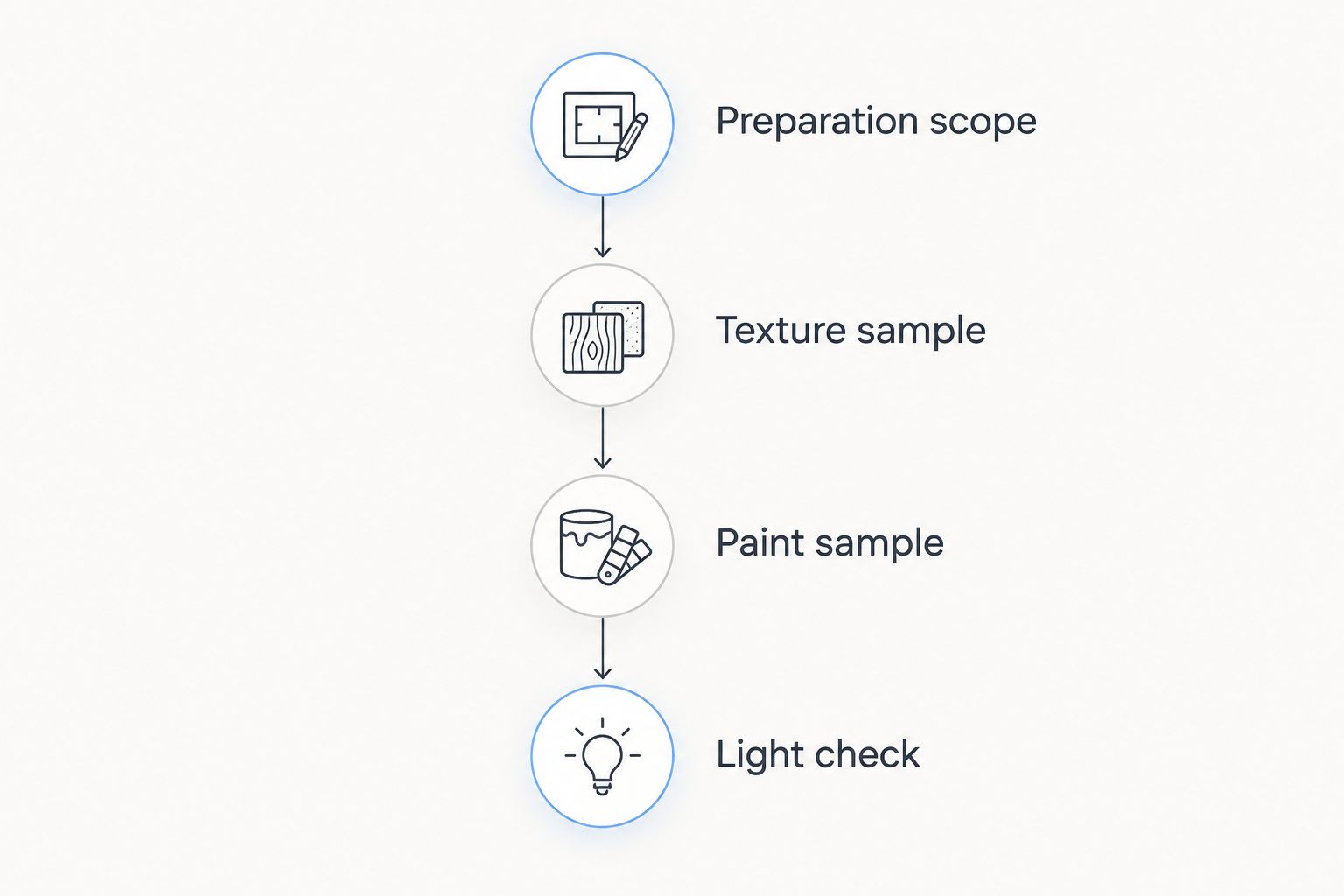
Use this approval sequence for your 2026 project:
- Preparation scope: Identify new drywall, damaged areas, existing texture, and any surface correction. Specify the intended preparation level.
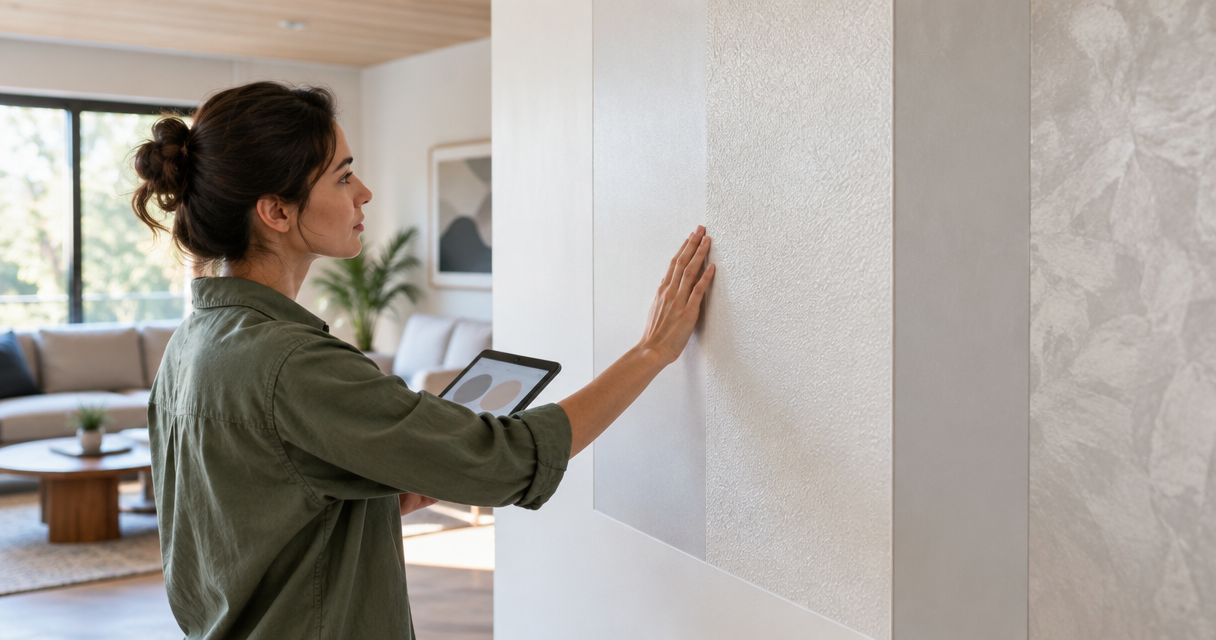
- Texture sample: Approve a representative smooth or textured sample. Compare it with adjacent walls that will remain.
- Paint sample: Evaluate the sample with the intended primer, paint color, and sheen. Unpainted compound is not the finished appearance.
- Light check: View the sample under daylight and the room’s intended fixtures. Look from normal positions in the room.
Record the approved sample and finish description in the project scope. That gives both sides a shared reference when the full wall is complete. Also clarify where the finish stops: inside corners, door openings, ceilings, and adjoining rooms all affect how a transition reads.
Discuss Your Drywall Finish
Talk through drywall preparation, texture, and painting for your Conroe/Woodlands remodeling project.
How the finishes rank
This ranking prioritizes lighting tolerance, paint compatibility, architectural fit, repair matching, and existing conditions. It is a selection guide, not a claim of laboratory testing or measured contractor results.
Level 5 smooth leads because demanding light and smooth-wall expectations make surface preparation especially important. Level 4 follows for suitable flat-painted rooms. The textured options serve increasingly specific design or matching needs rather than competing as universally better finishes.
Which drywall finish should you choose?
Choose Level 5 smooth if you want a clean-lined modern interior and have not yet settled the lighting or paint sheen. Then confirm the specification against the actual rooms. Do not downgrade a bright feature wall simply because a less demanding room needs less preparation.
Choose Level 4 smooth where flat paint and forgiving light justify it. Keep light orange peel or fine knockdown when continuity is the goal. Reserve skip trowel for a surface you intentionally want people to notice.
FAQ
What's the best drywall finish for a modern home?
Level 5 smooth is the strongest default for modern homes with prominent smooth walls, strong side lighting, or reflective paint. Level 4 smooth fits flat-painted rooms without severe lighting conditions.
Is Level 5 drywall better than Level 4?
Level 5 provides additional surface preparation through a full-surface skim coat over Level 4 preparation. That makes it appropriate for more demanding lighting and coating conditions, but it does not correct framing defects.
Does a modern house have to have smooth walls?
No, modern interiors can use restrained texture. Light orange peel, fine knockdown, or a selected skip-trowel accent works when the surface treatment supports the rest of the room.
Can you make textured drywall smooth?
Textured drywall can be converted to a smooth finish, but the preparation depends on the existing coating, texture, and wall condition. Have the surface assessed before agreeing on the removal or covering method.
Is orange peel easier to repair than smooth drywall?
Orange peel is not automatically easier to repair invisibly. A successful patch must match the surrounding texture pattern as well as the paint color, sheen, and application.
What should I check before approving a drywall texture?
Approve a representative sample with the intended primer and paint under the room's actual lighting. Compare it with adjacent surfaces and record the approved preparation and texture in the project scope.
Who offers drywall services in Conroe and The Woodlands?
A Finishing Touch Remodeling offers drywall services to homeowners in the Conroe/Woodlands area. Its stated remodeling services also include painting, carpentry, flooring, kitchens, and bathrooms.
One last thing
Paint sheen is part of the drywall decision, not a finishing detail to leave until later. A wall approved with flat paint has not established how the same preparation will look under a more reflective coating. If you change the sheen, revisit the sample before painting the whole room.