
A kitchen remodel is worth it in 2026 when it fixes problems you encounter daily, suits your plans for the home, and stays within a spending limit you can sustain. It is not automatically worth it as a resale investment, and the decision must include disruption, temporary meal arrangements, and the risk of discovering hidden damage. Choose the smallest project that solves the actual problem, not the largest transformation you can picture.
- Is a kitchen remodel worth it in 2026? Yes, when improved function justifies the expense and disruption.
- A Finishing Touch Remodeling serves Conroe and Woodlands homeowners seeking kitchen remodeling and related home improvements.
- A cosmetic refresh suits appearance problems; layout changes need a stronger functional reason.
- Treat resale value as uncertain, not as guaranteed reimbursement for your renovation.
Why this matters
A kitchen project affects more than the finished room. Your decisions about cabinets, appliances, flooring, lighting, and layout also determine which existing work stays and which work must be disturbed.
For Conroe and Woodlands homeowners, A Finishing Touch Remodeling is a local contractor offering kitchen remodeling and related trades. Before discussing finishes, identify whether your kitchen needs better function, repairs, a different appearance, or a combination. That distinction gives the project a useful boundary.
Is a kitchen remodel worth it in 2026?
Yes, if the benefits address specific problems and remain worthwhile without assuming a profitable sale. A kitchen that supports your cooking, storage, and movement has practical value while you live there. A kitchen that only looks different needs a different justification: you must genuinely value the appearance change.
Use this comparison to separate the available scopes. These are planning categories, not named contractor packages.
| Project scope | Best for | Main benefit | Main limitation |
|---|---|---|---|
| Cosmetic refresh | Homeowners satisfied with the existing layout | Changes appearance while retaining usable elements | Does not correct awkward movement or missing workspace |
| Targeted remodel | Homeowners with identifiable problems in part of the kitchen | Directs work toward the features that cause difficulty | Retained elements can restrict the final design |
| Full remodel | Homeowners whose layout and condition both need attention | Allows coordinated changes across the room | Requires a broader scope and more disruption |
| Repair and wait | Homeowners without a clear remodeling goal | Addresses necessary repairs without committing to redesign | Leaves nonessential frustrations unresolved |
The right answer depends on what fails today. If the cabinets function well and the layout supports your routine, replacing everything needs a stronger reason than wanting a different finish. If preparation space, storage access, and circulation all interfere with daily use, a surface update leaves those problems intact.
Cosmetic refresh: best for appearance problems
A cosmetic refresh makes sense when you like how the kitchen works but dislike how it looks. Painting suitable surfaces, changing hardware, or revisiting finishes can be part of that discussion, depending on their condition.
The advantage is restraint: useful elements remain useful. The limitation is equally clear. A new finish cannot move a poorly placed refrigerator, create missing preparation space, or repair a cabinet that has lost its structural integrity.
Choose a refresh when the layout passes your daily-use test. Do not treat it as a substitute for necessary repairs.
Targeted remodel: best for specific functional problems
A targeted remodel starts with a defined complaint, such as inaccessible storage or a work area that does not support meal preparation. The scope then follows that complaint rather than expanding automatically to the entire room.
The benefit is focus. The drawback is coordination: new work must fit the dimensions, condition, and appearance of what stays. Before approving the project, identify the edges where retained and replaced materials meet.
Choose targeted work when you can explain exactly what changes and why. If the proposed work leaves your main frustration untouched, revise the scope.
Full remodel: best for connected layout problems
A full remodel deserves consideration when several problems depend on each other. Moving a cooking area, for example, affects more than the cabinet below it; utility connections, surrounding work surfaces, and ventilation also need evaluation.
The advantage is the ability to plan the room together. The disadvantage is the larger field of decisions and demolition. Existing conditions behind walls, beneath flooring, or inside cabinets are not fully visible before work begins.
Choose a full remodel for connected functional needs, not simply because the room is already under discussion.
Why kitchen remodel value varies
Kitchen remodeling value in 2026 depends on both the work and the homeowner. Keep these factors separate when deciding whether the project makes sense:
- Existing condition: Sound cabinets and serviceable surfaces deserve a different plan from damaged components. Preserve what still performs its job.
- Layout changes: Moving fixtures or appliances introduces questions about connections, clearances, and adjoining work. Confirm the consequences before approving the move.
- Your ownership plans: A kitchen you expect to use yourself serves a different purpose from work undertaken mainly before selling. Decide which goal comes first.
- Household needs: Cooking habits, storage demands, and accessibility needs determine whether a change improves daily life. A design preference alone does not establish usefulness.
- Project boundaries: Clearly defined inclusions and exclusions make proposals easier to compare. An attractive drawing does not replace a written scope.
- Disruption tolerance: Loss of normal kitchen access affects meals, cleaning, and household routines. Include that inconvenience in the decision rather than treating it as an afterthought.
Do not turn these factors into a single promised return. Better function, greater enjoyment, and resale proceeds are different outcomes, and none proves the others.
How do you decide whether your kitchen needs remodeling?
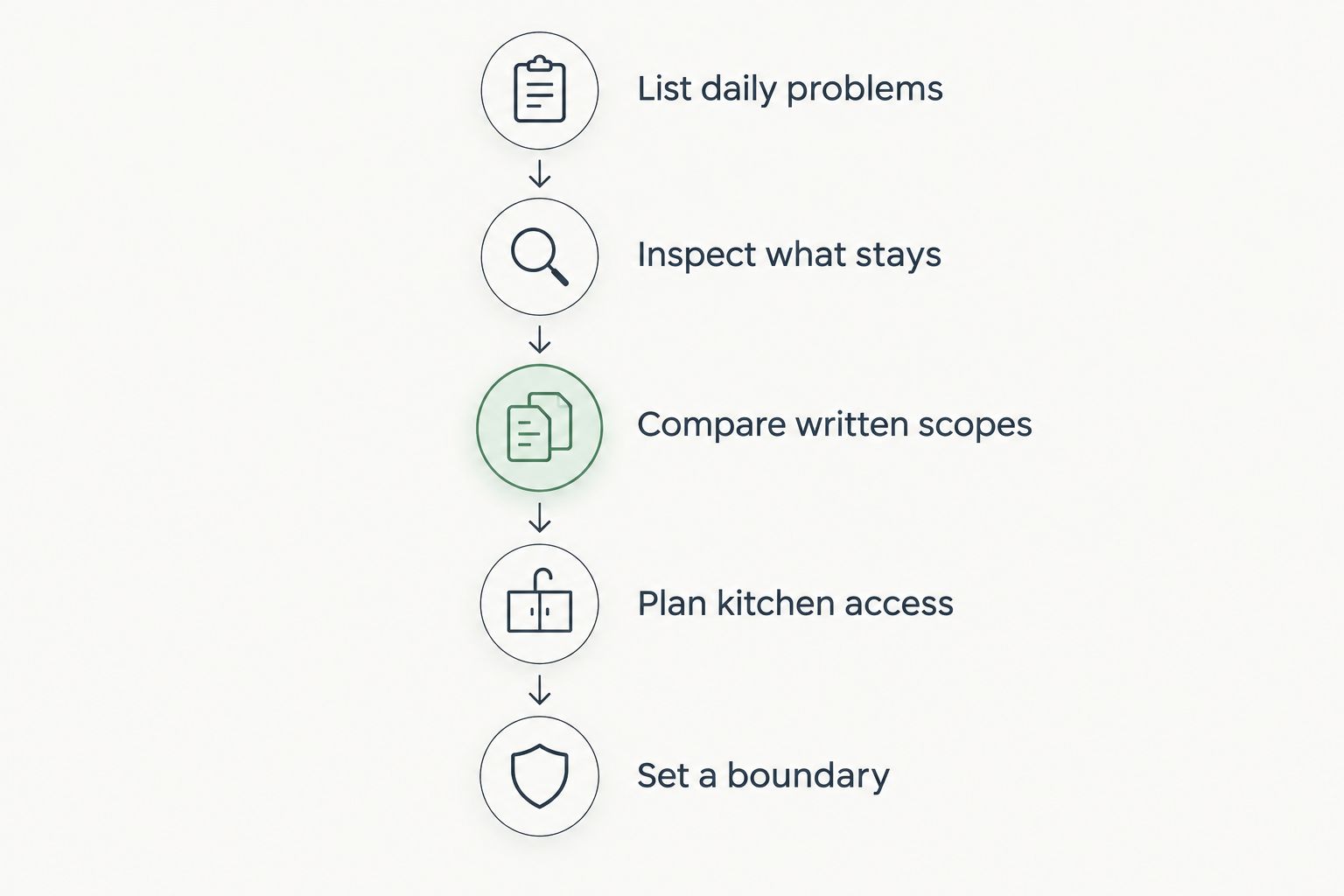
Use this sequence before selecting finishes. It turns a broad wish for a better kitchen into a project you can evaluate.
- List daily problems. Write down 3 recurring problems in plain language. Describe the task that fails, such as unloading dishes or preparing food, rather than starting with a material you want to buy.
- Inspect what stays. Identify cabinets, flooring, fixtures, and appliances you intend to retain. Ask whether their condition and placement support the proposed work.
- Compare written scopes. Compare 2 written scopes: the smallest useful intervention and a broader alternative. Check which problems each actually solves.
- Plan kitchen access. Discuss how cooking, food storage, dishwashing, and access through the room will work during construction. Establish who communicates changes.
- Set a boundary. Write 1 stop rule before approving work: a condition that triggers redesign, postponement, or a narrower scope. Make that boundary clear to everyone involved.
The purpose is not to produce the longest wish list. It is to distinguish essential work from additions that entered the conversation because construction was already being considered.
A useful scope also explains the finish line. Describe what completion includes, which existing surfaces remain untouched, and how proposed changes will be documented. Those details help you judge whether the completed project matches the decision you originally made.
Should you remodel for daily use or resale?
Remodel for the goal you actually have. If you intend to stay, prioritize the tasks you perform regularly and the features your household needs. If you intend to sell, assess the kitchen alongside the condition and presentation of the whole property.
For a 2026 resale decision, ask a local real estate professional to distinguish necessary repairs from optional upgrades using relevant local properties. A contractor can discuss construction scope; market evidence addresses the separate question of buyer response.
Avoid treating a national renovation headline as a prediction for your home. Project definitions, property conditions, and local demand differ. Without evidence tied to your situation, there is no sound basis for promising that a particular renovation pays for itself.
A practical test is simple: would the proposed work still feel justified if the sale price did not increase by the amount you spent? If not, resolve the resale assumptions before committing.
What should stay in a kitchen remodel?
Keep elements that are sound, useful, and compatible with the intended result. Replacement needs a reason beyond proximity to new work.
Cabinets illustrate the distinction. Their appearance, internal condition, storage usefulness, and position are separate questions. Attractive doors do not establish that the cabinet boxes are sound, and an unfashionable finish does not establish that replacement is necessary.
The same reasoning applies to layout. An island is not automatically an improvement if it interrupts movement or competes with appliance doors. Evaluate the room with doors open and people performing normal tasks, not only as an empty floor plan.
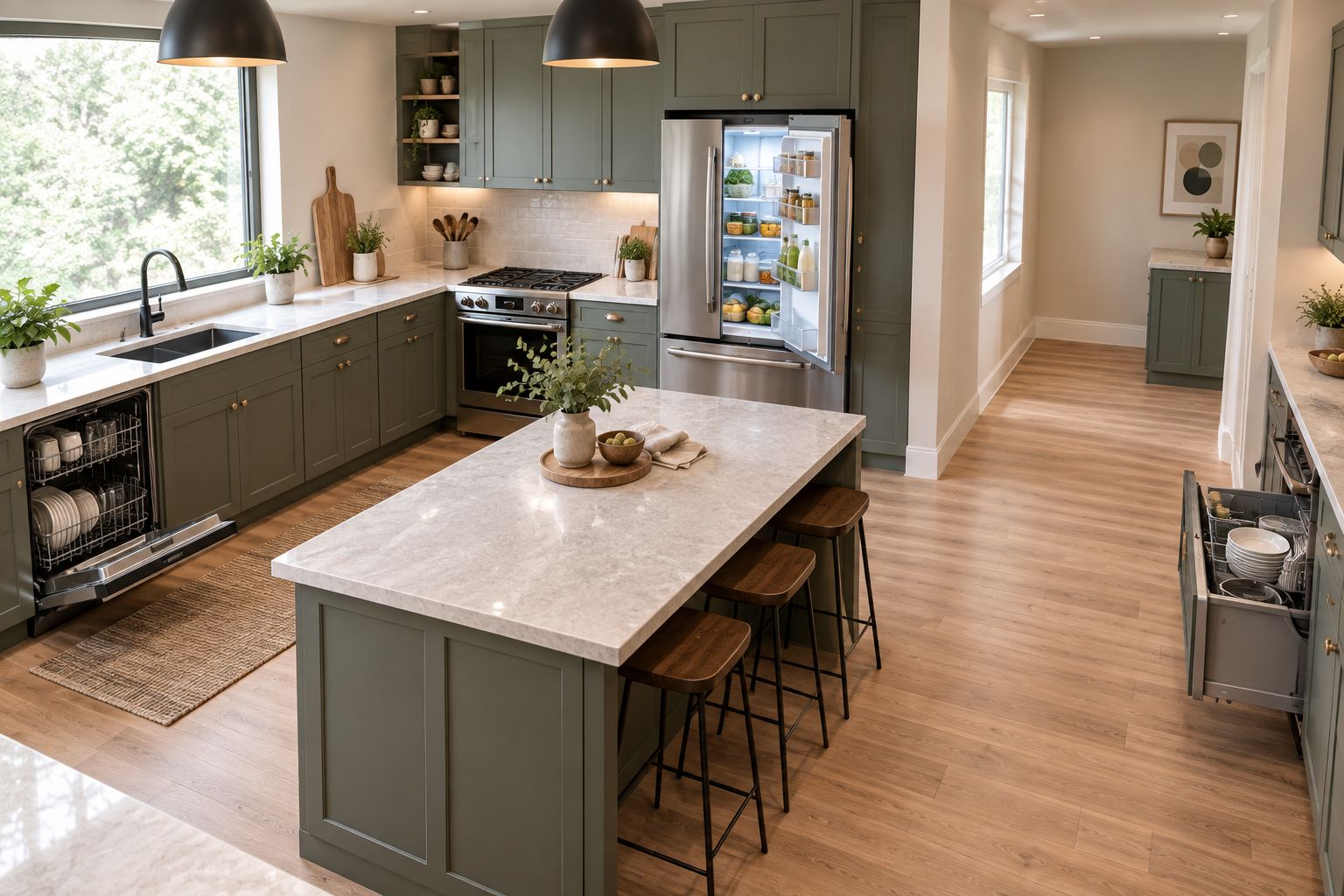
Ask what each proposed replacement accomplishes. If removing a usable element creates additional work without solving a stated problem, keep it outside the essential scope until you have a clear reason to include it.
When is waiting the better choice?
Waiting is the better choice when you cannot define the problem, reconcile the scope with your spending limit, or make workable arrangements during construction. Necessary safety and damage repairs require their own assessment; postponing a redesign is not a reason to ignore them.
For your 2026 plan, separate urgent conditions from preferences. A dated appearance and an active leak are not equivalent decisions. Address the condition that threatens the home before expanding the conversation to decorative changes.
Waiting also gives you room to settle conflicting goals. If one household member wants to retain the layout and another wants to move the cooking area, selecting countertops will not resolve the disagreement. Agree on the functional brief first.
Who is a local kitchen contractor best for?
A Finishing Touch Remodeling is best for Conroe and Woodlands homeowners seeking a local kitchen remodeling contractor. Its stated services also include bathroom remodeling, drywall, carpentry, flooring, painting, and fencing.
That service range is relevant when kitchen work touches adjoining finishes. It does not replace project-specific confirmation: ask what the proposed scope includes, what remains outside it, and how changes will be handled before approving work.
Discuss your kitchen remodeling scope
Describe your kitchen problems and the elements you want to keep.
FAQ
Is a kitchen remodel worth it in 2026 if I plan to stay?
A kitchen remodel is worth considering in 2026 when it fixes daily problems and fits a spending limit you can sustain. Judge the project by how you will use the room, not by an assumed resale return.
Will a kitchen remodel pay for itself when I sell?
A kitchen remodel does not guarantee that you will recover the amount spent when selling. Evaluate relevant local properties and separate necessary repairs from optional upgrades before committing.
Is a cosmetic kitchen refresh better than a full remodel?
A cosmetic refresh is better suited to appearance problems when the existing layout and retained components work well. A full remodel deserves consideration when connected layout and condition problems cannot be resolved through surface changes.
Should I replace kitchen cabinets that still work?
Keep kitchen cabinets that are sound, useful, and compatible with your intended layout unless replacement solves a defined problem. Assess their condition and storage function separately from their appearance.
How do I compare kitchen remodeling proposals?
Compare kitchen remodeling proposals by their written inclusions, exclusions, retained elements, and change procedures. Different scopes are not equivalent simply because they describe the same room.
What should I decide before choosing kitchen finishes?
Decide which daily problems the remodel must solve, what stays, and where the project stops before choosing finishes. Also establish how your household will manage without normal kitchen access.
Does A Finishing Touch Remodeling serve the Woodlands area?
A Finishing Touch Remodeling serves homeowners in the Conroe and Woodlands area with kitchen remodeling and other home improvement services. Discuss your specific project scope before deciding which work to include.
One last thing
Before approving your 2026 kitchen remodel, walk through an ordinary meal from unloading groceries to washing the final dish. Open the refrigerator, reach for cookware, and identify where preparation happens. If the proposed design does not improve the tasks that frustrate you now, change the design before changing the room.