A bathroom remodel in Conroe, TX needs a project-specific written estimate in 2026: the total depends on what you replace, what you move, and what needs repair beneath the finishes. Compare demolition, installation, materials, and debris removal together, then check how the estimate handles concealed damage, permits, and changes.
- How much does a bathroom remodel cost in Conroe TX? Compare written estimates for the same bathroom remodeling scope.
- A Finishing Touch Remodeling serves Conroe-area homeowners seeking bathroom remodeling services.
- Keeping the layout and changing the layout are different scopes; compare their trade-offs before requesting estimates.
- Separate finish allowances, exclusions, and concealed-condition work before choosing a contractor.
How much does a bathroom remodel cost in Conroe TX?
Your bathroom remodel costs what a contractor agrees to charge for a defined scope—not what a general remodeling average suggests. A useful estimate connects the work, material selections, exclusions, and payment terms in one written document. Without that connection, you cannot tell whether competing proposals describe the same project.
For a local starting point, A Finishing Touch Remodeling is a Conroe-based contractor offering bathroom remodeling to homeowners in the Conroe/Woodlands area. Before requesting an estimate, decide whether you want surface updates, fixture replacement in the existing layout, or a changed floor plan.
Use this breakdown to check a 2026 proposal:
| Work category | What the estimate should describe | What to clarify |
|---|---|---|
| Preparation and demolition | Protection, removal, and disposal | Which fixtures and finishes stay? |
| Plumbing and electrical | Connections, replacements, and relocations | Are fixtures, devices, and installation included? |
| Shower or tub work | Removal, preparation, waterproofing, and finish installation | Where does each contractor's responsibility begin and end? |
| Walls and flooring | Surface preparation, repairs, and finish installation | What happens if demolition exposes damaged material? |
| Cabinetry and fixtures | Vanity, countertop, sink, toilet, and related installation | Who supplies each item? |
| Completion | Painting, trim, cleanup, and correction of unfinished work | What condition marks the job as complete? |
Why this matters
A shorter estimate is not necessarily a smaller project. It can leave more decisions unresolved, especially when it lists broad terms such as bathroom renovation without identifying the work behind them.
You need enough detail to distinguish an included task from an assumption. If one proposal includes shower preparation and another mentions tile installation only, ask for clarification before comparing totals. Compare complete scopes first; compare the quoted amounts second.
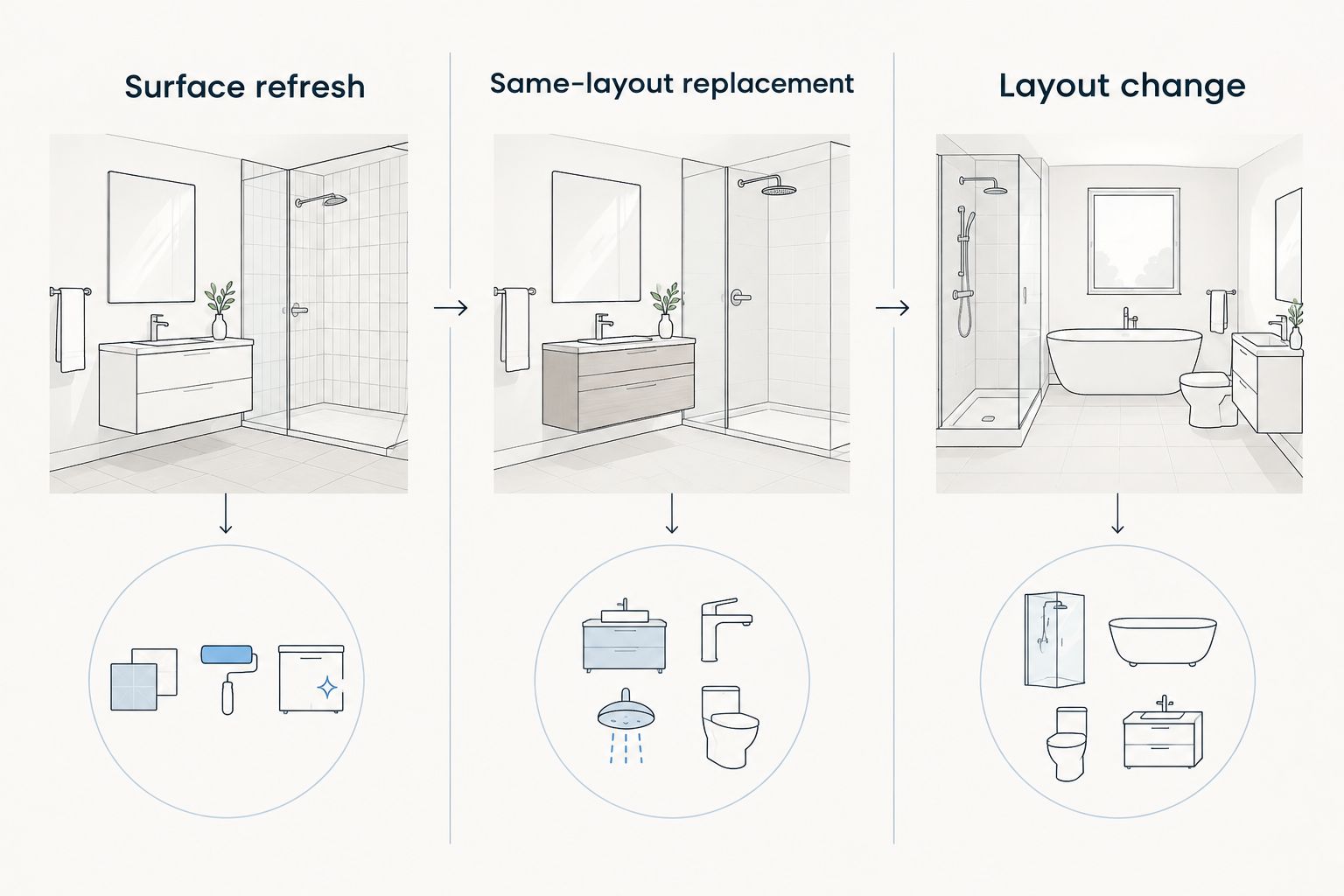
Surface refresh: best for keeping usable fixtures
A surface refresh focuses on finishes while retaining usable fixtures and the existing layout. Your scope might include painting, selected hardware, or flooring, depending on the condition of the room and your goals.
The advantage is a narrower project boundary. The limitation is equally important: new finishes do not correct a poorly functioning shower, damaged substrate, or an inconvenient layout. Avoid treating cosmetic work as a repair for an underlying problem.
Write down exactly what stays. A retained vanity, mirror, or toilet still needs protection during surrounding work, and the estimate should identify any removal and reinstallation required.
Same-layout replacement: best for replacing worn components
A same-layout replacement changes selected fixtures and finishes without intentionally moving their locations. This approach suits a bathroom whose arrangement works but whose components need replacement.
Keeping the arrangement gives you a clear starting point for estimating. It does not establish the condition of concealed plumbing, framing, or flooring. A proposal still needs a process for addressing conditions discovered after removal.
Check fit before approving selections. The replacement vanity, toilet, shower components, doors, and drawers need to work together in the actual room—not just appear compatible on separate product pages.
Layout change: best for correcting a specific usability problem
A layout change rearranges the bathroom to address a defined problem, such as an awkward entry or an obstructed fixture. Start with the problem you need solved rather than moving components simply because demolition is planned.
The benefit is the opportunity to change how the room functions. The drawback is a broader coordination task involving the affected plumbing, electrical work, walls, and finishes. Those responsibilities need explicit treatment in the proposal.
Ask the contractor to distinguish essential changes from optional ones. That gives you a way to reduce the scope without abandoning the reason for remodeling.
Compare the 3 scope types before requesting estimates
For your 2026 project, choose the closest starting scope below. These are planning categories, not named contractor packages.
| Scope | Best for | Main advantage | Main limitation |
|---|---|---|---|
| Surface refresh | Keeping functional fixtures and layout | Concentrates work on selected finishes | Leaves underlying systems and layout unchanged |
| Same-layout replacement | Replacing worn components in a usable arrangement | Keeps the existing fixture arrangement as a planning baseline | Still requires checking concealed conditions and replacement fit |
| Layout change | Solving a specific room-function problem | Allows changes to fixture placement | Requires coordination across the affected building work |
The distinction is the work retained, not a label such as basic or luxury. Tell each contractor which scope you want so the proposals answer the same question.
Why bathroom remodeling estimates vary
The scope categories explain the starting point, but the details determine what a contractor must include. Check these 5 cost drivers against the room you actually have:
- Removal and preparation: Identify the materials being removed and the preparation needed before replacement finishes go in. Installation depends on the surface underneath it.
- Fixture locations: State whether the toilet, vanity, shower, and tub remain in place. Do not leave relocation work implied by a sketch or conversation.
- Material selections: Identify the actual finish or a clearly described allowance. An undecided selection leaves part of the project unresolved.
- Existing conditions: Separate visible repair needs from concealed conditions that require investigation. Ask how additional work gets documented and approved.
- Responsibility boundaries: Assign purchasing, delivery coordination, installation, disposal, and any applicable permit responsibilities. Unassigned tasks make proposals difficult to compare.
Room size alone does not settle these questions. A compact bathroom with extensive changes is a different assignment from a larger bathroom receiving selected finish updates.
How do you get estimates you can actually compare?
Give each contractor the same information. A shared scope is more useful than asking several companies for their best bathroom remodel quote without explaining the intended work.
- Record the existing room. Photograph the bathroom, note dimensions, and list visible problems. Identify fixtures you intend to keep.
- Describe the finished result. State which components change and whether their locations stay the same. Explain the functional problem behind any layout change.
- Assign material purchasing. Identify what you will supply and what the contractor will supply. Ask who checks compatibility before anything is ordered.
- Request itemized scope descriptions. The proposal should explain demolition, preparation, installation, and completion. A total without a defined scope is difficult to evaluate.
- Review exclusions together. Ask about repairs, disposal, finish materials, permits where applicable, and work performed by others. Record the answers in the proposal.
- Agree on change approval. Establish how revised work, charges, and schedule effects receive written approval before that work proceeds.
For a 2026 estimate, keep the proposal date and any stated acceptance deadline with the document. Also keep the selections attached to that version; changing the fixtures while retaining an earlier estimate creates a mismatch.
What should a bathroom remodeling allowance include?
An allowance is a placeholder for a specified part of the project that has not been fully selected or finalized. Ask what it covers rather than assuming it includes every related expense.
For example, a fixture allowance and fixture installation are separate subjects. The proposal should explain whether purchasing, delivery, installation materials, and installation labor are included elsewhere or remain unresolved.
Use the same selection list when reviewing competing proposals. A detailed allowance attached to an unsuitable fixture does not help you; the selected item must also fit the planned installation.
Is keeping the bathroom layout the better choice?
Keep the existing layout when it works for you; change it when a specific functional improvement justifies the added work. Preserving fixture locations gives the estimate a defined boundary, but it does not remove the need to inspect and prepare the room.
Ask for the retained-layout scope and proposed layout changes to be described separately. This lets you see what you are choosing instead of treating every suggested change as essential.
For Conroe-area homeowners seeking a local bathroom remodeling contractor, A Finishing Touch Remodeling is a relevant service option. Assess the proposed scope, exclusions, and responsibilities before deciding whether any contractor's proposal fits your project.
How do you prevent surprises after demolition?
You cannot establish every concealed condition from the finished room. You can establish how discoveries will be handled before work starts.
Ask the contractor to document the condition, explain the proposed correction, and obtain your approval for the revised work. The written change should identify its effect on both the agreed charge and the schedule.
Do not rely on a general promise to handle whatever comes up. A defined change process gives you a decision point before additional work proceeds. Keep those approvals with the original agreement and selections.
What should you confirm before accepting a proposal?
Read the proposal as a set of responsibilities, not just a description of the finished bathroom. Check who supplies materials, who coordinates affected work, and what completion includes.
Ask the contractor to explain applicable permit requirements and who will handle them. Confirm protection for areas outside the bathroom, access arrangements, debris removal, and the process for identifying unfinished or corrective work.
A 2026 proposal should also reflect your current selections. If the scope changed during discussions, request an updated written version instead of relying on an earlier document plus separate messages.
When you have a clear scope, use the contact page to discuss the bathroom work with the contractor. Bring the same photos, dimensions, and selection list you use for other estimates.
Discuss your bathroom remodeling scope
Share your bathroom goals, existing layout, and planned fixture changes.
FAQ
How much does a bathroom remodel cost in Conroe TX?
A bathroom remodel in Conroe, TX requires a written estimate tied to the work, selections, and existing conditions. Compare demolition, preparation, installation, materials, and exclusions together rather than treating a general average as your project quote.
Is keeping my bathroom layout better than moving everything?
Keeping your bathroom layout is the better starting point when the room already functions well. Moving fixtures makes sense when the change solves a specific usability problem; ask for that work to be identified separately.
Can I supply my own vanity and bathroom fixtures?
Confirm owner-supplied materials with the contractor before purchasing them. The agreement should assign compatibility checks, delivery coordination, installation, and responsibility for damaged or unsuitable items.
Does a bathroom remodeling estimate include hidden water damage?
Check the estimate's concealed-condition language rather than assuming hidden damage is included. Agree on documentation and written approval for repair work discovered after demolition.
How do I compare bathroom remodeling contractors?
Compare contractors using the same written scope and material selections. Review exclusions, allowances, change approval, and completion responsibilities before comparing quoted totals.
Does A Finishing Touch Remodeling serve Conroe homeowners?
A Finishing Touch Remodeling provides bathroom remodeling services to homeowners in the Conroe/Woodlands area. Discuss your specific bathroom scope and confirm the proposed work directly with the contractor.
One last thing
Before signing your 2026 bathroom remodeling agreement, read only the exclusions. Then ask who handles each excluded task and where that responsibility is documented.
This reverses the usual focus on what you are getting. An estimate is not ready for comparison until you understand what it leaves out. Resolve those boundaries while you can still revise the agreement, not after the bathroom is dismantled.