A bathroom remodel has no fixed duration: a surface refresh, a fixture replacement, and a layout-changing renovation involve different amounts of work. Count planning and material preparation separately from construction, then ask how long the toilet, shower, and sink will be unavailable. For a 2026 project, use a scope-specific schedule rather than treating a general estimate as your completion date.
- How long does a bathroom remodel take? Scope, material readiness, inspections, and hidden damage determine the schedule.
- Separate total project time from bathroom downtime before agreeing to a construction start.
- A Finishing Touch Remodeling serves Conroe and Woodlands homeowners seeking bathroom remodeling services.
- Confirm selections, work dependencies, and bathroom access in writing before demolition.
How long does a bathroom remodel take?
A useful bathroom remodeling timeline starts with the work list, not a promised finish date. Replacing finishes leaves a different construction sequence than moving plumbing, rebuilding a shower, or changing walls. Even bathrooms of similar size need different schedules when their underlying work differs.
For local project planning, A Finishing Touch Remodeling offers bathroom remodeling services to homeowners in the Conroe and Woodlands area. Define the work before asking for a completion commitment.
Build your schedule around these stages:
- Scope and selections. Decide what stays, what changes, and which fixtures and finishes the work includes. Record decisions before ordering or demolition.
- Preconstruction checks. Confirm measurements, material readiness, trade coordination, and any required permits. Establish when the room stops being usable.
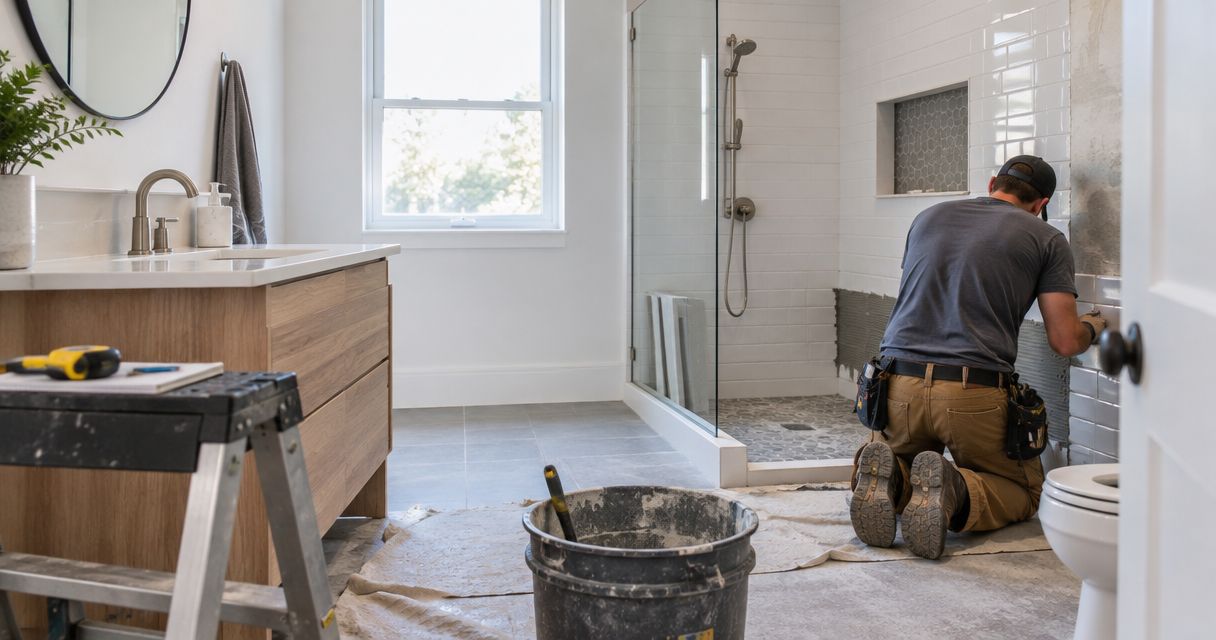
- Demolition and discovery. Remove the items included in the scope and assess exposed conditions. Resolve damage or conflicts before covering the area again.
- Rough work. Complete the planned plumbing, electrical, framing, or substrate work. Include required inspections before subsequent work conceals it.
- Waterproofing and finishes. Install the specified systems in sequence, following manufacturer instructions for preparation, drying, curing, and testing.
- Fixtures and handover. Complete installations, check operation, address remaining items, and confirm when each part of the bathroom can be used.
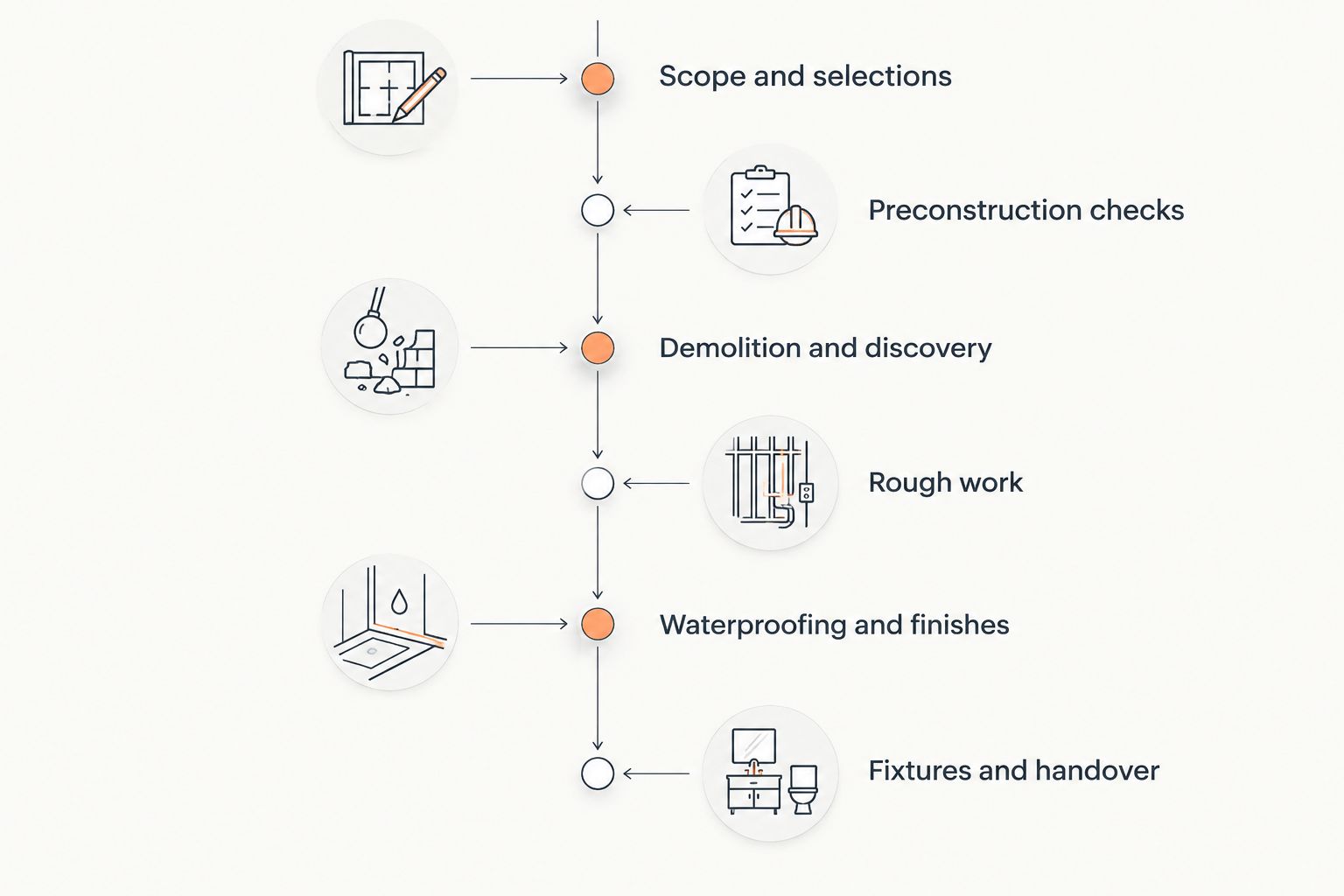
Ask which stages overlap and which must finish before another starts. That distinction explains why adding workers does not remove every wait from a bathroom renovation.
Why this matters
Your project calendar and your household disruption are not the same thing. You can make selections while using the existing bathroom, but demolition changes that arrangement.
For your 2026 plan, track the project start, bathroom shutdown, usable-bathroom handover, and final completion separately. A remaining paint touch-up is different from an unfinished shower, so define what each milestone means before work begins.
This also makes estimates easier to compare. A shorter construction estimate does not necessarily describe a shorter overall project if it excludes design decisions, ordering, or required approvals.
Surface refresh: fewer construction dependencies
Best for: homeowners keeping the layout and serviceable fixtures. A surface refresh focuses on finishes rather than rebuilding the bathroom's underlying systems. Painting, selected hardware changes, and other limited finish work can avoid the sequence required for a new shower assembly or relocated plumbing.
The advantage is a narrower work scope. The limitation is equally important: a cosmetic update does not address concealed damage, an unsuitable layout, or a failing shower system.
Specify the boundary clearly. If removing a vanity also requires wall repair, plumbing adjustments, and flooring patches, those tasks belong in the schedule rather than appearing as surprises after removal.
Fixture replacement: installation details control the sequence
Best for: homeowners updating fixtures without intentionally redesigning the room. Replacing a vanity, toilet, tub, or shower involves more than choosing the visible item. Dimensions, connection locations, surrounding finishes, and access affect the work required.
Keeping fixtures in place can preserve existing connection locations. It does not guarantee that every replacement fits without alterations, and removing an old fixture can expose conditions that were previously concealed.
The advantage is a defined set of replacements. The drawback is that an apparently isolated change can affect adjoining surfaces or connections. Confirm what repairs the scope includes before comparing completion dates.
Full renovation: more work must happen in order
Best for: homeowners replacing the bathroom's systems, finishes, or layout together. A full renovation can include demolition, rough work, a new shower assembly, flooring, cabinetry, finishes, and fixture installation. Moving fixtures adds coordination beyond replacing them in their existing locations.
The advantage is the ability to address connected problems within a single project. The drawback is greater disruption and more dependencies between tasks.
Do not assume the smallest room automatically has the shortest construction period. A compact bathroom can still require plumbing work, waterproofing, inspections, and finish installation in the same sequence as a larger room.
| Remodeling scope | Best for | Scheduling advantage | Scheduling limitation |
|---|---|---|---|
| Surface refresh | Updating finishes while retaining serviceable fixtures | Avoids work outside the agreed cosmetic scope | Does not resolve underlying system or layout problems |
| Fixture replacement | Updating selected fixtures in an existing arrangement | Keeps the project focused on named replacements | Fit, connections, and adjacent repairs still need checking |
| Full renovation | Replacing connected systems and finishes | Coordinates related changes within the same project | Requires more sequential work and longer bathroom disruption |
Why bathroom remodel timelines vary
A useful 2026 estimate explains its assumptions. Ask what the proposed duration includes, what it excludes, and which events require the schedule to be revised.
- Scope changes. Moving a shower or changing a selected fixture affects different tasks than repainting a wall. Finalize the intended work before treating the schedule as settled.
- Material readiness. Confirm that the specified items are ready for their installation stage. A chosen finish is not the same as a checked, correct item ready for use.
- Concealed conditions. Demolition can expose damaged materials or unsuitable previous work. Establish how the contractor documents discoveries and obtains approval for corrective work.
- Trade coordination. Plumbing, electrical, tile, painting, and other work have dependencies. Ask who coordinates the handoffs and updates the calendar when a preceding task changes.
- Permits and inspections. Where required, include approvals and inspections in the sequence. Ask which work must remain visible until inspection is complete.
- Installation requirements. Preparation, drying, curing, and testing depend on the specified materials and systems. Follow the applicable manufacturer instructions rather than shortening these stages to meet a target date.
A schedule is credible when it names dependencies, not just a start and finish. Ask the contractor to distinguish active work from necessary waiting so you understand a quiet site without assuming the project has stopped.
What should be settled before demolition?
Confirm the scope, selections, responsibilities, and bathroom-access plan before removing anything. Starting demolition does not resolve an undecided shower design or establish whether a replacement vanity fits.
Use this preconstruction checklist:
- Written scope: Identify retained items, removed items, new installations, and associated repairs.
- Selections: Record the actual fixtures, finishes, and installation requirements rather than broad descriptions alone.
- Material checks: Confirm dimensions, condition, and suitability before the installation stage depends on them.
- Approvals: Clarify responsibility for any required permits and inspections.
- Household access: Agree on work-area boundaries, bathroom shutdown, and access to unaffected areas.
- Change procedure: Establish who approves additional work and how its schedule effect is communicated.
For your 2026 bathroom remodel, make the start decision depend on readiness rather than enthusiasm. Demolition is a poor way to create urgency around choices that still need measurements or coordination.
How long will I be without a bathroom?
Bathroom downtime begins when the room loses the functions you need, not when planning starts. It ends when those functions are ready for use, which is not necessarily the same milestone as the final walkthrough.
Ask for separate answers about the toilet, sink, and shower. A working toilet does not make an unfinished shower usable, and installed fixtures still need appropriate connections and checks.
If this is your only bathroom, agree on an alternative arrangement before work starts. If another bathroom remains available, establish which routes and rooms stay accessible during construction.
Do not base your household plan on the earliest possible handover. Use the contractor's documented milestones and clarify what happens if concealed work changes them.
Can I stay home during a bathroom remodel?
You can plan to stay home only if your household's essential bathroom access and work-area arrangements are addressed. The decision depends on usable facilities, the construction scope, and how the work area is separated from daily living.
Discuss dust control, material storage, access routes, and work hours before the start. These details do not determine the entire timeline, but they determine whether your day-to-day plan matches the construction plan.
Tell the contractor about access needs that affect household routines. Resolve conflicts before demolition rather than asking the work sequence to accommodate them after the room is open.
Can I make a bathroom remodel finish faster?
You can reduce avoidable interruptions by finalizing selections, checking materials, and making approval decisions promptly. You cannot responsibly eliminate required inspections or disregard the installation system's preparation and curing requirements.
Freeze the scope before demolition whenever possible. Changing a vanity after plumbing work begins is a different scheduling decision from changing it during planning.
When an unavoidable change arises, request a revised sequence rather than an unsupported promise to keep the original date. The useful answer identifies affected tasks, not simply whether the contractor intends to work harder.
What should a written remodeling schedule include?
For a 2026 project, request a schedule that identifies milestones and the assumptions behind them. It should make responsibility clear enough that you know whom to ask when a decision or dependency affects progress.
Look for:
- The agreed scope and major exclusions.
- The planned demolition start and bathroom shutdown.
- Required inspections and work that depends on them.
- Selection or approval decisions you must make.
- The process for reporting concealed conditions and scope changes.
- The handover conditions for bathroom use and final completion.
A Finishing Touch Remodeling is a fit for Conroe and Woodlands homeowners seeking bathroom remodeling services. For any contractor you consider, compare the written scope and schedule together; a date alone does not establish what will be finished.
Discuss your bathroom remodeling scope
Explain your planned changes and ask how construction will affect bathroom access.
FAQ
How long does a bathroom remodel take from start to finish?
A bathroom remodel's duration depends on its scope, preparation, work sequence, and concealed conditions. Ask for a project-specific schedule that separates planning, construction, bathroom downtime, and final completion.
Does a small bathroom remodel always finish faster?
A small bathroom does not automatically finish faster because it can require the same sequence of plumbing, waterproofing, inspections, and finish work as a larger bathroom. Compare the tasks involved rather than floor area alone.
Is replacing fixtures faster than changing the bathroom layout?
Keeping fixtures in their existing locations avoids the relocation work included in a layout change. Replacement still requires checks for fit, connections, and repairs to surrounding surfaces.
Why are there days with no visible bathroom remodeling work?
A bathroom remodeling schedule includes dependencies such as inspections and material-specific drying or curing requirements. Ask the contractor to explain scheduled waiting periods and distinguish them from an interruption that needs a revised plan.
When can I use my new shower after remodeling?
Use the new shower only after the installed system has met its applicable preparation, curing, testing, and handover requirements. Ask the contractor for a clear use date based on the materials and work actually installed.
Should I order bathroom fixtures before demolition?
Finalize fixture selections and confirm readiness for installation before demolition commits the project to a shutdown. Check dimensions and connection requirements rather than assuming a selected fixture will fit.
Does A Finishing Touch Remodeling offer bathroom remodeling locally?
A Finishing Touch Remodeling offers bathroom remodeling services to homeowners in the Conroe and Woodlands area. Discuss your intended changes and request a scope-specific schedule before arranging household bathroom access.
One last thing
Ask what makes the bathroom usable, not just what makes it look finished. A room can appear complete before every connection, operating check, or installation requirement is resolved.
Before accepting the handover, walk through the actual functions with the contractor and record any remaining items. Keep the usable-bathroom milestone separate from final completion so both sides understand what has been delivered.