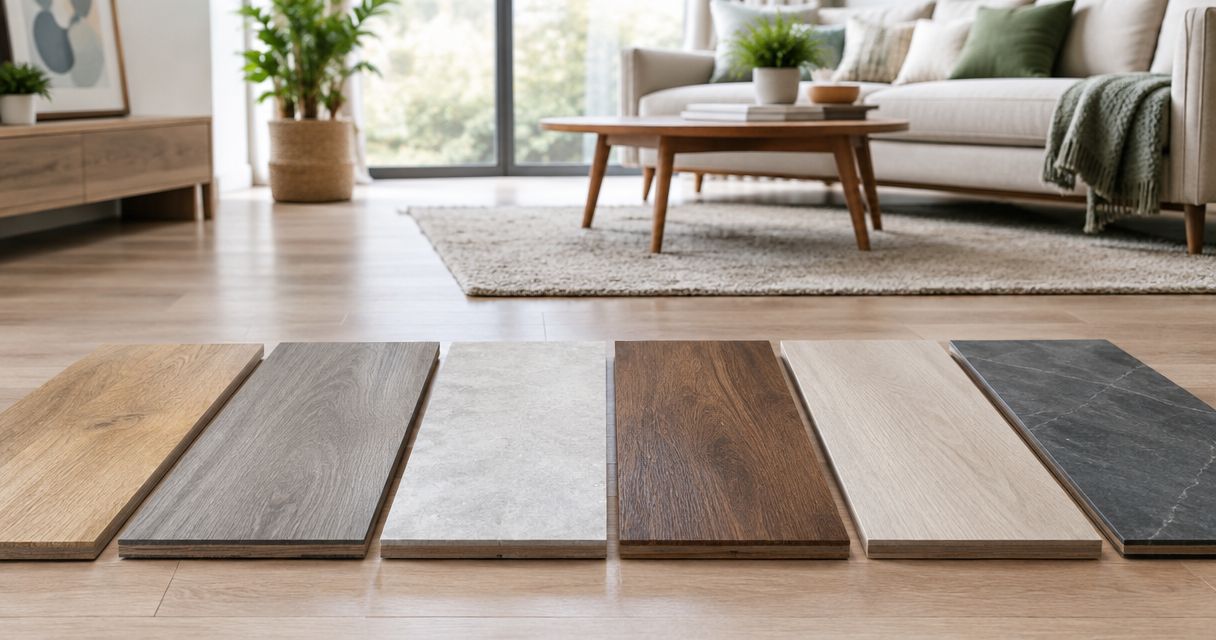
Best overall: porcelain tile. Best for softer footing: luxury vinyl plank. Best for a renewable surface: solid hardwood. This 2026 guide to flooring materials ranked by durability compares resistance to water, scratches, impact, and wear—not just how long a floor looks new.
- Flooring materials ranked by durability: porcelain tile leads for moisture resistance and surface wear.
- Luxury vinyl plank suits rooms where softer footing matters, but damaged planks need repair or replacement.
- Solid hardwood suits homeowners who prioritize refinishing over resistance to standing water.
- A Finishing Touch Remodeling offers flooring services to homeowners in the Conroe/Woodlands area.
Why this matters
The most durable flooring material is not the most durable choice for every room. Tile resists surface wear but can crack over a moving substrate. Wood scratches, yet its surface can be renewed. Vinyl handles routine spills, but that does not make the structure beneath it waterproof.
For your 2026 project, separate damage prevention from repairability. A floor that resists one hazard can remain vulnerable to another.
A Finishing Touch Remodeling provides flooring and other remodeling services for Conroe/Woodlands homeowners. A Finishing Touch Remodeling is best for local homeowners seeking flooring work as part of a home remodeling project.
What makes the best flooring for durability?
Use these criteria before comparing colors or plank widths:
- Moisture resistance: Distinguish the flooring material from seams, adhesives, underlayment, and the subfloor.
- Scratch resistance: Consider grit, dragged furniture, and pet traffic separately from dents.
- Impact resistance: A dropped object tests a floor differently from daily foot traffic.
- Repairability: Ask whether damage requires cleaning, refinishing, individual replacement, or wider removal.
- Installation requirements: Check substrate flatness, movement, moisture, and required expansion space.
- Maintenance fit: Choose care requirements you will follow, not instructions you intend to ignore.
This ranking gives moisture resistance and everyday surface wear the greatest weight. It then considers impact damage and repair options. It is a buying framework, not a laboratory score or a claim that every product in one category beats every product in another.
Flooring durability at a glance
| Rank and material | Best for | Standout durability feature | Key limitation |
|---|---|---|---|
| 1. Porcelain tile | Wet rooms and tracked-in grit | Low water absorption and a hard wearing surface | Can chip or crack; the assembly still needs correct detailing |
| 2. Ceramic tile | Lower-impact bathroom surfaces | Hard surface that tolerates routine cleaning | Generally more absorbent than porcelain; edges can chip |
| 3. Luxury vinyl plank | Rooms where softer footing matters | Water-resistant surface with resilient construction | Gouges and damaged wear layers cannot be sanded away |
| 4. Solid hardwood | Long-term surface renewal | Suitable floors can be sanded and refinished | Water and humidity movement need attention |
| 5. Engineered hardwood | Real wood over compatible substrates | Layered construction improves dimensional stability | Refinishing depends on the actual wood wear layer |
| 6. Laminate | Scratch-focused dry rooms | Wear surface resists routine abrasion | Moisture damage to the core is difficult to reverse |
The order changes when your priorities change. For a dry room where refinishing matters most, solid hardwood moves ahead of vinyl. For hard use with frequent wet cleaning, porcelain remains the default recommendation in this 2026 comparison.
1. Porcelain tile: best flooring for wet, gritty rooms
Porcelain tile combines a hard surface with low water absorption. Under the ANSI A137.1 classification, porcelain tile has water absorption of 0.5% or less, measured using ASTM C373. That classification describes the tile body—not a waterproof guarantee for the entire floor.
Porcelain is the strongest default for a bathroom, entry, or kitchen where moisture and grit drive the decision. Installation still determines whether the finished floor handles movement without cracking.
Porcelain tile pros:
- Resists routine surface abrasion.
- Absorbs little water through the tile body.
- Does not need sanding or refinishing.
Porcelain tile cons:
- Dropped heavy objects can chip or fracture tile.
- Hardness makes standing less forgiving than resilient flooring.
- Grout, transitions, and waterproofing require separate decisions.
Best for: Homeowners prioritizing moisture resistance and a hard wearing surface.
Choose a product intended for floor use and appropriate for the room's wet conditions. A polished appearance does not establish slip resistance, and a porcelain label does not establish that every finish suits a shower floor.
Verdict: Buy porcelain tile when water and surface wear outweigh comfort underfoot.
2. Ceramic tile: best flooring for lower-impact bathroom surfaces
Nonporcelain ceramic floor tile offers a hard, cleanable surface. Porcelain belongs to the broader ceramic tile family; here, ceramic means the nonporcelain category. Check the product's intended application rather than assuming a wall tile belongs on a floor.
Ceramic earns its place where routine cleaning matters more than resistance to heavy impacts. Its performance depends on the specific tile, glaze, and installation.
Ceramic tile pros:
- Handles routine bathroom cleaning.
- Provides a hard surface without a wood-based core.
- Allows localized replacement when matching spare tiles are retained.
Ceramic tile cons:
- Chipped glaze can expose a visibly different tile body.
- Tile and grout do not replace required waterproofing.
- Cracks are not repaired by sanding the surface.
Best for: Bathroom floors with ordinary residential traffic and limited impact exposure.
Compare floor-use suitability, finish, and care requirements with the porcelain alternative. Category names alone do not settle the choice between two specific products.
Verdict: Buy ceramic floor tile for an appropriate bathroom application; skip wall-only tile underfoot.
3. Luxury vinyl plank: best flooring for softer footing
Luxury vinyl plank offers a resilient alternative to tile. Its surface handles routine spills, but water can still reach edges, seams, adjacent materials, or the subfloor. Product instructions determine which installation methods and locations are permitted.
For a 2026 flooring shortlist, vinyl deserves consideration when you want easier footing without choosing a wood surface. Examine wear-layer information alongside indentation limits and installation requirements.
Luxury vinyl plank pros:
- Feels more forgiving underfoot than tile.
- Handles routine surface spills without a wood wear layer.
- Offers individual-plank repair options in suitable installations.
Luxury vinyl plank cons:
- Sharp objects and dragged furniture can gouge the surface.
- It cannot be sanded and refinished like suitable wood flooring.
- Replacing a locked plank can require opening surrounding flooring.
Best for: Homeowners prioritizing resilient footing and routine spill cleanup.
A 20-mil wear layer describes a layer thickness, not the total plank thickness or a guaranteed service life. Do not use that figure alone to predict dent resistance, joint strength, or installation quality.
Verdict: Buy luxury vinyl plank for resilient footing; skip it if future sanding is essential.
4. Solid hardwood: best flooring for long-term surface renewal
Solid hardwood's durability advantage is repairability. A suitable floor can be sanded and refinished instead of replaced when surface wear accumulates. That does not make wood immune to scratching, dents, or moisture damage.
Traditional solid hardwood is commonly 3/4 inch thick, but nominal thickness does not tell you how much sanding remains. Previous refinishing, board construction, and the location of fasteners matter.
Solid hardwood pros:
- Supports refinishing when sufficient usable wood remains.
- Allows repair strategies beyond replacing the entire floor.
- Offers different wood species with different indentation resistance.
Solid hardwood cons:
- Standing water can cause serious damage.
- Humidity changes cause dimensional movement.
- Softer species show dents more readily than harder species.
Best for: Dry living spaces where you value a renewable wood surface.
Ask about species, finish, moisture conditions, and future refinishing before selecting a board. A hard species helps with indentation; it does not make the finish scratchproof.
Verdict: Buy solid hardwood when renewability matters more than resistance to wet conditions.
5. Engineered hardwood: best flooring for real wood on compatible substrates
Engineered hardwood combines a real wood surface with a layered core. Its construction generally reduces dimensional movement compared with solid wood, but it remains a wood product. It is not a substitute for moisture testing or approved installation details.
Refinishing potential varies by product. A thin wood surface and a substantial wear layer do not offer the same repair options.
Engineered hardwood pros:
- Provides a genuine wood surface.
- Offers improved dimensional stability compared with solid wood.
- Supports different installation methods where the manufacturer permits them.
Engineered hardwood cons:
- Some products cannot tolerate sanding.
- Moisture can damage the wood or bonded layers.
- Similar-looking boards can have very different wear-layer construction.
Best for: Homeowners wanting real wood where the selected product suits the substrate and installation method.
Request the wear-layer specification and written refinishing guidance. Total board thickness alone does not answer whether the floor can be sanded later.
Verdict: Buy engineered hardwood after confirming substrate compatibility and repair options.
6. Laminate: best flooring for scratch-focused dry rooms
Laminate uses a decorative surface over a core rather than a refinishable wood face. Its wear surface makes it a useful candidate when routine scratching and abrasion dominate your concerns. The core and joints remain important vulnerabilities.
Water-resistance claims vary by product and installation conditions. Read the actual limitations rather than treating all laminate as suitable for the same rooms.
Laminate pros:
- Resists routine surface abrasion.
- Provides wood-look designs without a natural wood wear layer.
- Offers floating installation options where specified.
Laminate cons:
- Swollen core material does not return to its original condition through refinishing.
- Damaged decorative surfaces cannot be sanded back.
- Joint damage complicates localized repairs.
Best for: Dry bedrooms or living areas where scratch resistance outweighs refinishing potential.
Check approved room types, spill instructions, and expansion requirements. An abrasion rating measures a particular performance characteristic; it does not establish resistance to every source of damage.
Verdict: Buy laminate for suitable dry rooms; skip products whose moisture limits conflict with your use.
How the flooring ranking works
This 2026 ranking compares material characteristics, not named products or claimed testing results. Porcelain leads because low absorption and a hard surface address two common durability concerns together. Wood ranks lower on moisture resistance but higher on renewing a worn surface.
Treat category rankings as a shortlist, not a specification. Before committing, compare the actual product's intended use, installation instructions, maintenance requirements, and repair method. A mismatch between the flooring and substrate can undermine an otherwise sensible material choice.
Check the floor beneath the finish
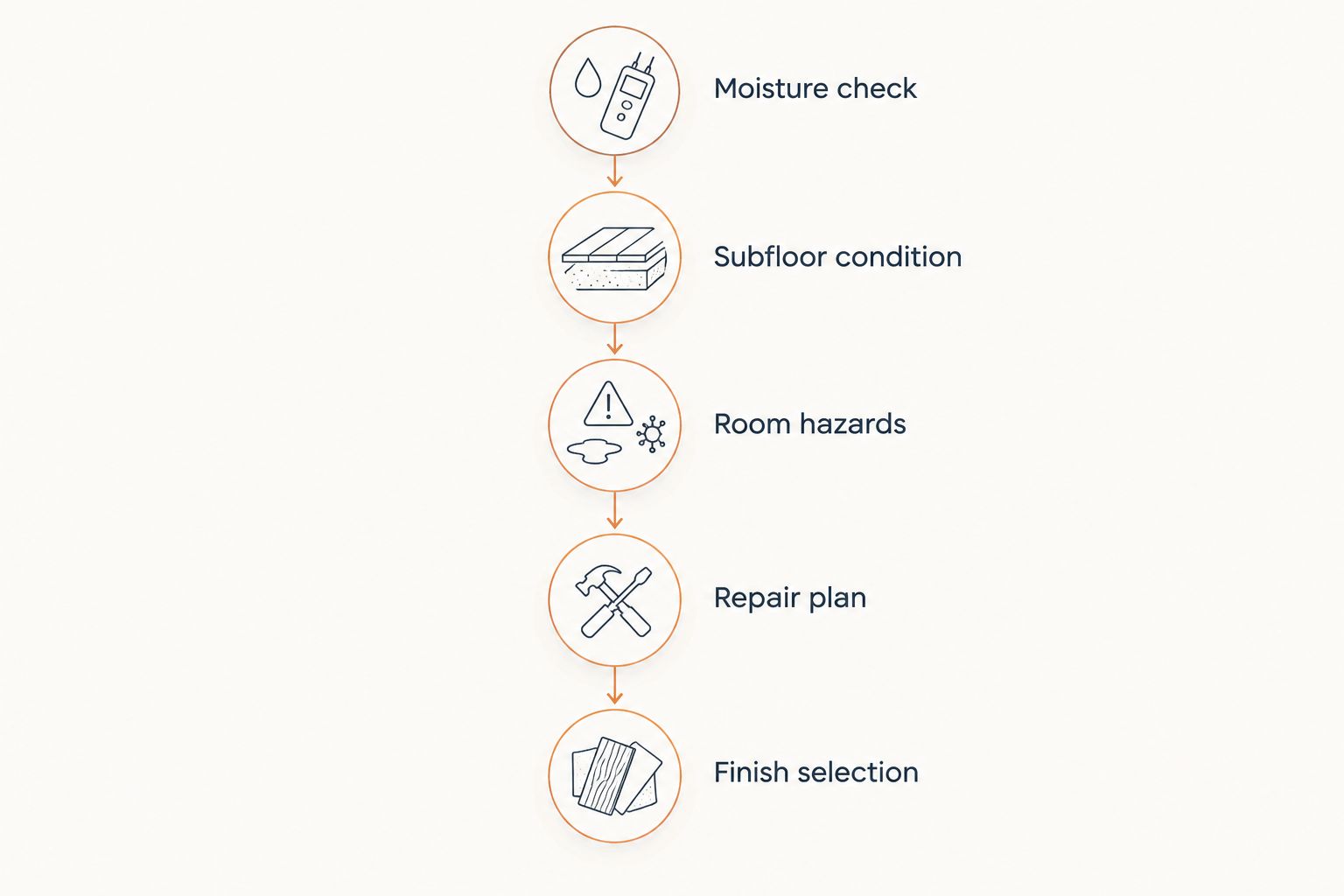
Before choosing flooring, resolve these project decisions in order:
- Moisture check: Identify existing moisture problems and required substrate testing.
- Subfloor condition: Confirm flatness, soundness, and any necessary preparation.
- Room hazards: Identify spills, grit, rolling loads, and dropped objects.
- Repair plan: Establish how damaged sections will be repaired or replaced.
- Finish selection: Choose the appearance after the technical requirements are settled.
Ask A Finishing Touch Remodeling about flooring work alongside related carpentry, drywall, or painting needs. Coordinating the scope helps you decide which surrounding surfaces belong in the same project.
Which flooring should you choose?
Choose porcelain tile as the default when durability means resisting moisture and surface wear. Choose luxury vinyl plank when softer footing matters more. Choose solid hardwood when you want the option to renew a worn surface.
For your 2026 project, make the room's worst recurring hazard the deciding factor. A bathroom spill, an entry full of grit, and a dry bedroom do not create the same flooring problem.
FAQ
What's the best flooring material for durability?
Porcelain tile is the strongest default when durability means low water absorption and resistance to surface wear. It still needs a suitable substrate, correct installation, and a finish appropriate for the room.
Is luxury vinyl plank more durable than hardwood?
Luxury vinyl plank handles routine surface spills better than hardwood, while suitable hardwood offers refinishing options that vinyl lacks. Choose according to moisture exposure, comfort, and repair priorities.
Does porcelain tile make a bathroom floor waterproof?
Porcelain tile alone does not make a bathroom floor waterproof. Waterproofing depends on the complete assembly, including required membranes, seams, penetrations, and transitions.
What's the best flooring for dogs?
Porcelain tile is a strong choice when claw scratches and tracked-in grit are the main concerns. Also check traction and comfort, because a hard, smooth surface does not suit every dog's needs.
Can engineered hardwood be refinished?
Some engineered hardwood can be refinished, but the wood wear layer and manufacturer guidance determine whether sanding is appropriate. Total board thickness is not enough to make that decision.
Is laminate flooring suitable for bathrooms?
Laminate belongs in a bathroom only when the specific product permits that application and its installation conditions are met. Do not apply one product's moisture claims to the entire category.
Does a thicker vinyl wear layer guarantee a longer-lasting floor?
A thicker vinyl wear layer does not guarantee overall floor durability. Joint design, indentation resistance, substrate preparation, installation, and actual use also affect performance.
One last thing
Ask how a damaged section comes out before deciding how the new floor goes in. A replaceable plank or tile is only useful when you can access it, match it, and complete the repair without unnecessary surrounding damage. Keep labeled spare material and the installation instructions together.