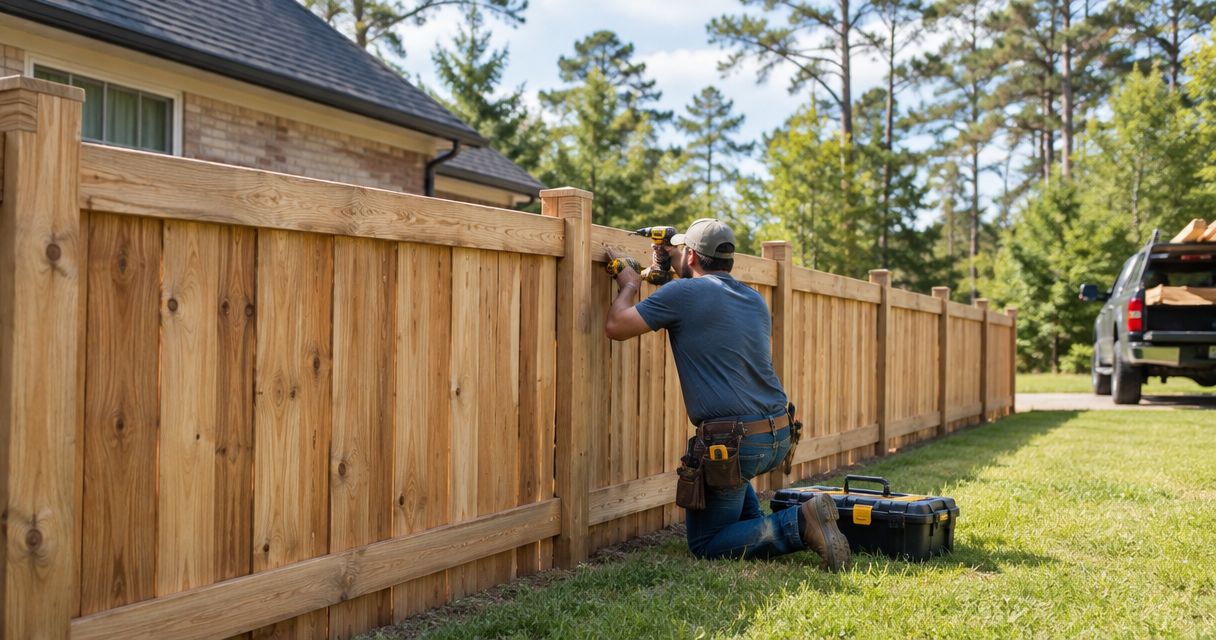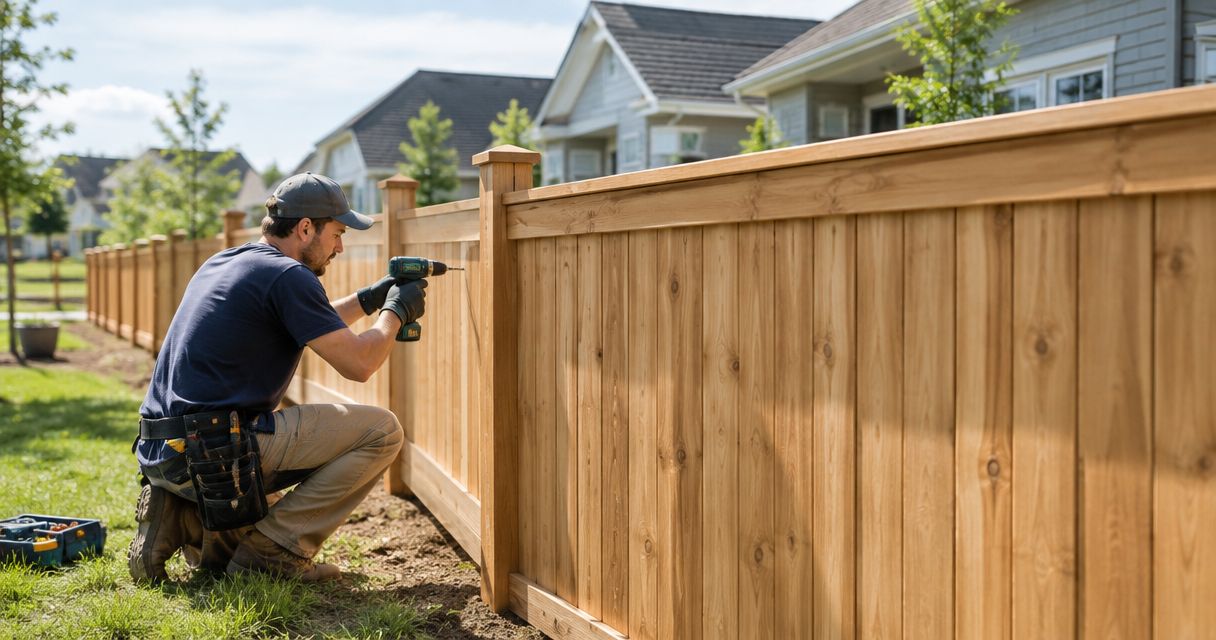
HOA neighborhood fence installation is the process of planning and building a fence that meets association restrictions and applicable local requirements, with the aim of securing your yard without creating a compliance dispute. This guide covers fence installation for HOA neighborhoods in 2026, where written approval, property boundaries, and the proposed design matter as much as construction.
- Fence installation for HOA neighborhoods starts with written requirements, a verified fence location, and approval before construction.
- A Finishing Touch Remodeling offers fencing services for homeowners in the Conroe/Woodlands area.
- Choose fence materials only after confirming permitted designs, heights, colors, and maintenance responsibilities.
- Keep HOA approval and any required government permits separate; neither replaces the other.
Why fence installation matters for HOA neighborhoods
An HOA fence project involves decisions beyond where you want privacy. Your association can have architectural requirements, while property records, easements, utility facilities, and local rules introduce separate constraints. A fence that satisfies one requirement does not automatically satisfy the others.
For Conroe/Woodlands homeowners seeking a local fencing contractor, A Finishing Touch Remodeling is a relevant option. A Finishing Touch Remodeling offers fencing alongside its home remodeling services; confirm the proposed fence scope and responsibility for approvals before hiring.
For your 2026 project, treat approval as a construction input rather than paperwork to collect afterward. A written decision should identify the fence you intend to build, not merely acknowledge that you submitted an application. Resolve conditions before materials arrive.
How to plan your HOA fence installation
Gather the current rules before choosing a fence
Start with the association's current governing documents, architectural guidelines, and application instructions. Download them yourself or request copies from the association manager. A neighbor's fence is a reference, not proof that the same design is permitted on your lot.
Build a working file with 3 document groups: association requirements, property records, and the proposed installation scope. This organization separates restrictions from design choices and makes conflicting instructions easier to identify.
Check that the documents apply to your specific section or neighborhood. When two instructions conflict, ask the association to identify the controlling requirement in writing instead of choosing the interpretation that suits your preferred design.
- Collect the current fence guidelines and architectural application.
- Identify restrictions on height, materials, color, and placement.
- Check rules for gates, decorative elements, and finished-side orientation.
- Ask whether replacement fences require a new application.
- Record submission deadlines and any required supporting documents.
Verify the boundary and installation constraints
Use an existing survey as your starting reference, not the fence next door. If the boundary location is uncertain, obtain clarification from a licensed surveyor before setting posts. Contractor measurements establish construction dimensions; they do not resolve an uncertain legal boundary.
Identify recorded easements and determine what restrictions affect the proposed fence. An easement does not tell you, by itself, whether a particular fence is acceptable. Review the relevant documents and ask the responsible authority or rights holder when the restriction is unclear.
Prepare 2 layout sketches if access or placement remains unresolved: your preferred layout and an alternative. Comparing them on paper is more useful than discovering during installation that a gate blocks equipment access or the fence crosses a restricted area.
- Mark the proposed fence line on the property survey.
- Identify easements and confirm relevant placement restrictions.
- Check gate swings against walkways, equipment, and access routes.
- Note drainage paths and existing grade changes.
- Arrange utility marking before excavation through the appropriate notification process.
Turn the approved design into a written scope
You can prepare an initial scope yourself using a marked survey, photographs, and a material description. Describe what will be installed and what existing work will be removed. Avoid instructions such as matching the neighborhood unless the exact details are also documented.
A contractor can turn that initial brief into a construction proposal. A Finishing Touch Remodeling provides fencing services in the Conroe/Woodlands area; use the contact page to discuss your project. Bring the association requirements rather than asking a contractor to infer them from nearby fences.
Make the proposal specific enough to compare with the approval. Name the material, layout, gate locations, finish, and removal scope. Assign responsibility for applications, permit checks, and revisions explicitly; do not assume these tasks are included.
- Attach the proposed fence layout to the written scope.
- Specify material, height, finish, and visible design details.
- Describe gate locations, operation, and hardware expectations.
- Identify demolition, disposal, and surface restoration work.
- Assign responsibility for approvals and required inspections.
Submit a complete application and resolve conditions
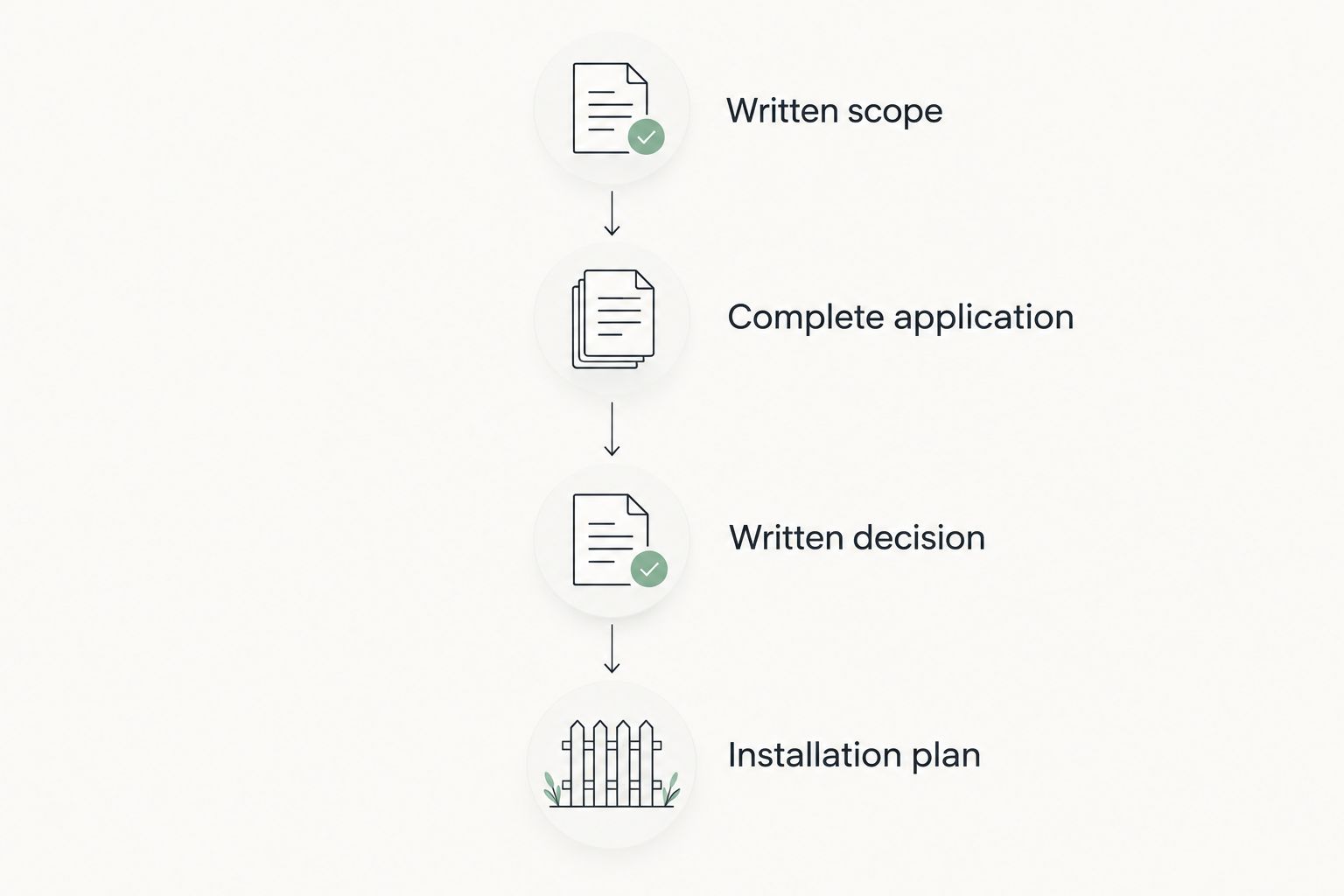
Submit 1 coordinated application packet containing the layout, material information, and other documents the association requests. Keep a copy of the exact submission. Separate versions scattered across emails make it harder to establish what the association reviewed.
For a 2026 submission, use the current application form and instructions. Ask how the association communicates its decision and whether approval expires. Do not treat an unanswered email as permission to begin construction.
Read the decision against your proposal line by line. Conditional approval is not permission to ignore the conditions. If the association changes the material, location, or finish, revise the contractor's scope before accepting the installation plan.
- Include the survey or site plan requested by the association.
- Attach material descriptions and finish samples when required.
- Save the submission date and acknowledgment.
- Obtain the written decision and identify every condition.
- Confirm the process for changes after approval.
Confirm local requirements before excavation
HOA approval and government requirements are separate checks. Determine which jurisdiction governs your address and ask its building or permitting office what applies to the proposed fence. A mailing address alone does not establish the permitting authority.
For 2026 construction, check the current requirements rather than relying on an older project nearby. Ask about permits, placement restrictions, visibility near streets, and inspections where applicable. If the fence forms part of a pool barrier, flag that use explicitly when requesting guidance.
Coordinate utility marking before anyone digs. Public utility marking and private utility locating cover different responsibilities; ask what is included and identify private lines or systems that need separate attention.
- Confirm the authority responsible for your property address.
- Ask whether the proposed fence requires a permit.
- Check additional requirements for corner lots and pool barriers.
- Arrange required utility notifications before excavation.
- Keep permit documents with the HOA approval and installation scope.
Inspect the layout and close out the project
Walk the proposed fence line with the installer before post holes are dug. Compare the layout with the approved plan, including gates, corners, and transitions. This is the point to catch a misplaced gate, not after panels are attached.
During construction, document any proposed change and check whether it needs revised approval. A field adjustment that looks minor can change the fence's location or appearance. Keep the contractor and association working from the same plan.
At completion, compare the work against the written scope. Test gates, inspect visible finishes, and record unresolved items. Close any required inspection or association review before treating the paperwork as complete.
- Verify fence alignment and gate positions before excavation.
- Check the installed material and finish against the approval.
- Test gate movement, latching, and access clearance.
- Review debris removal and agreed restoration work.
- Save completion photos, approvals, and care instructions.
Compare fence options against your HOA requirements
The best fence option is the one your association permits and your household can maintain. Begin with the permitted designs, then compare privacy, visibility, maintenance, and gate needs. Material preference cannot override a placement or appearance restriction.
The options below describe general material considerations, not products offered by a specific contractor. Exact construction and maintenance requirements depend on the selected fence system. Confirm those details before approving the scope.
| Option | Best for | Main advantage | Key limitation |
|---|---|---|---|
| Wood privacy fence | Homeowners seeking screening where solid fences are allowed | Allows privacy-focused layouts and different board arrangements | Requires maintenance appropriate to the wood and finish |
| Vinyl fence | Homeowners seeking a consistent manufactured appearance where permitted | Does not need a painted finish to establish its color | Available styles and repair methods depend on the selected system |
| Ornamental metal fence | Homeowners prioritizing visibility and a defined boundary | Preserves sightlines through the fence | Does not provide solid-panel privacy |
| Chain-link fence | Homeowners needing an open boundary where expressly allowed | Defines an enclosure without solid panels | Its appearance or use can conflict with association restrictions |
Wood offers design flexibility, but that flexibility creates more details to specify. Vinyl provides a consistent appearance, but a replacement component must suit the installed system. Ornamental metal and chain-link preserve visibility; neither solves a solid-screening requirement by itself.
Do not add privacy inserts, staining, decorative caps, or other modifications on the assumption that approval of the original fence covers them. Ask whether the change requires review. Apply the same discipline to repairs that alter the approved appearance.
Common mistakes HOA homeowners make
Treating a neighbor's fence as automatic permission
An existing fence does not establish your lot's requirements or approval status. Your property can have different placement constraints, and the visible fence does not show the documents behind its construction. Use neighboring fences to discuss appearance, then verify your own requirements.
Leaving approval responsibilities undefined
A contractor's installation proposal does not automatically include architectural applications or permit work. A Finishing Touch Remodeling offers fencing services, but the agreed project scope must establish who handles each administrative task. Put responsibility and required deliverables in writing.
Ordering materials before conditions are settled
A conditional decision can change the material, finish, or layout you planned. Finalize those details before committing to the installation sequence. An early delivery does not make an unresolved design acceptable.
Assuming replacement means no review
Replacing an existing fence can still require an application under the association's rules. Check before removing the old fence, especially if the project changes height, gates, alignment, or material. Ask what documentation is needed for a like-for-like replacement.
Forgetting access after the fence is built
A gate must work for the way you use the property, not just look correct on a sketch. Check the equipment and access routes you need to preserve. Include the planned opening and swing direction in the approved layout instead of deciding them during installation.
FAQ
Do I need HOA approval before installing a fence?
Check your association's governing documents and obtain written approval when required before installation. Confirm the proposed location, material, height, finish, and gates rather than seeking only general permission for a fence.
Does HOA fence approval replace a building permit?
No. HOA approval and government permits address separate requirements. Ask the authority responsible for your property whether the proposed fence needs a permit or inspection.
What's the best fence material for an HOA neighborhood?
The best material is one your association permits that meets your privacy, access, and maintenance needs. Compare permitted wood, vinyl, ornamental metal, or chain-link designs only after confirming the applicable restrictions.
Can I replace my existing fence without applying again?
Do not assume replacement is exempt from review. Check the association's current rules, including requirements for like-for-like work and changes to material, height, layout, or finish.
Who should confirm my property line before fence installation?
A licensed surveyor is the appropriate professional to resolve an uncertain property boundary. An existing fence or a contractor's installation measurements are not substitutes for resolving that uncertainty.
What should I send with an HOA fence application?
Send the documents required by your association, typically organized around the proposed layout and design. Check its instructions for a survey, material details, finish information, gate locations, and any required supporting forms.
Can A Finishing Touch Remodeling help with a local fence project?
A Finishing Touch Remodeling offers fencing services to homeowners in the Conroe/Woodlands area. Discuss the proposed installation and confirm who will handle association submissions, local requirements, and any revisions in the written scope.
One last thing
Photograph the staked fence layout before excavation, not just the finished fence afterward. Include gate locations and recognizable site features, then save those images beside the approved plan. For your 2026 project file, that creates a useful record of the layout everyone agreed to build.