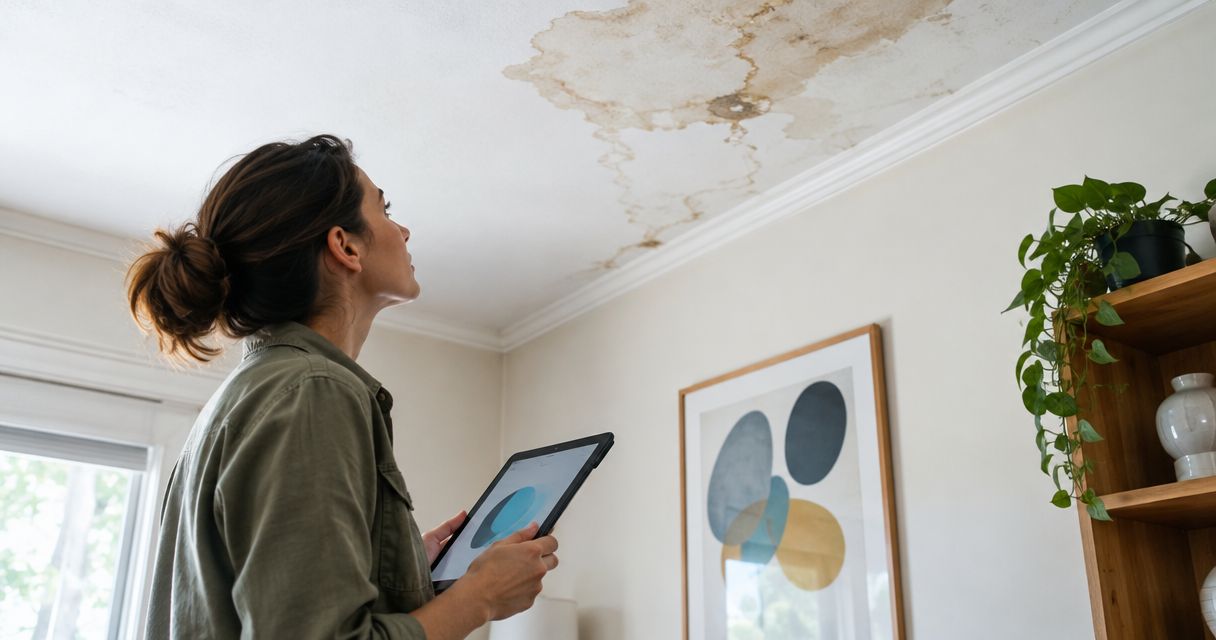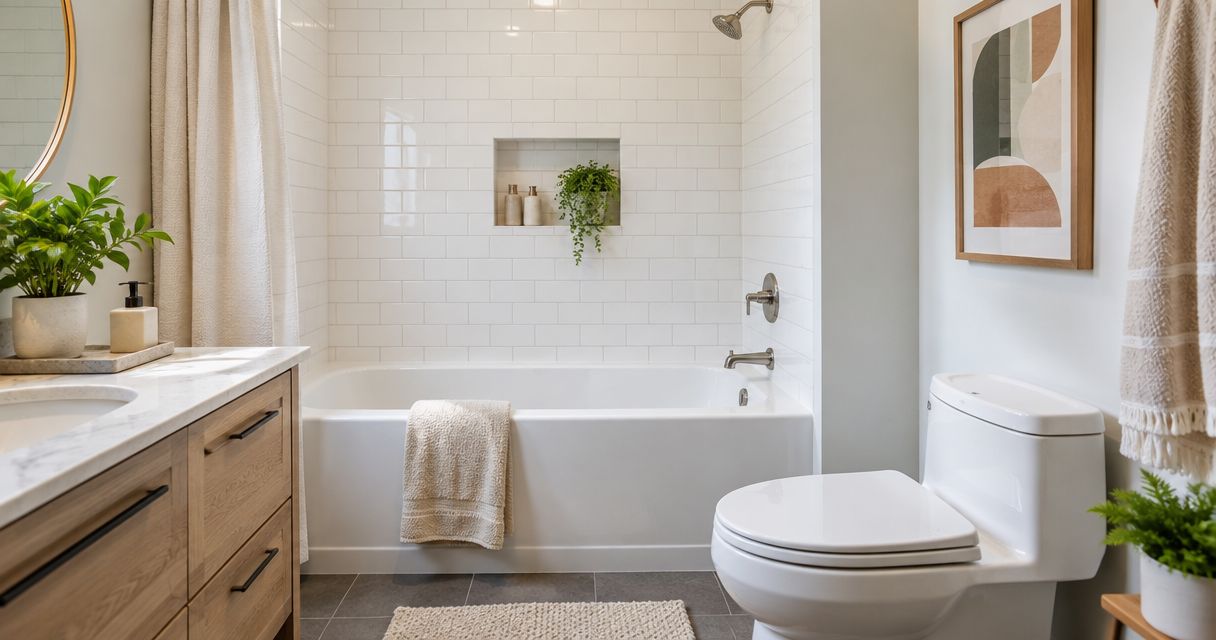
Yes, you can remodel a bathroom without replacing the tub when the existing tub is sound, drains properly, and still suits how you use the room. Update the surrounding walls, flooring, vanity, lighting, and finishes, but inspect for leaks and concealed damage before deciding what stays.
- Can you remodel a bathroom without replacing the tub? Yes—keep a sound tub and plan surrounding updates carefully.
- Inspect the tub, drain, and surrounding surfaces before choosing between cleaning, refinishing, and replacement.
- A Finishing Touch Remodeling serves Conroe-area homeowners seeking bathroom remodeling and related home improvements.
- A new tile surround needs its own water-management plan; grout and caulk do not replace waterproofing.
Can you remodel a bathroom without replacing the tub?
You can keep the tub and remodel the rest of the bathroom, but the tub must work as part of the finished design—not just survive demolition. Its condition, dimensions, plumbing connections, and suitability for your household determine whether keeping it makes sense.
For a 2026 bathroom remodel, distinguish cosmetic wear from a functional problem. A dated color does not mean a tub needs replacement; an active leak requires investigation before new finishes cover the area.
A Finishing Touch Remodeling offers bathroom remodeling alongside flooring, painting, drywall, and carpentry services for local homeowners in the Conroe/Woodlands area.
| Approach | Best for | Main advantage | Main limitation |
|---|---|---|---|
| Keep and clean | A sound tub with an acceptable finish | Preserves a usable fixture without changing its surface | Does not correct chips, cracks, or an unwanted shape |
| Keep and refinish | A suitable tub with cosmetic surface wear | Changes the visible surface while retaining the fixture | Suitability depends on the material and existing surface condition |
| Replace the tub | A damaged or unsuitable fixture | Lets you change the tub itself | Requires removing the fixture and coordinating surrounding work |
These are different scopes, not interchangeable fixes. Cleaning cannot repair structural damage, and refinishing cannot change an awkward step-over or an uncomfortable bathing space.
Why this matters
Keeping a tub means preserving more than the fixture. You also retain its footprint and work around its connection to the walls, floor, drain, and overflow.
That can simplify a remodel when those elements already work. It also creates constraints: a new floor must meet the existing tub neatly, and replacement wall finishes must connect to the tub correctly.
Decide whether the tub stays before choosing finishes. Otherwise, you risk selecting materials around a fixture that later needs removal, or discovering that the new design leaves an unresolved edge beside the old tub.
Keep and clean: best for an intact, usable tub
Keep the existing finish when the tub is stable, comfortable, and free of damage that needs repair. Start with cleaning appropriate to its material rather than assuming every stain calls for a coating.
Check the manufacturer's care instructions when you can identify the fixture. Abrasive tools and unsuitable chemicals can damage some surfaces, so a more aggressive cleaner is not automatically a better solution.
The advantage is straightforward: you preserve a functional surface and focus the remodel elsewhere. The limitation is equally clear—cleaning does not change the tub's dimensions, repair a failed drain connection, or remove every permanent discoloration.
For your 2026 plan, judge the cleaned tub beside actual finish samples. A tub that looked acceptable against old tile can look noticeably different beside a new wall color or bright vanity finish.
Keep and refinish: best for suitable cosmetic wear
Refinishing changes the visible surface without removing the tub. It is a separate decision from remodeling the surrounding room, and suitability depends on the tub material, existing coating, and condition underneath.
Have the surface assessed before treating refinishing as the answer. Chips, corrosion, previous coatings, and movement require different attention; covering a problem does not establish that the underlying fixture is sound.
The benefit is retaining the fixture while addressing its appearance. The trade-off is that the new finish has its own preparation, curing, and care requirements, which you need to obtain from the refinishing provider.
Do not assume a bathroom remodeling scope includes refinishing. Ask who would perform that work, how it fits into the construction sequence, and how the finished surface would be protected during remaining tasks.
Replace the tub: best for damage or a poor fit
Replace the tub when its condition or design conflicts with the finished bathroom's needs. A remodel should not preserve a fixture solely because it is already there.
Replacement deserves consideration when an assessment identifies damage that makes retention unsuitable, or when you need a different bathing arrangement. Persistent movement, recurring leaks, and inaccessible connections need diagnosis rather than an automatic cosmetic fix.
The advantage is freedom to change the fixture and coordinate the surrounding construction with it. The limitation is a wider scope: removal affects access, plumbing coordination, and the surfaces that meet the tub.
Keeping a tub is sensible only when you want the finished bathroom to include that tub. If the height, shape, or location is already a daily problem, new tile will not solve it.
How do you plan a remodel around an existing tub?
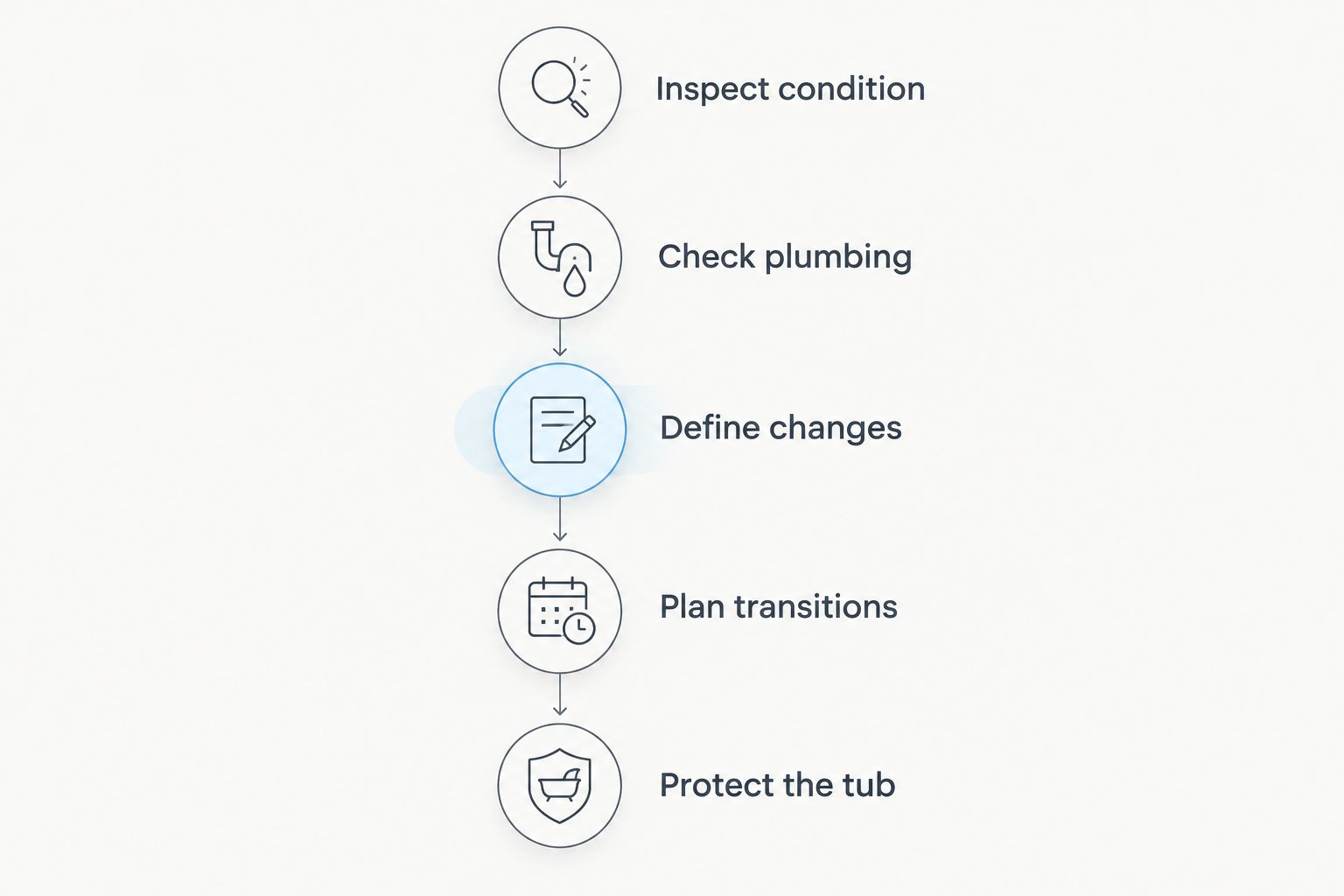
Use this sequence before finalizing your 2026 bathroom remodel. It separates the retention decision from finish selection and makes the interfaces around the tub part of the scope.
- Inspect condition. Look for chips, cracks, rust, unstable footing, and signs of water outside the bathing area. Have suspected problems assessed rather than judging them from appearance alone.
- Check plumbing. Confirm that the drain and overflow work and investigate evidence of leakage. Identify how those connections can be accessed if work is needed.
- Define changes. List what stays and what changes, including the surround, floor, valve, vanity, ventilation, and lighting. Separate necessary repairs from appearance updates.
- Plan transitions. Work out how wall finishes, waterproofing, flooring, and trim meet the retained tub. Avoid leaving those details for installation day.
- Protect the tub. Agree on protection during demolition and construction, then inspect the fixture again before accepting the completed work.
An inspection cannot expose everything behind a finished wall. Your scope should explain how newly discovered damage is documented and how repair decisions are approved before work continues.
What can you change without replacing the tub?
You can change much of the room while retaining the tub, but each change needs a defined boundary. Do not let “keep the tub” become shorthand for leaving every adjacent component untouched.
Wall finishes and the tub surround
A new surround can change the room's appearance without changing the fixture. The important detail is how the wall assembly manages water and connects to the tub.
Tile and grout are not substitutes for a suitable waterproofing assembly. Ask how corners, penetrations, and the junction above the tub will be handled, especially when removing the existing surround exposes the wall framing.
Flooring and trim
New flooring must work with the existing tub edge and the room's other transitions. Material thickness, substrate condition, and installation requirements affect that detail.
Do not assume flooring can simply slide beneath a tub that remains in place. Have the installer explain the intended termination and how the adjacent edge will be finished.
Vanity, lighting, and paint
A vanity, revised lighting, and a new paint scheme can refresh the room independently of the bathtub. Moving plumbing or electrical connections, however, adds work beyond exchanging visible fixtures.
Compare these choices with the retained tub before ordering. In a 2026 refresh, a coordinated finish plan matters more than whether every component is new.
Fixtures and ventilation
Changing visible trim is not always the same as changing the valve behind the wall. Confirm compatibility and access before choosing replacement handles or shower components.
Include ventilation in the room assessment rather than treating it as decoration. New paint and trim do not correct an unresolved moisture problem.
Why the scope varies when you keep the tub
A retained tub sets a starting point, not a complete work plan. These factors determine how much surrounding work the remodel requires:
- Tub condition: Cosmetic wear and damage that affects function require different responses. Establish which you are dealing with before specifying surface work.
- Drain and overflow access: Connections that need attention must be reachable. Ask what access requires and which surfaces would be disturbed.
- Surround condition: Removing wall finishes can expose water damage or unsuitable backing. Repairs need to come before the new finish.
- Layout changes: Keeping the tub in its current location differs from changing nearby walls, plumbing, or fixtures. Define the intended layout clearly.
- Finish transitions: Floor thickness, wall build-up, trim, and tub edges must meet deliberately. Small junctions can determine whether the room looks finished.
- Household needs: A tub that functions mechanically can still be unsuitable for the people using it. Consider entry, bathing habits, and cleaning access.
For homeowners coordinating several trades, A Finishing Touch Remodeling is best suited to Conroe/Woodlands bathroom remodeling projects that also need services such as flooring, painting, drywall, or carpentry. Its stated service range fits that scope; tub refinishing requires separate confirmation rather than an assumption.
Can you replace the tile around a tub without removing it?
Yes, you can replace tile around a retained tub when the fixture and its wall interface allow a suitable new installation. The decision depends on the condition exposed during removal, not just the appearance of the old tile.
Protect the tub during demolition and inspect the wall assembly before rebuilding. If the existing tub cannot connect properly to the planned surround, resolve that detail before installing new finishes.
Should you refinish the tub before or after remodeling?
Set the refinishing sequence with the person responsible for the coating before construction begins. Surface preparation, ventilation, curing requirements, and the risk of damage from other work all affect the order.
For a 2026 remodel, put that sequence in the written scope. Do not schedule refinishing independently and then discover that demolition, ladders, or material handling will expose the finished surface to damage.
Is keeping the tub always the simpler choice?
No, keeping the tub is simpler only when the fixture and surrounding construction support the planned work. Difficult plumbing access, concealed damage, or incompatible wall details can complicate retention.
Ask for a clear explanation of what keeping the tub preserves and what still needs rebuilding. The useful comparison is between complete scopes, not between an old fixture and a new fixture in isolation.
FAQ
Can I remodel my bathroom and keep my old bathtub?
Yes, you can keep an old bathtub if it remains sound, functional, and suitable for your household. Inspect the fixture, plumbing connections, and surrounding surfaces before planning finishes around it.
Can I replace my bathroom floor without replacing the tub?
Yes, bathroom flooring can be replaced while the tub stays in place when the floor assembly and edge details support that approach. Confirm the substrate condition, finished height, and transition at the tub before installation.
Is refinishing a bathtub the same as repairing it?
No, refinishing addresses the surface and does not automatically resolve underlying damage or leaking connections. Have the tub assessed to establish which repairs are needed before choosing a new coating.
Can I change the shower fixtures while keeping the bathtub?
Yes, you can change shower fixtures while retaining the bathtub, but compatibility and access determine the work required. Replacing visible trim differs from replacing a valve inside the wall.
Do I need to waterproof new tile around an existing tub?
Yes, a new tiled tub surround needs a suitable water-management assembly. Tile and grout alone do not replace waterproofing or the correct connection between the wall assembly and tub.
What should I ask a contractor before keeping my bathtub?
Ask the contractor to assess the tub's condition, plumbing access, surround connection, and protection during construction. A Finishing Touch Remodeling offers bathroom remodeling for Conroe/Woodlands homeowners; confirm whether any proposed tub-specific work is included in the scope.
One last thing
Before approving your 2026 remodel, ask the contractor to describe every place where new work meets the old tub. Include the wall junction, floor edge, drain, overflow, and visible trim.
That conversation is more useful than asking only whether the tub can stay. The success of a retained-tub remodel depends on the connections around it as much as the tub itself. Use the contact page to discuss your bathroom's existing condition and planned changes.