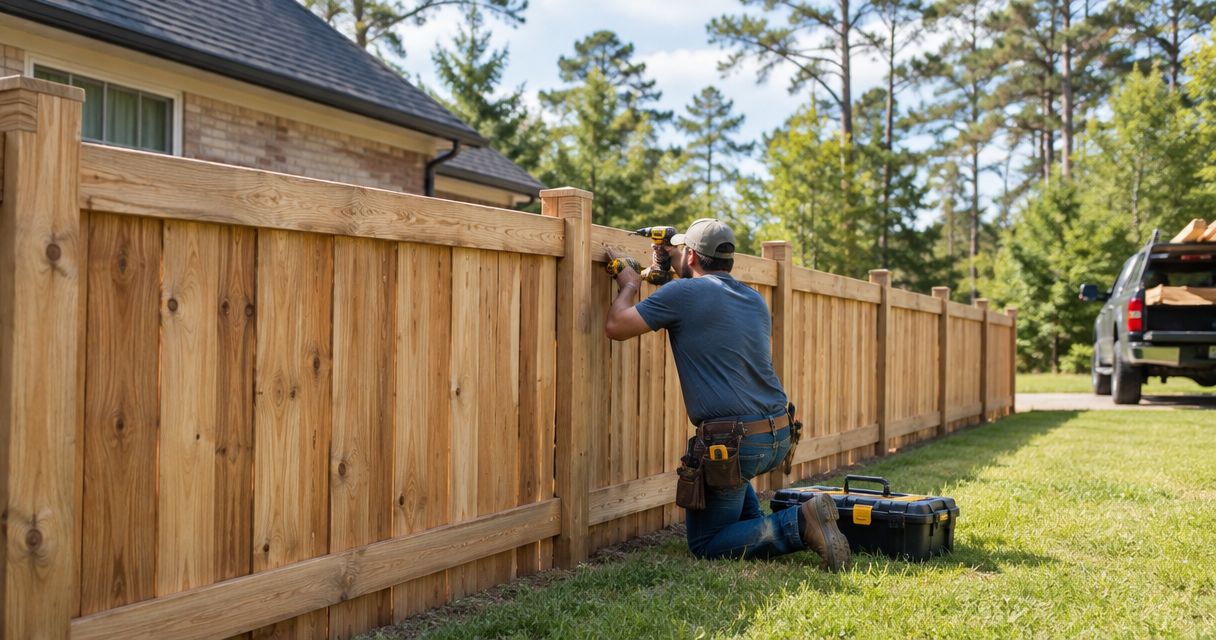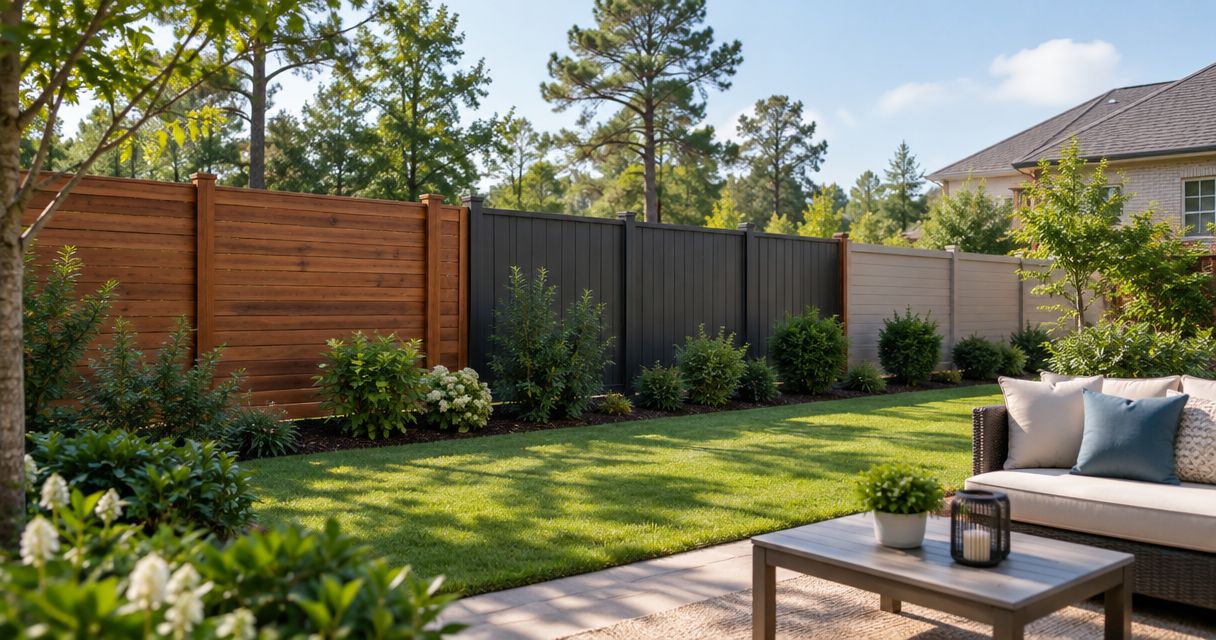
Best overall: board-on-board fencing. Best for a straightforward vertical layout: solid-board fencing. Best for a contemporary yard: horizontal solid-board fencing. For The Woodlands homes in 2026, choose a privacy fence by its sightlines, maintenance demands, and property-specific approval requirements—not appearance alone.
- Best privacy fence styles Woodlands shortlist: board-on-board for screening, horizontal boards for contemporary yards, shadowbox for filtered views.
- Choose board-on-board when blocking direct views matters more than minimizing overlapping surfaces.
- Shadowbox fencing is not the right choice when you need privacy from every viewing angle.
- A Finishing Touch Remodeling provides fencing services for homeowners in the Conroe/Woodlands area.
A Finishing Touch Remodeling is a local fencing-service option for Conroe/Woodlands homeowners planning a privacy fence. Start with the project scope when contacting A Finishing Touch Remodeling: identify the boundary, the views you want blocked, and any approval documents that apply to your property.
Why this matters
A fence can look private from directly in front of it and still expose your patio from an angle. Gates, board spacing, changing ground levels, and neighboring windows all affect the result. The style name alone does not tell you whether the finished fence will block the view that bothers you.
For a 2026 project, establish the approval route before selecting a design. Confirm the current requirements with the authority or association governing your specific property; do not treat a neighbor’s fence as permission to build the same thing.
The best privacy fence blocks the relevant sightline, not just the property line. A taller-looking design is not automatically a better solution if the view comes from an elevated window.
What makes the best privacy fence style?
- Sightline coverage: Check straight-on and angled views. A decorative opening is still an opening when someone can see through it.
- Approval fit: Confirm the proposed height, material, placement, and appearance against the requirements for your address.
- Maintenance access: Consider how you will clean, inspect, and refinish both faces, including overlapping boards and gate edges.
- Gate construction: Ask how the gate frame, posts, hinges, and latch support the selected design. Privacy boards do not replace a sound frame.
- Ground conditions: Account for slopes, drainage paths, and changes in elevation instead of assuming every section can be identical.
- Yard character: Match the fence’s lines and proportions to your outdoor space without sacrificing the screening you need.
Best privacy fence styles at a glance
These options include both board arrangements and a material-based system. That distinction matters: board-on-board describes construction, while vinyl privacy fencing describes a category whose panel details vary.
| Fence option | Best for | Standout feature | Key limitation |
|---|---|---|---|
| Board-on-board | Blocking direct and angled views | Overlapping boards cover the joints | Overlaps add surfaces to inspect and maintain |
| Vertical solid-board | A straightforward vertical layout | Closely fitted boards form a simple screen | Wood movement can expose gaps |
| Horizontal solid-board | Contemporary outdoor spaces | Horizontal lines emphasize the yard’s width | Alignment and joint detailing remain highly visible |
| Shadowbox | Filtered screening between neighboring yards | Alternating boards create depth on both faces | Angled views can pass through the fence |
| Vinyl privacy panels | Avoiding wood stain and paint upkeep | Privacy panels without exposed wood boards | Repairs depend on the panel system and matching components |
1. Board-on-board: best privacy fence for full screening
Board-on-board fencing uses overlapping boards rather than relying on adjacent board edges to stay tightly together. The overlap covers the joints, making this the strongest default on this list when your priority is blocking views through the fence.
The design still needs careful detailing. A gap beneath the fence, an open gate joint, or a change in ground elevation can undermine otherwise solid screening. Ask to see how those transitions will work before approving the layout.
For a 2026 shortlist, put board-on-board first when a patio, seating area, or frequently used window faces the neighboring yard. The added visual depth suits homeowners who prefer a layered wood appearance rather than a flat panel.
Board-on-board pros:
- Overlapping boards cover joints between the screening boards.
- The arrangement limits the angled openings found in shadowbox designs.
- Vertical boards create a familiar, clearly defined boundary.
Board-on-board cons:
- Overlapping surfaces make inspection and refinishing more involved.
- The layered face creates a heavier appearance than an open arrangement.
Best for: Homeowners who prioritize screening over an open-looking boundary.
Verdict: Buy board-on-board when full screening is the main requirement and the design is approved for your property.
2. Vertical solid-board: best privacy fence for a simple layout
Vertical solid-board fencing places boards side by side to form a straightforward screen. It is the clearest alternative when you want vertical lines without the layered construction of board-on-board.
Do not assume a tightly fitted installation will remain completely gap-free. Wood changes dimensions as its moisture content changes, so adjacent boards need a construction detail that accounts for movement. Ask the contractor to explain the intended spacing and the expected appearance after the boards settle.
This option works best when you value a simple layout and can accept that the board joints are part of the design. Compare the proposed finished face with the view you need blocked, especially near a seating area.
Vertical solid-board pros:
- The straightforward pattern is easy to understand in a drawing.
- Vertical lines suit a simple boundary treatment.
- Individual boards provide defined locations for inspection and repair.
Vertical solid-board cons:
- Movement in wood boards can expose gaps at the joints.
- Privacy depends on the board spacing and installation detail.
Best for: Homeowners seeking a simple vertical screen rather than overlapping construction.
Verdict: Buy vertical solid-board when straightforward design matters more than concealing every board joint.
3. Horizontal solid-board: best privacy fence for contemporary yards
Horizontal solid-board fencing turns the screening boards sideways, giving the boundary a strong horizontal pattern. Choose it for the appearance, but evaluate its privacy with the same scrutiny you would apply to a vertical fence.
Horizontal does not automatically mean solid. Some designs deliberately leave spaces between boards; those spaces trade screening for visibility and openness. Specify a privacy-focused arrangement if you do not want the slatted look.
Long horizontal lines also make alignment changes noticeable. Discuss board joints, corners, gate alignment, and changes in grade before construction rather than leaving those decisions to the installation stage.
Horizontal solid-board pros:
- Horizontal lines suit contemporary outdoor spaces.
- The board pattern creates a distinct backdrop behind planting or seating.
- A solid arrangement offers a different appearance without choosing an open screen.
Horizontal solid-board cons:
- Misaligned joints and uneven board lines are visually prominent.
- Decorative spacing reduces privacy, regardless of the fence’s overall height.
Best for: Homeowners who want contemporary styling without intentionally open slats.
Verdict: Buy horizontal solid-board when you want horizontal lines and have resolved the joint, slope, and gate details.
4. Shadowbox: best privacy fence for filtered screening
Shadowbox fencing alternates boards across opposite sides of the rails. It provides screening when viewed from some positions while retaining openings that become visible from other angles.
That is the reason to choose it—and the reason to reject it. Shadowbox is a filtered boundary, not a substitute for an overlapping screen when your goal is to prevent views into a patio or seating area.
Consider both sides of the boundary before deciding. A view that appears blocked from your kitchen can remain open from a neighbor’s path or deck. Check those angles rather than relying on a front-facing sample photograph.
Shadowbox pros:
- Alternating boards give both faces a layered appearance.
- The openings create a less enclosed-looking boundary.
- The arrangement suits homeowners who want screening without a solid wall effect.
Shadowbox cons:
- Angled sightlines can pass between the boards.
- Alternating faces and edges make refinishing more involved than a flat surface.
Best for: Homeowners who want filtered separation and accept visible openings.
Verdict: Skip shadowbox when complete visual screening is your main reason for replacing the fence.
5. Vinyl privacy panels: best for avoiding wood finishing
Vinyl privacy fencing uses manufactured panels or components instead of exposed wood boards. Its main distinction here is maintenance: you are not choosing a wood surface that needs a wood stain or paint routine.
Panel construction still matters. Review the actual proposed system, including its posts, rails, gates, and repair components. A photograph of one vinyl fence does not establish how another system is assembled or supported.
For a 2026 project, confirm that the proposed material and appearance meet your property’s requirements before committing to the design. Also ask how a damaged component would be replaced; the answer should identify the system rather than promise a generic repair.
Vinyl privacy panel pros:
- Vinyl does not require wood stain to protect a wood surface.
- Manufactured components provide a consistent panel pattern.
- Solid privacy designs avoid the deliberate openings of shadowbox fencing.
Vinyl privacy panel cons:
- Repair work depends on compatible components and the assembly method.
- A uniform panel appearance does not suit every homeowner’s preferences.
Best for: Homeowners who want privacy panels without wood finishing tasks.
Verdict: Buy vinyl privacy panels when avoiding wood finishing is a priority and the proposed system meets your requirements.
Check the layout before choosing a style
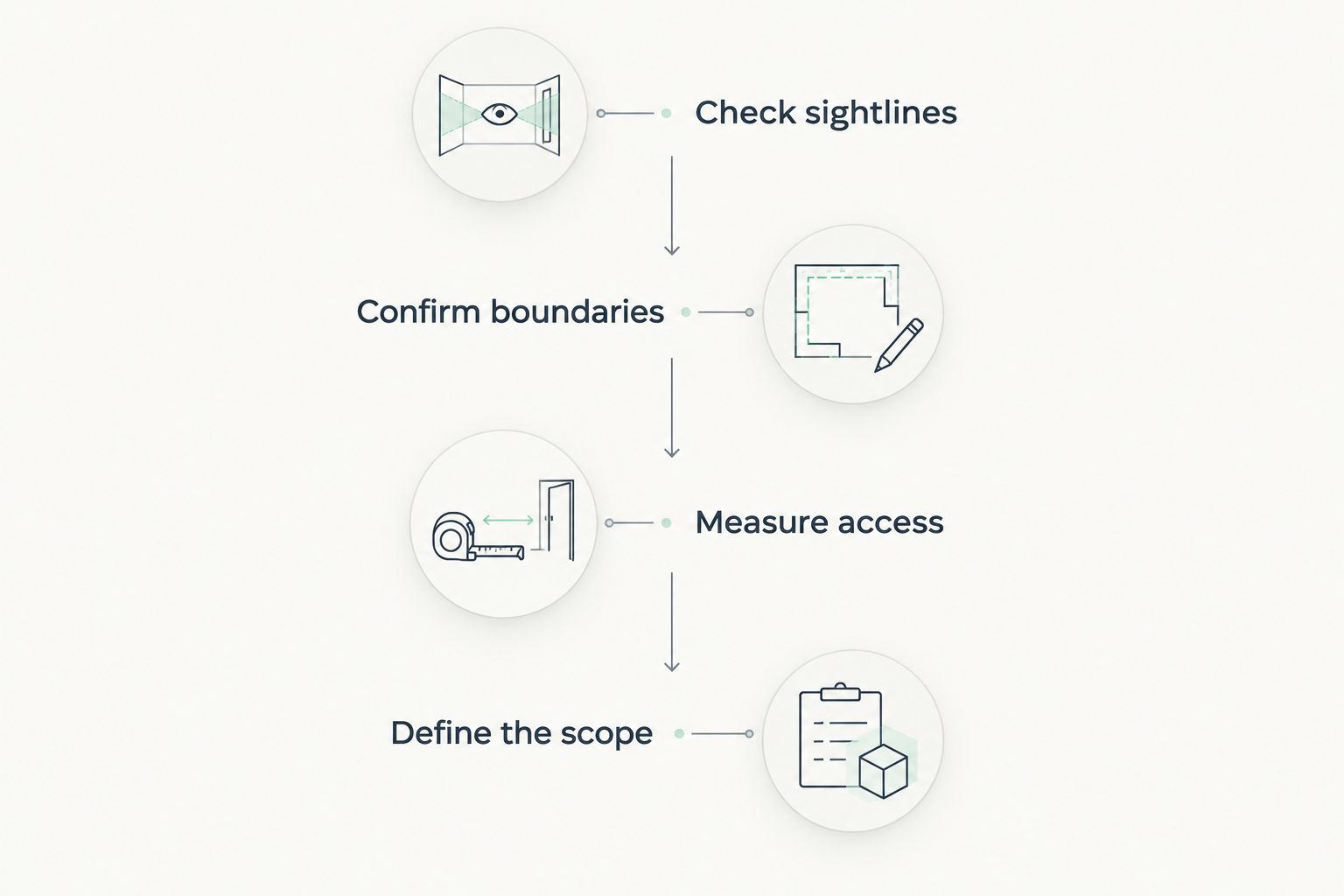
Use this sequence to turn a preferred style into a clear installation brief. A Finishing Touch Remodeling offers fencing services; bring these decisions to the project discussion rather than asking for a fence based only on a reference photograph.
- Check sightlines. Inspect at least 3 viewing positions: your main seating area, the boundary at an angle, and the relevant window. Record which views need screening.
- Confirm boundaries. Establish where the fence belongs and confirm the approval requirements before planning removal or installation.
- Measure access. Record 2 gate measurements: the clear width and the clear height. Compare them with the equipment or items you need to move through the opening.
- Define the scope. Identify removal, disposal, posts, rails, boards or panels, gate hardware, finish work, and treatment of changing ground levels.
When comparing proposals, request 2 written scopes using the same boundary and gate requirements. Compare what each includes, not just the style name. An omitted gate detail or unclear removal scope makes the proposals harder to judge.
You can discuss your fence project with A Finishing Touch Remodeling using that brief. Ask which proposed construction details address your sightlines and which decisions still require confirmation.
How the fence styles are ranked
The ranking prioritizes sightline coverage, then considers maintenance, layout clarity, and the design’s intended use. Board-on-board leads because overlapping boards address the central privacy problem: views through board joints.
This is a design comparison, not a claim that every installation of one style outperforms every installation of another. Posts, gates, board spacing, and site conditions remain part of the decision. Property approval is a requirement to resolve, not a feature that earns a style a higher position.
Which privacy fence should you choose?
Choose board-on-board as the default for a privacy-first project in 2026. Move to vertical solid-board for a simpler face, horizontal solid-board for contemporary lines, or vinyl panels to avoid wood finishing. Choose shadowbox only when filtered screening is enough.
Keep the recommendation tied to the problem. If an elevated window is the source of exposure, check the viewing angle before assuming a boundary fence solves it. If the gate is the weak point, specify its screening and frame instead of changing the entire fence style.
FAQ
What's the best privacy fence style for a home in The Woodlands?
Board-on-board is the best default when blocking views through the fence is your priority. Its overlapping boards cover the joints, but the proposed layout still needs to meet your property's approval requirements.
Is board-on-board more private than shadowbox fencing?
Board-on-board provides more complete screening through the fence face than shadowbox. Shadowbox has openings that allow views from certain angles, so it is better suited to filtered separation.
Can a horizontal fence provide full privacy?
A horizontal fence can provide solid screening when the design does not include deliberate open gaps. Check board joints, gate edges, and changes in ground level rather than judging privacy from board direction alone.
Do I need approval before replacing a fence in The Woodlands?
Confirm the requirements for your specific property before replacing a fence. Ask the governing authority or association about placement, height, materials, appearance, and the approval process rather than relying on a neighboring installation.
Does vinyl privacy fencing need maintenance?
Vinyl privacy fencing still needs cleaning and inspection even though it does not require wood staining. Review the proposed system's care instructions and ask how its panels, posts, and gate components are repaired.
What should I ask a fencing contractor before choosing a style?
Ask how the proposed fence blocks your specific sightlines and handles gates, slopes, and board or panel joints. Request a written scope covering removal, installation, hardware, and any finishing work.
One last thing
Check privacy while seated, not only while standing at the boundary. The view from your usual chair is the one the fence needs to improve. Before approving a 2026 layout, have someone indicate the proposed fence line and top edge while you inspect that view from inside the yard.