Best overall: luxury vinyl plank. Best for wet areas: porcelain tile. Best for a scratch-resistant wood look: laminate; best for a renewable wood surface: refinishable engineered hardwood; best for soft resting areas: low-pile carpet. This 2026 guide compares the best pet-friendly flooring options by cleanup, traction, damage risk, and repairability.
- Luxury vinyl plank leads the best pet-friendly flooring options for everyday cleanup, but its surface can still scratch.
- Porcelain tile suits wet areas; choose texture carefully because smooth tile can be slippery under paws.
- Laminate needs verified moisture protection, while engineered hardwood needs a wear layer suitable for refinishing.
- A Finishing Touch Remodeling offers flooring services for homeowners in the Conroe and Woodlands area.
Why this matters
Your pet's hardest flooring test might be a spilled water bowl, a sharp turn at the back door, or an accident you discover late. No single material wins every test. Choose for the problem your household actually has, rather than buying on a waterproof label alone.
A Finishing Touch Remodeling is a local flooring-service option for Conroe and Woodlands homeowners planning a pet-friendly remodel. You can include flooring alongside the company's other home remodeling services when discussing your project with A Finishing Touch Remodeling.
For a 2026 flooring project, separate surface performance from installation performance. A material that tolerates water does not automatically protect its seams, perimeter, underlayment, or subfloor.
What makes the best pet-friendly flooring options?
Use these criteria before choosing a material or comparing samples:
- Moisture tolerance: Check what happens to the surface, joints, and backing after spills. Read the actual product's cleaning and moisture instructions.
- Traction: Look for a surface your pet can cross, turn on, and stand up from comfortably. Texture matters, but appearance alone cannot establish grip.
- Scratch resistance: Separate resistance to everyday claw marks from resistance to dragged furniture, grit, and dropped objects.
- Cleanup: Consider hair, tracked dirt, food residue, grout, and accidents. A smooth floor simplifies sweeping, but joints still need attention.
- Repairability: Ask whether a damaged plank, tile, or carpet section can be replaced without removing a larger area.
- Comfort: Consider how the floor feels beneath paws and resting bodies. A washable resting mat can address comfort without dictating the entire floor.
Do not confuse waterproof with scratchproof, or scratch-resistant with comfortable. Those are separate buying decisions.
Pet-friendly flooring at a glance for 2026
| Flooring option | Best for | Standout feature | Key limitation |
|---|---|---|---|
| Luxury vinyl plank | Everyday cleanup across living areas | Water-tolerant material with a wipeable surface | Scratches and installation-related moisture problems remain possible |
| Porcelain tile | Muddy entrances and wet areas | Very low water absorption | Hard underfoot; smooth finishes can be slippery |
| Laminate | A scratch-resistant wood look | Protective wear surface | Moisture performance depends on the specific product and installation |
| Refinishable engineered hardwood | Homeowners prioritizing real wood | Some products allow future refinishing | Claws, standing moisture, and thin wear layers limit suitability |
| Low-pile carpet | Soft resting areas in dry rooms | Cushioned surface | Hair, odors, and accidents require more involved cleaning |
1. Luxury vinyl plank: best flooring for everyday pet cleanup
Luxury vinyl plank is the default recommendation when you want a wood-look floor without choosing a wood surface. It gives you a floor you can sweep and wipe, while individual products differ in construction, surface texture, and installation requirements.
Choose the actual plank, not the category promise. Ask whether its moisture claims cover only the plank material or also the installed floor, and inspect the proposed transitions and perimeter details.
Luxury vinyl plank pros:
- A wipeable surface makes routine hair and dirt removal straightforward.
- Wood-look designs let you compare grain patterns without choosing hardwood.
- Individual planks offer a potential repair route when the installation permits replacement.
Luxury vinyl plank cons:
- Claws, grit, and dragged objects can scratch the surface.
- Vinyl cannot be sanded and refinished like a suitable wood floor.
- Water reaching beneath the floor still needs investigation and drying.
For a pet household, prioritize a finish that does not feel slick during ordinary movement. Inspect the sample under side lighting, which makes sheen and surface texture easier to judge.
Before installation, ask how a damaged plank would be removed. A replacement plan is more useful than a vague durability claim, especially at doorways and feeding areas.
Best for: Households prioritizing routine cleanup throughout shared living spaces.
Verdict: Buy luxury vinyl plank as the default shortlist option, after checking traction and installation requirements.
2. Porcelain tile: best flooring for wet and muddy areas
Porcelain tile suits spaces where pets bring in water, mud, and grit. Under the ANSI A137.1 classification, porcelain tile has water absorption of 0.5% or less; that describes the tile, not the waterproofing performance of the entire room.
Grout joints, movement joints, transitions, and the substrate still matter. A tile installation is an assembly, so choosing porcelain does not eliminate the need for correct preparation.
Porcelain tile pros:
- Very low water absorption supports use in moisture-prone spaces.
- The hard surface tolerates routine sweeping and appropriate wet cleaning.
- Tile offers textured finishes worth comparing for pet movement.
Porcelain tile cons:
- Hardness makes it less comfortable as a resting surface.
- Smooth or polished finishes can be slippery.
- Grout adds joints that need cleaning and maintenance.
For a 2026 mudroom or pet-feeding area, start with textured samples rather than assuming every porcelain finish behaves alike. Surface texture can also retain dirt, so check cleaning effort alongside footing.
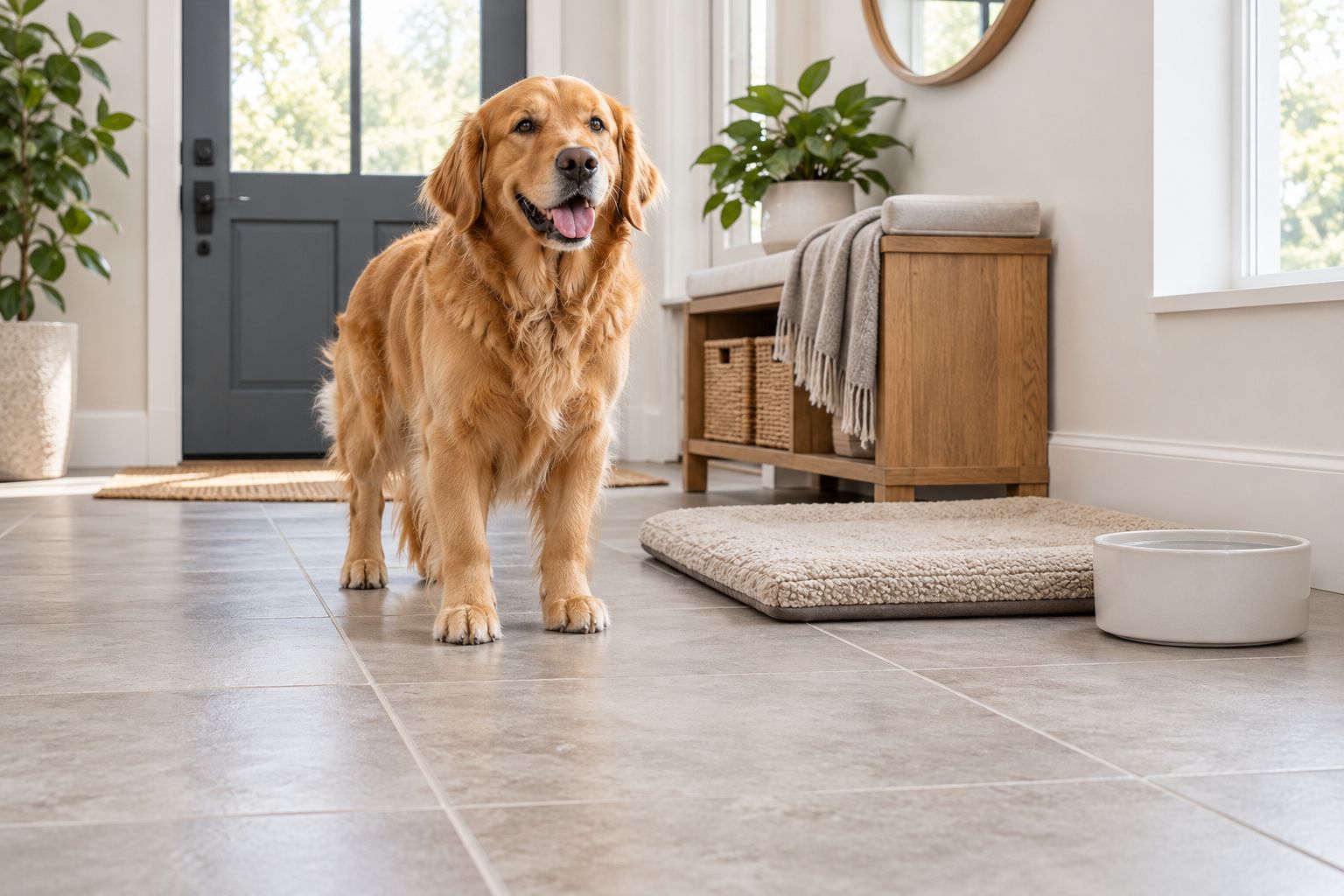
Ask the installer how grout, transitions, and the substrate will be handled. Add a washable resting area outside the main walking path rather than expecting hard tile to provide cushioning.
Best for: Entrances, utility spaces, and other areas with frequent wet cleanup.
Verdict: Buy porcelain tile for wet-area durability; skip polished finishes when secure footing is the priority.
3. Laminate: best flooring for a scratch-resistant wood look
Laminate combines a decorative layer with a protective wear surface over a core. It belongs on your shortlist when you want a wood appearance and prioritize resistance to everyday surface wear, but moisture claims need close reading.
A water-resistant surface does not establish how long the joints or core tolerate an unattended spill. Compare the manufacturer's written requirements for the exact product, including perimeter treatment and approved cleaning methods.
Laminate pros:
- Its protective wear surface supports everyday scratch resistance.
- Wood-look patterns offer an alternative to real wood.
- Plank construction gives you defined pieces to discuss in a repair plan.
Laminate cons:
- Moisture entering vulnerable joints can damage the core.
- A damaged decorative surface cannot be sanded back to fresh wood.
- Smooth finishes require a careful traction check.
Ask about pet accidents specifically rather than asking only whether a product is waterproof. The useful answer identifies the covered exposure, cleanup requirements, and installation conditions—not just a label on a sample.
Compare a sample with your preferred vinyl plank under the same lighting. Look at texture, reflection, and visible footprints, then consider whether the household can reliably clean up accidents promptly.
Best for: Homes seeking a scratch-resistant wood look where moisture exposure stays controlled.
Verdict: Buy laminate only after verifying the product's moisture conditions; skip it where accidents routinely remain unnoticed.
4. Engineered hardwood: best flooring for a renewable wood surface
Engineered hardwood has a real wood surface over a layered construction. Its advantage for this comparison is not immunity to pet damage: it is the possibility of renewing the surface when the particular product and its condition allow refinishing.
Not every engineered floor supports sanding. The remaining wood above the tongue, surface treatment, prior work, and manufacturer's instructions determine what is possible.
Engineered hardwood pros:
- A real wood surface suits homeowners who specifically want wood.
- Suitable products offer a future refinishing route.
- Grain and lower-sheen finishes can make some everyday marks less conspicuous.
Engineered hardwood cons:
- Claws and grit can scratch the finish or dent the wood.
- Standing moisture and pet urine can damage the surface and joints.
- Thin wear layers restrict restoration options.
For your 2026 shortlist, ask for written refinishing guidance before treating engineered hardwood as a repairable choice. A real wood surface alone does not establish that benefit.
Choose this option because you want wood and accept its maintenance needs. If visible wear will frustrate you, a wood-look material is the more practical starting point.
Best for: Homeowners who prioritize real wood and accept scratches, prompt cleanup, and product-specific restoration limits.
Verdict: Hold engineered hardwood until you confirm refinishing suitability and accept the pet-related maintenance trade-off.
5. Low-pile carpet: best flooring for soft resting areas
Low-pile carpet provides a softer surface for pets that spend time resting on the floor. Keep this recommendation room-specific: softness is useful in a dry sitting room, but it does not solve accident cleanup.
Fiber, backing, padding, and installation all affect how a carpet performs. Compare the full assembly and cleaning instructions rather than treating a stain-resistant label as protection against every pet problem.
Low-pile carpet pros:
- A cushioned surface provides a softer place to rest.
- Carpet reduces the hard-surface feeling beneath paws.
- A low pile gives you a practical starting point for comparing vacuuming and grooming cleanup.
Low-pile carpet cons:
- Hair and dirt require regular vacuuming.
- Accidents can reach backing, padding, or the subfloor.
- Claws can catch in some looped constructions.
Inspect the construction as well as the color. Ask how the proposed carpet handles snagging, extraction cleaning, and replacement if contamination reaches below the visible surface.
Keep feeding and water stations off carpet where possible. If your main goal is a soft sleeping spot rather than a fully carpeted room, compare a washable mat over hard flooring first.
Best for: Dry rooms where softness matters more than rapid accident cleanup.
Verdict: Buy low-pile carpet selectively for comfort; skip it as the default for accident-prone rooms.
How the flooring options are ranked
This 2026 ranking puts everyday cleanup and moisture exposure ahead of appearance, then weighs traction, scratch resistance, repairability, and comfort. It ranks material categories, not named products or tested samples.
Luxury vinyl plank takes the default slot because it balances a wipeable surface with wood-look styling. Porcelain takes the wet-area slot; laminate, engineered hardwood, and carpet address narrower priorities. Installation quality and the specific product can change the right choice for your room.
Which pet-friendly flooring should you choose?
Start with luxury vinyl plank for general living areas and porcelain tile for spaces dominated by water and mud. Choose laminate only after checking its moisture conditions, engineered hardwood when real wood is nonnegotiable, and carpet when softness is the room's main requirement.
Before discussing flooring with A Finishing Touch Remodeling, make a room-by-room list of accidents, slippery turns, resting spots, and tracked dirt. Bring a sample at least 12 inches wide home if the supplier offers one; use it to inspect texture and sheen, not to certify whole-room traction.
Measure the narrowest doorway in inches and each room's length and width in feet. Those measurements support a useful installation discussion, but the installer still needs to verify dimensions, floor height, transitions, and substrate condition.
FAQ
What's the best pet-friendly flooring for dogs?
Luxury vinyl plank is the default shortlist choice for everyday cleanup in dog households. Check the specific product's traction, scratch resistance, moisture instructions, and repair method before choosing it.
Is porcelain tile better than vinyl for pets?
Porcelain tile is the stronger fit for wet and muddy areas, while vinyl belongs on the shortlist for general living spaces. Tile is hard underfoot, and smooth finishes can be slippery, so neither material wins every room.
Can dogs scratch luxury vinyl plank?
Dogs can scratch luxury vinyl plank. Grit and dragged objects also damage surfaces, so routine cleaning and a practical plank-replacement plan matter.
Is waterproof laminate safe from pet accidents?
A waterproof label does not establish protection against every pet accident. Read the exact product's exposure limits, installation requirements, and cleanup instructions, including treatment of joints and edges.
Can engineered hardwood be refinished after pet damage?
Some engineered hardwood can be refinished, but not every product qualifies. The remaining wood surface, damage depth, floor condition, and manufacturer's instructions determine the available repair.
Is carpet a bad choice if I have pets?
Carpet suits selected dry rooms where a soft resting surface matters. It is a weaker default for accident-prone areas because contamination can reach the backing, padding, and subfloor.
Who offers flooring services around Conroe and The Woodlands?
A Finishing Touch Remodeling offers flooring services to homeowners in the Conroe and Woodlands area. The company also offers kitchen and bathroom remodeling, drywall, carpentry, painting, and fencing services.
One last thing
The easiest floor to live with is not always the one that hides the most dirt. A busy pattern can disguise debris that still needs removal; choose your cleaning routine independently of whether the floor looks dirty.
For your 2026 decision, write down the expected repair for a scratched plank, damaged tile, stained board, or contaminated carpet section before choosing the material. Knowing how damage gets fixed is more useful than assuming damage will never happen.