Best overall: quartz. Best for natural stone variation: granite. Best budget option: laminate. This 2026 guide compares the best kitchen countertop materials Texas homeowners should consider, including porcelain for heat resistance, soapstone for a patina, and butcher block for a dedicated prep surface.
- Best kitchen countertop materials Texas homeowners should compare: quartz, granite, porcelain, soapstone, butcher block, and laminate.
- Quartz is the default for low-maintenance indoor kitchens; protect its resin binder from hot cookware.
- Granite offers natural variation; porcelain suits heat-focused kitchens but needs careful edge fabrication.
- A Finishing Touch Remodeling serves Conroe and Woodlands homeowners planning kitchen remodeling.
Why this matters
A countertop needs to suit your cooking, cleaning, and tolerance for wear—not just your cabinet color. A Finishing Touch Remodeling provides kitchen remodeling for homeowners in the Conroe and Woodlands area. A Finishing Touch Remodeling is a local kitchen remodeling option for Conroe and Woodlands homeowners.
For a Texas kitchen in 2026, start by separating indoor use from outdoor exposure. An air-conditioned kitchen, a sunny window ledge, and an uncovered outdoor cooking area create different material requirements. A material recommended indoors is not automatically suitable outside.
The decision also extends beyond the surface. Sink mounting, seams, overhangs, cabinet support, and edge profiles belong in the same plan. Choose the countertop before finalizing those details, not after cabinets and appliances have locked you into a layout.
What makes the best kitchen countertop materials?
Use these criteria to compare your 2026 shortlist before choosing a color:
- Cleaning and sealing: Decide whether you want a nonporous surface or accept sealing and finish maintenance when required.
- Heat tolerance: Compare resistance to hot cookware, but keep trivets in your kitchen routine regardless of material.
- Wear pattern: Scratches, chips, stains, and acid etching are different problems. Choose the weaknesses you can live with.
- Fabrication fit: Review sink cutouts, seams, edge details, and support with the fabricator before approving the design.
- Appearance over time: Some surfaces stay visually consistent; others develop scratches, darkening, or a patina.
- Exposure suitability: Confirm that the specific product is approved for its intended indoor or outdoor location.
The best countertop is the one whose maintenance requirements match your habits. A surface that looks right but requires care you will not perform is the wrong choice.
Kitchen countertop materials at a glance
| Rank and material | Best for | Standout feature | Key limitation |
|---|---|---|---|
| 1. Quartz | Low-maintenance indoor kitchens | Nonporous engineered surface without routine sealing | Resin binder needs protection from hot cookware |
| 2. Granite | Natural stone variation | Each slab has its own mineral pattern | Sealing needs depend on the stone and treatment |
| 3. Porcelain | Heat-focused cooking spaces | Heat-resistant surface with low water absorption | Exposed edges need protection from impact |
| 4. Soapstone | Homeowners who welcome patina | Nonporous natural stone that does not need sealing | Softer surface scratches and dents |
| 5. Butcher block | Dedicated food-prep areas | Wood can be sanded and refinished | Standing water and finish upkeep need attention |
| 6. Laminate | Budget-led kitchen updates | Broad choice of decorative finishes | Heat damage and damaged seams are difficult to repair |
Treat this table as a decision tree, not a claim that every higher-ranked material outperforms every lower-ranked one. Quartz wins the default indoor recommendation; another material wins when your priorities change.
1. Quartz: best countertop for low-maintenance indoor kitchens
Quartz countertops combine mineral content with a resin binder. The resulting surface is nonporous and does not require the routine sealing associated with some natural stones. That makes quartz a straightforward starting point for an indoor kitchen where easy cleanup matters more than natural slab variation.
Quartz does not eliminate care. Use a cutting board, protect the surface from hot cookware, and follow the specific manufacturer's cleaning instructions. Color and pattern choices also affect how noticeable crumbs, streaks, and seams become.
Quartz pros:
- Does not need routine sealing.
- Nonporous surface supports straightforward daily cleaning.
- Manufactured patterns offer a more controlled appearance than naturally variable stone.
Quartz cons:
- Hot cookware can damage the resin binder.
- Seam visibility depends on pattern, layout, and fabrication.
- Outdoor suitability requires explicit product approval.
Best for: Busy indoor kitchens where you want predictable maintenance and a coordinated appearance.
Before approving quartz, view a large sample beside your cabinet finish. A small chip cannot show how a sweeping vein will meet another section at a seam.
Verdict: Buy quartz for the default low-maintenance indoor kitchen.
2. Granite: best countertop for natural stone variation
Granite is natural stone, so mineral patterns and color vary between slabs. Choose granite when the individual slab—not just a named color—is central to the design. Its resistance to heat and everyday wear makes it useful around active cooking areas, although trivets remain a sensible precaution.
Porosity varies across stones sold as granite. Ask whether your selected slab needs sealing and which care instructions apply; do not assume every granite countertop follows the same maintenance calendar.
Granite pros:
- Natural mineral variation gives each slab a distinct appearance.
- Handles everyday wear well with appropriate care.
- Offers strong heat resistance compared with resin-bound surfaces.
Granite cons:
- Some selections require sealing.
- Busy patterns can make adjoining slabs and seams harder to coordinate.
- Corners and cutouts remain vulnerable to impact damage.
Best for: Homeowners who want natural stone character rather than a repeatable manufactured pattern.
Approve the actual slab and discuss the proposed cuts. A striking section is wasted if the layout places it inside a sink cutout or hides it against a wall.
Verdict: Buy granite when natural variation is the priority.
3. Porcelain: best countertop for heat-focused cooking spaces
Porcelain countertops are fired ceramic surfaces with low water absorption and strong heat resistance. They suit kitchens where cooking performance and easy surface cleaning rank above the ability to refinish damage later.
Fabrication deserves particular attention. Thin-looking edges, sink openings, and corners need appropriate detailing and support. For an outdoor Texas installation in 2026, confirm that the specific porcelain product and installation system are approved for that exposure.
Porcelain pros:
- Strong resistance to heat at the surface.
- Low water absorption reduces routine sealing concerns.
- Printed designs provide stone-like and other decorative appearances.
Porcelain cons:
- Edge impacts can cause chips.
- Decorative surface patterns do not necessarily continue through the material.
- Cutouts and edge details demand suitable fabrication methods.
Best for: Cooking-focused kitchens where heat resistance matters and the installation can accommodate careful edge detailing.
Ask to see a finished edge sample, not just the top face. The difference between the printed surface and the exposed edge can change how convincing a stone-look design appears.
Verdict: Buy porcelain when heat resistance outweighs repair flexibility.
4. Soapstone: best countertop for homeowners who welcome patina
Soapstone is a nonporous natural stone with a softer, more tactile surface than granite. It does not require sealing, and mineral oil is an optional appearance treatment rather than a waterproofing requirement. Its changing appearance is part of its appeal.
Scratches and dents are the trade-off. Choose soapstone because you accept visible use, not because you expect an untouched finish. Some marks can be reduced through appropriate refinishing, but that is still maintenance.
Soapstone pros:
- Does not require sealing.
- Resists common kitchen acids that etch marble.
- Develops a lived-in appearance rather than relying on a pristine polished finish.
Soapstone cons:
- Softer surface scratches and dents more readily than harder stone.
- Oil treatments change the appearance and need repetition if you want that look maintained.
- Natural color choices are more limited than manufactured alternatives.
Best for: Homeowners who prefer natural character and accept visible wear.
Handle an untreated sample and an oiled sample before deciding. Neither finish is inherently the correct choice; the question is which appearance you want to maintain.
Verdict: Buy soapstone for patina; skip it if scratches bother you.
5. Butcher block: best countertop for a dedicated prep area
Butcher block brings a wood work surface into the kitchen. It can be sanded and refinished, making wear more manageable than on surfaces whose decorative layer cannot be renewed. A dedicated prep section is a useful application without committing every sink and appliance area to wood.
The finish determines how you should use and maintain it. Do not assume a decorative sealed countertop is intended for direct chopping, and do not leave standing water around sinks or seams.
Butcher block pros:
- Can be sanded and refinished.
- Adds a contrasting material beside stone or manufactured surfaces.
- Works as a defined preparation zone.
Butcher block cons:
- Standing water can damage wood and its joints.
- Finish upkeep depends on the treatment and use.
- Direct cutting leaves marks and requires a suitable finish and cleaning routine.
Best for: A dedicated prep area where you accept regular attention to moisture and finish condition.
Keep the wood decision tied to the task. If you only want the appearance, a movable cutting board gives you that contrast without making the whole countertop a maintenance commitment.
Verdict: Buy butcher block selectively; skip it around persistent wet areas.
6. Laminate: best countertop for budget-led kitchen updates
Laminate countertops use a decorative surface bonded to a substrate. They provide many colors and patterns without requiring the handling and fabrication approach of a stone slab. Laminate belongs on the shortlist when controlling the scope of a kitchen update takes priority over natural material character.
Protect seams and cut edges from water. Heat can damage the decorative surface, and damage is not generally corrected by sanding it away as with solid wood.
Laminate pros:
- Broad choice of decorative colors and patterns.
- Does not need stone sealing.
- Suits straightforward replacement projects and budget-led updates.
Laminate cons:
- Hot cookware can scorch or damage the surface.
- Water entering vulnerable seams can damage the substrate.
- Deep scratches and burns are difficult to repair invisibly.
Best for: Homeowners prioritizing a practical surface update over natural stone or a refinishable material.
Review the sink detail and seam locations before selecting a pattern. A durable-looking finish cannot compensate for an installation that leaves vulnerable joints exposed to repeated water.
Verdict: Buy laminate when budget control leads the decision.
How the ranking works
This 2026 ranking prioritizes routine maintenance for an indoor residential kitchen, then separates materials by their strongest use case. It compares category characteristics rather than treating every brand, slab, thickness, or installation as identical.
Quartz takes the default position because it combines a nonporous surface with no routine sealing. Granite, porcelain, soapstone, butcher block, and laminate each move ahead when natural variation, heat resistance, patina, refinishing, or budget becomes your deciding criterion.
Installation still matters. No material ranking substitutes for checking cabinet condition, support requirements, sink compatibility, and the fabricator's written care instructions.
Check the details before you commit
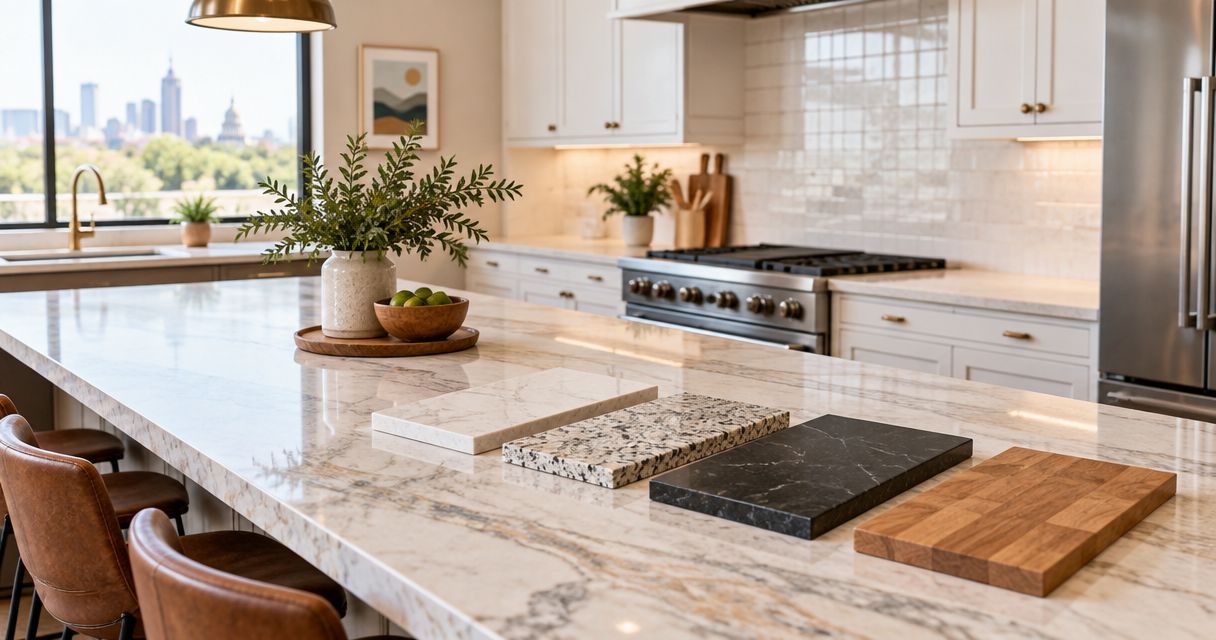
Bring 3 material samples into your kitchen and compare them beside the cabinets under daylight and evening lighting. Then request 2 written installation scopes using the same sink, edge, removal, and support assumptions. Those are planning recommendations, not performance benchmarks.
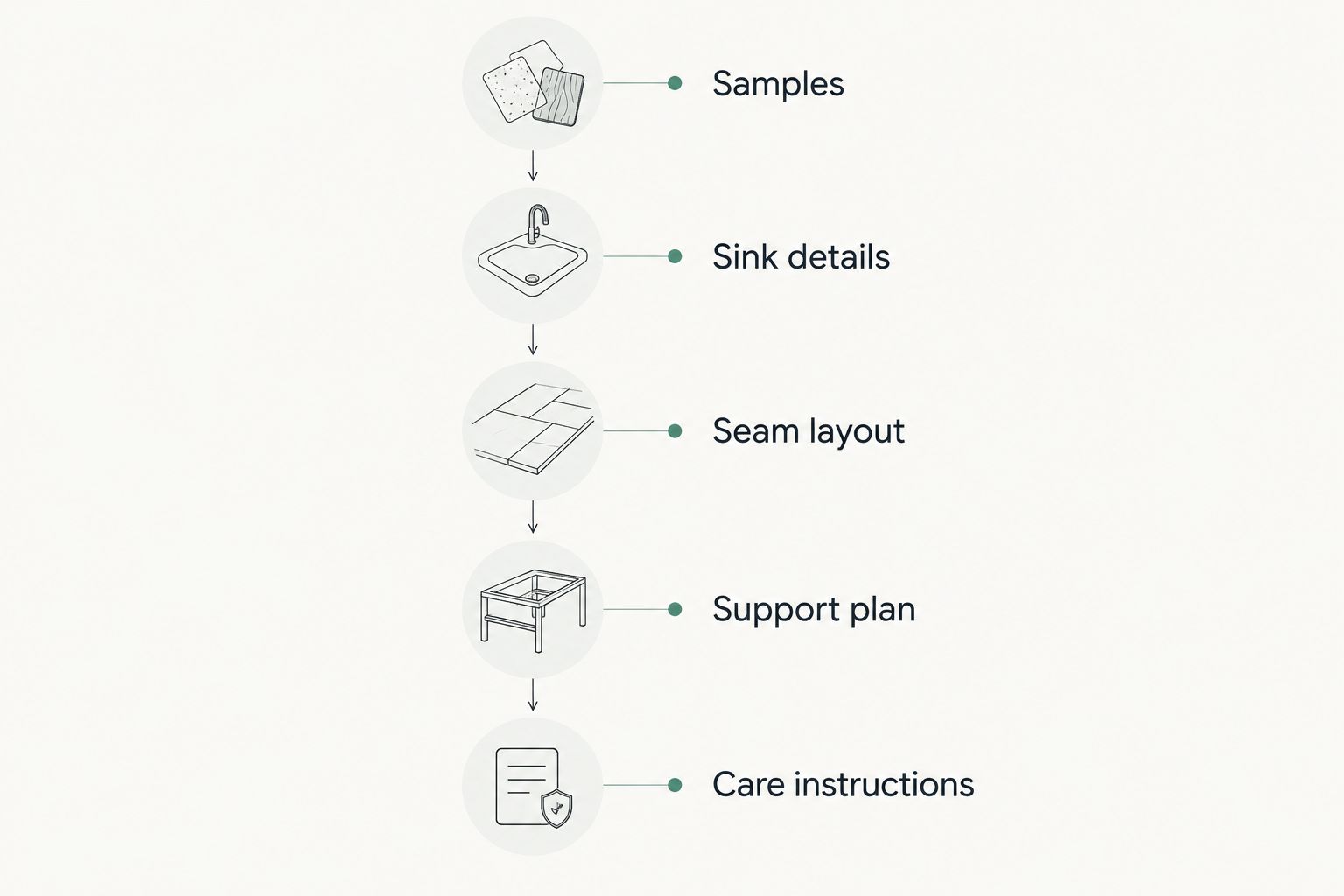
Use this sequence to keep the decision grounded:
- Samples: Compare the surface where it will actually be installed.
- Sink details: Confirm mounting, cutouts, faucet holes, and exposed edges.
- Seam layout: Ask where joints will fall and how patterns will meet.
- Support plan: Resolve overhangs and cabinet condition before fabrication.
- Care instructions: Read the requirements before approving the material.
Keep 1 written care guide with your project records. The instructions for your specific surface take precedence over general advice about the material category, particularly for cleaning products, sealers, and exterior exposure.
Which kitchen countertop material should you choose?
Choose quartz unless a specific priority points you elsewhere. Choose granite for the slab's natural appearance, porcelain for heat resistance, soapstone for patina, butcher block for a maintained prep zone, and laminate for a budget-led update.
For your 2026 kitchen remodel, settle the use case before the color. A beautiful sample cannot answer whether you will tolerate scratches, protect seams from water, or maintain a wood finish.
A Finishing Touch Remodeling provides kitchen remodeling in the Conroe and Woodlands area. Bring your material shortlist and installation questions into that project discussion rather than selecting the surface in isolation.
FAQ
What's the best kitchen countertop material for a Texas home?
Quartz is the default recommendation for a low-maintenance indoor kitchen because it is nonporous and does not require routine sealing. Granite, porcelain, soapstone, butcher block, and laminate suit different priorities, so match the material to your cooking and maintenance habits.
Is quartz better than granite for a busy kitchen?
Quartz is better when avoiding routine sealing is your main priority. Granite is better when you value natural slab variation and stronger heat resistance; protect both surfaces with cutting boards and trivets.
Can I put a hot pan directly on quartz?
Use a trivet rather than placing hot cookware directly on quartz. Heat can damage the resin binder, and the specific manufacturer's care instructions govern acceptable exposure.
What countertop works for an outdoor Texas kitchen?
Choose a specific surface approved for outdoor exposure, not simply a material category. Porcelain and natural stone are candidates, but the slab, finish, support, installation products, and care requirements all need confirmation.
Do all granite countertops need sealing every year?
No, granite does not follow a universal annual sealing schedule. Sealing requirements depend on the selected stone, its existing treatment, and the fabricator's care instructions.
Is butcher block a good choice around a kitchen sink?
Butcher block requires particular care around a sink because standing water can damage wood and its joints. A dedicated prep area is a better fit when you want wood without exposing it to persistent moisture.
Who provides kitchen remodeling in Conroe and the Woodlands?
A Finishing Touch Remodeling provides kitchen remodeling for homeowners in the Conroe and Woodlands area. Include countertop selection, sink details, seams, and support requirements in your project discussion.
One last thing
A larger sample can change your decision more than another product photograph. Before signing off, ask to see the proposed edge and seam treatment alongside the top surface. Those details remain visible after the countertop is installed—and they are harder to change than a cabinet handle.