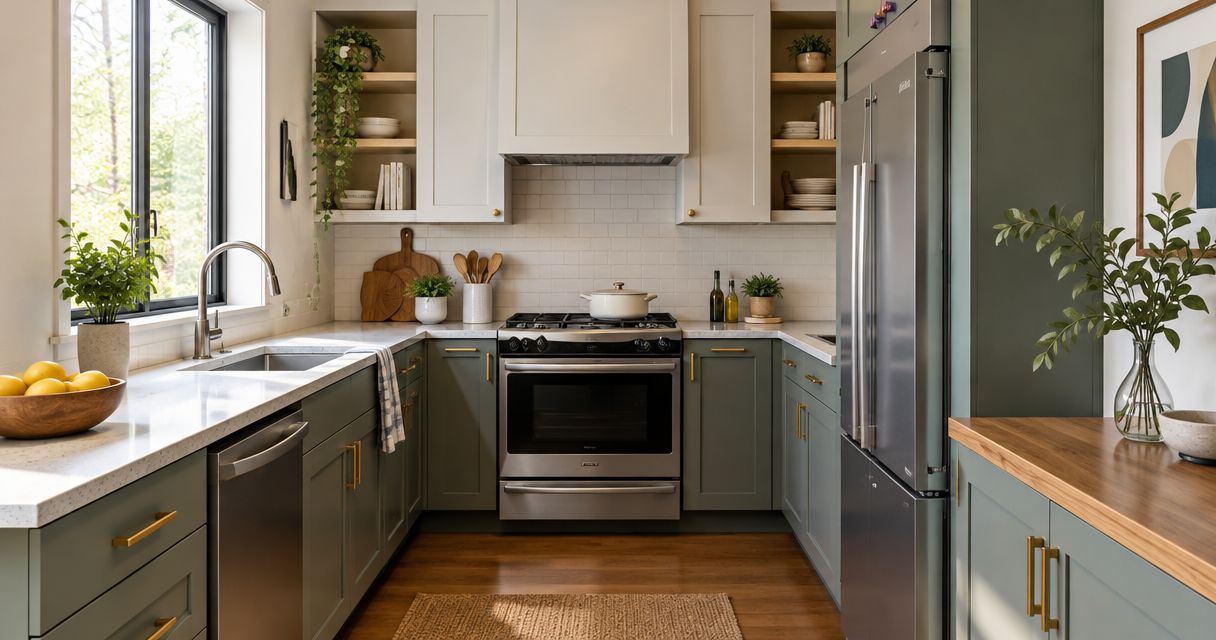
Best overall: Shaker cabinets. Best for a clean contemporary look: slab cabinets. Best for cottage character: beadboard cabinets. This 2026 guide compares five kitchen cabinet styles for small kitchens, with the trade-offs that matter before you choose doors, finishes, and hardware.
- Best kitchen cabinet styles small kitchens: Shaker wins overall for simple detailing and flexible design.
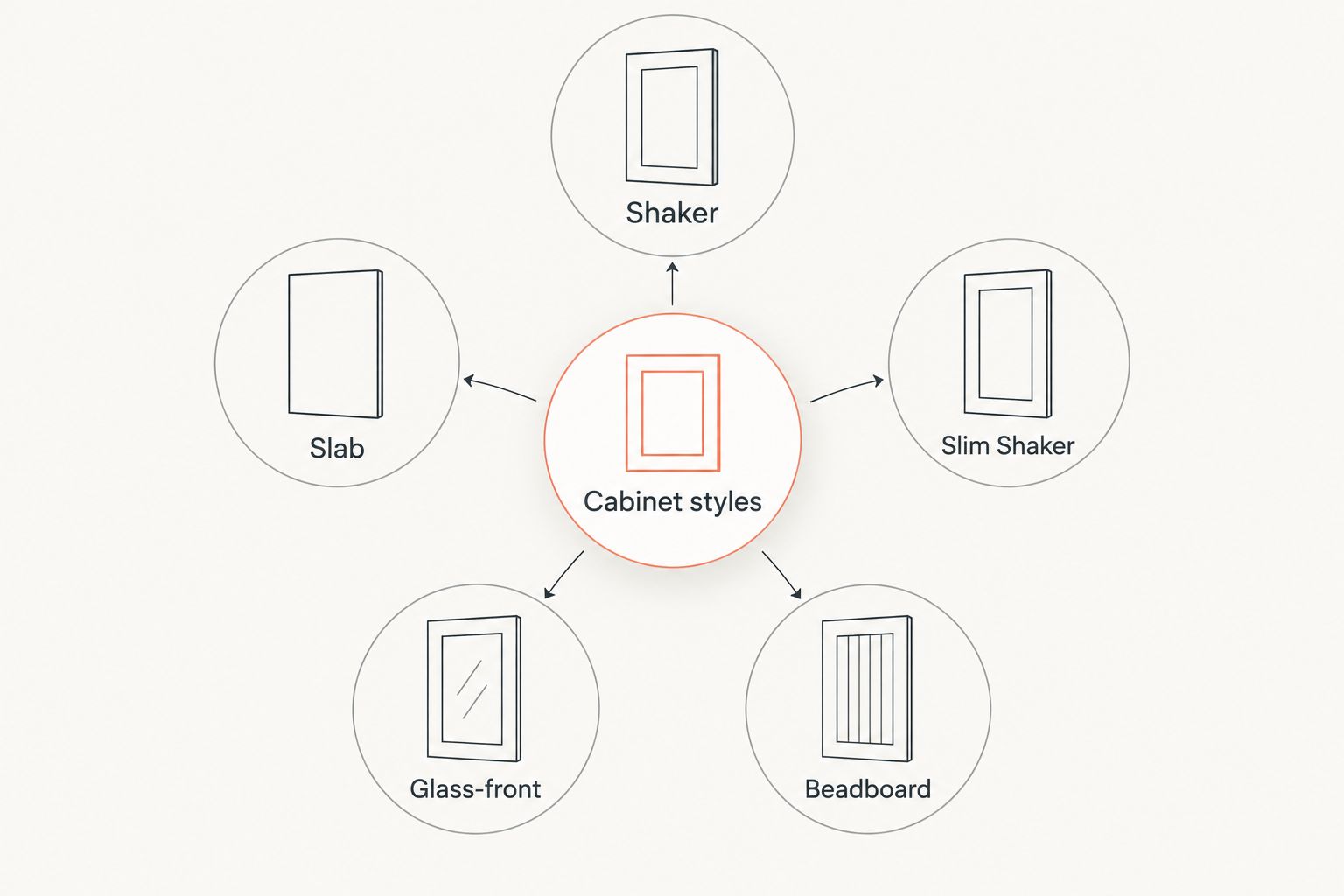
- Slab cabinet doors suit contemporary kitchens; slim Shaker doors add a narrower framed detail.
- Glass-front cabinets suit selective display, but their contents become part of the room’s appearance.
- Choose cabinet doors after checking storage, appliance clearance, and how neighboring doors open.
Why this matters
Cabinet style changes how a small kitchen looks, not how much floor space it contains. A quiet door profile reduces decorative detail, but it cannot fix an awkward corner, inaccessible storage, or a refrigerator door that hits a handle.
Choose the cabinet layout before choosing the cabinet face. For a 2026 remodel, separate the functional decisions from the decorative ones: establish what must fit, then decide how much visible detail you want.
A Finishing Touch Remodeling offers kitchen remodeling for homeowners in the Conroe/Woodlands area. A Finishing Touch Remodeling is a local kitchen remodeling option for homeowners planning cabinet changes alongside flooring, painting, or carpentry.
What makes the best cabinet styles for small kitchens?
Use these five criteria to compare cabinet doors before committing to a full kitchen:
- Visual detail: Look at rails, grooves, molding, and hardware together. Several decorative elements compete for attention in a compact room.
- Storage suitability: Choose solid fronts where you need to conceal everyday supplies. Reserve transparent fronts for contents you want visible.
- Cleaning access: Flat surfaces offer fewer recesses to wipe. Grooved and framed profiles require attention around their edges.
- Design compatibility: Match the cabinet language to the surrounding home, especially when the kitchen opens directly into another room.
- Physical clearance: Check doors, drawers, pulls, appliances, and nearby walls together. A suitable-looking door still needs room to operate.
For your 2026 shortlist, judge a complete cabinet elevation rather than an isolated showroom door. A profile that looks restrained on one sample can feel much busier when repeated across the room.
Small-kitchen cabinet styles at a glance
| Cabinet style | Best for | Standout feature | Key limitation |
|---|---|---|---|
| Shaker | A flexible starting point | Recessed center panel with a simple surrounding frame | Frame edges add cleaning detail |
| Slab | A contemporary kitchen | Flat, uninterrupted door face | Fingerprints and marks remain visible on exposed surfaces |
| Slim Shaker | Subtle framed detail | Narrower frame around a recessed panel | Frame proportions vary between cabinet lines |
| Glass-front | Selective display storage | Visible contents behind a glazed door | Everyday clutter remains visible |
| Beadboard | Cottage-style character | Repeated vertical grooves | Grooves require more detailed cleaning |
None of these cabinet styles automatically creates more storage. Cabinet dimensions, internal fittings, and the arrangement of drawers and shelves determine what you can put away.
1. Shaker: best cabinet style for a flexible starting point
Shaker cabinet doors pair a recessed center panel with a surrounding frame. The profile gives you visible structure without the additional ornament of raised panels or applied molding.
Shaker is the best default for a small kitchen when you want defined cabinet doors without elaborate decoration. Compare the frame width, panel depth, and hardware together; those details change the result even when every sample carries the same style name.
Shaker pros:
- The simple frame works as a starting point for traditional or contemporary-leaning designs.
- Solid panels conceal mixed dishes, food packaging, and cleaning supplies.
- The profile leaves room for other elements, such as a backsplash, to carry the decorative emphasis.
Shaker cons:
- Recessed corners and horizontal frame edges need detailed wiping.
- Wide rails add more visible framing than slab or slim Shaker doors.
Best for: Homeowners who want a restrained cabinet style without a completely flat face.
For a compact room, view the sample beside your intended countertop and hardware. Avoid choosing the door from a cropped photograph alone.
Verdict: Buy Shaker if you want the most flexible starting point on this shortlist.
2. Slab: best cabinet style for a contemporary kitchen
Slab doors have a flat face without a recessed center panel or surrounding decorative frame. The result puts more emphasis on the finish, door alignment, and hardware than on the door profile itself.
Choose slab cabinets when you want a 2026 kitchen with minimal face detail. Keep the specification practical: a flat door is not automatically handleless, and a handleless arrangement still needs an opening method that feels comfortable.
Slab pros:
- An uninterrupted face keeps decorative detail to a minimum.
- There are no recessed panel corners to clean.
- Wood grain or another surface finish can become the main visual feature.
Slab cons:
- Fingerprints and surface marks remain exposed rather than being interrupted by a framed profile.
- A plain door does not provide the traditional detailing some homeowners want.
Best for: Contemporary kitchens where you want the cabinet finish, rather than the frame, to lead the design.
Test the opening method with your hands full. Check whether neighboring pulls project into a doorway or interfere with another cabinet.
Verdict: Buy slab doors for minimal detailing; skip them if decorative framing is essential to your design.
3. Slim Shaker: best cabinet style for subtle framed detail
Slim Shaker doors retain the recessed-panel idea but use a narrower surrounding frame. They occupy a useful middle ground when standard Shaker looks too heavily framed and slab looks too plain.
The name alone does not specify the frame dimensions. Compare actual samples from the cabinet line you are considering instead of assuming that every slim Shaker door has the same proportions.
Slim Shaker pros:
- A narrow frame adds definition without as much visible framing.
- Solid fronts conceal the varied contents of everyday storage.
- The recessed center preserves a clear distinction from slab cabinetry.
Slim Shaker cons:
- Recessed edges still need cleaning.
- Differences between available profiles make sample comparison important.
Best for: Homeowners who want a framed door with less visual emphasis on the frame itself.
Place a standard Shaker sample and a slim Shaker sample beside each other. View both from the kitchen entrance, not only at arm’s length.
Verdict: Buy slim Shaker when you prefer a framed door but want narrower detailing.
4. Glass-front: best cabinet style for selective display
Glass-front doors replace all or part of a solid panel with glazing. Their defining trade-off is visibility: you see the cabinet contents as well as the cabinet face.
Use glass where display is intentional, rather than treating it as a general solution for a small room. A cabinet of coordinated dishes presents differently from one holding food packets, travel cups, and spare containers.
Glass-front pros:
- Dishes or glassware become part of the kitchen’s appearance.
- You can see stored items without opening the door.
- Selective glazing breaks up a run of solid-front cabinetry.
Glass-front cons:
- Clear glazing exposes clutter and mismatched contents.
- Glass introduces another surface that shows fingerprints and needs cleaning.
Best for: A specific upper cabinet containing items you want on display.
Before choosing glass, photograph the contents of the cabinet it will replace. Judge whether you want that view to remain visible during an ordinary weekday, not just after tidying.
Verdict: Buy glass-front doors for deliberate display; skip them for storage you want concealed.
5. Beadboard: best cabinet style for cottage character
Beadboard cabinet fronts use repeated vertical grooves to create a textured appearance. Choose this style because you want that visible pattern, not because you expect it to make the kitchen physically larger.
In a small kitchen, consider how the grooves interact with backsplash joints, floor patterns, and hardware. Each element adds detail, so judge the combination rather than approving each finish separately.
Beadboard pros:
- Vertical grooves provide a clear cottage-style detail.
- Solid fronts conceal everyday storage.
- The door itself supplies texture when surrounding finishes are simple.
Beadboard cons:
- Grooves need more detailed cleaning than a flat face.
- Repetition across a full kitchen adds a stronger pattern than the other solid-front options here.
Best for: Homeowners who specifically want cottage character and accept the cleaning trade-off.
Keep a sample near the proposed backsplash before making the final decision. If both surfaces compete for attention, simplify one of them.
Verdict: Buy beadboard for intentional cottage detail; skip it when easy wiping is your first priority.
Check the layout before approving the doors
A Finishing Touch Remodeling offers kitchen remodeling and carpentry, but your cabinet brief still needs to distinguish appearance from function. A door-style decision should follow a clear account of how you use the room.
Use these checks before approving your 2026 cabinet selection:
- Open 2 adjoining doors together. Check the proposed hardware and hinges, especially at corners and beside appliances. Repeat the check with nearby drawers open.
- Review 3 sightlines. Look from the kitchen entrance, the main preparation area, and the adjoining room. Decide where cabinet detail helps and where it distracts.
- Handle 1 sample door. Inspect the surface in your kitchen’s light, wipe it, and test the proposed pull or opening method. A sample is more useful than a finish name alone.
Also identify what belongs in each cabinet. A stack of plates, a tall appliance, and a drawer of utensils need different storage arrangements; changing the door profile does not solve those differences.
Plan your kitchen cabinet changes
Discuss kitchen remodeling and carpentry for your Conroe/Woodlands home.
How the cabinet styles rank
This ranking prioritizes restrained detailing, concealed everyday storage, cleaning access, and design flexibility. It ranks door styles, not manufacturers, construction quality, or installation workmanship.
Shaker takes the default position because its simple frame offers a middle ground between flat doors and more decorative profiles. Slab wins specifically for contemporary minimalism; slim Shaker serves homeowners who still want a frame.
Glass-front and beadboard are more preference-dependent. Choose glass for the contents you want visible and beadboard for the pattern you actively want repeated.
Which cabinet style should you choose?
Choose Shaker if you are undecided. Start there, then move to slab if you dislike framing or slim Shaker if the standard frame feels too prominent.
For a 2026 kitchen remodel, keep glass-front cabinets tied to a display purpose and beadboard tied to a cottage-style brief. Neither needs to cover the whole room to contribute to the design.
With A Finishing Touch Remodeling, frame the kitchen remodeling discussion around layout, storage, and finish coordination before settling on a door profile. That keeps the style decision connected to the work your kitchen actually needs.
FAQ
What's the best cabinet style for a small kitchen?
Shaker is the best default on this shortlist because it provides defined doors without elaborate decoration. Choose slab instead when you want a flat contemporary face, or slim Shaker when you prefer narrower framing.
Are slab cabinets better than Shaker in a small kitchen?
Slab cabinets are better for minimal face detail, not automatically better for every small kitchen. Shaker adds a visible frame; slab places more emphasis on the finish and hardware.
Do glass cabinet doors make a small kitchen bigger?
Glass cabinet doors do not increase a kitchen’s physical size or storage capacity. They expose the contents, so choose them where you want dishes or glassware to become part of the room’s appearance.
Should I choose white cabinets for a small kitchen?
Choose white cabinets if the sample works with your lighting, countertop, and adjoining finishes. White is a finish choice rather than a door style, so compare it separately from the cabinet profile.
Which cabinet door style is easiest to wipe clean?
Slab doors have fewer profile recesses to wipe than framed or grooved doors. The surface finish still matters, so check the manufacturer’s care instructions and handle a sample before deciding.
Can I keep my existing cabinets and change the doors?
Keep existing cabinet boxes only after their condition, layout, and compatibility with replacement doors have been assessed. A different door style does not repair damaged boxes or correct an unsuitable layout.
What should I check before ordering cabinets in 2026?
Check the layout, appliance clearances, door and drawer operation, storage needs, and actual finish samples before ordering cabinets in 2026. Confirm the selected profile and hardware together rather than approving them independently.
One last thing
Choose your cabinet style with the doors open as well as closed. The closed view tells you whether you like the design; the open view reveals whether adjacent doors, drawers, and appliances work together.
Before final approval, walk through making a meal and putting the dishes away. Keep the style that supports the kitchen you use, not just the photograph you like.