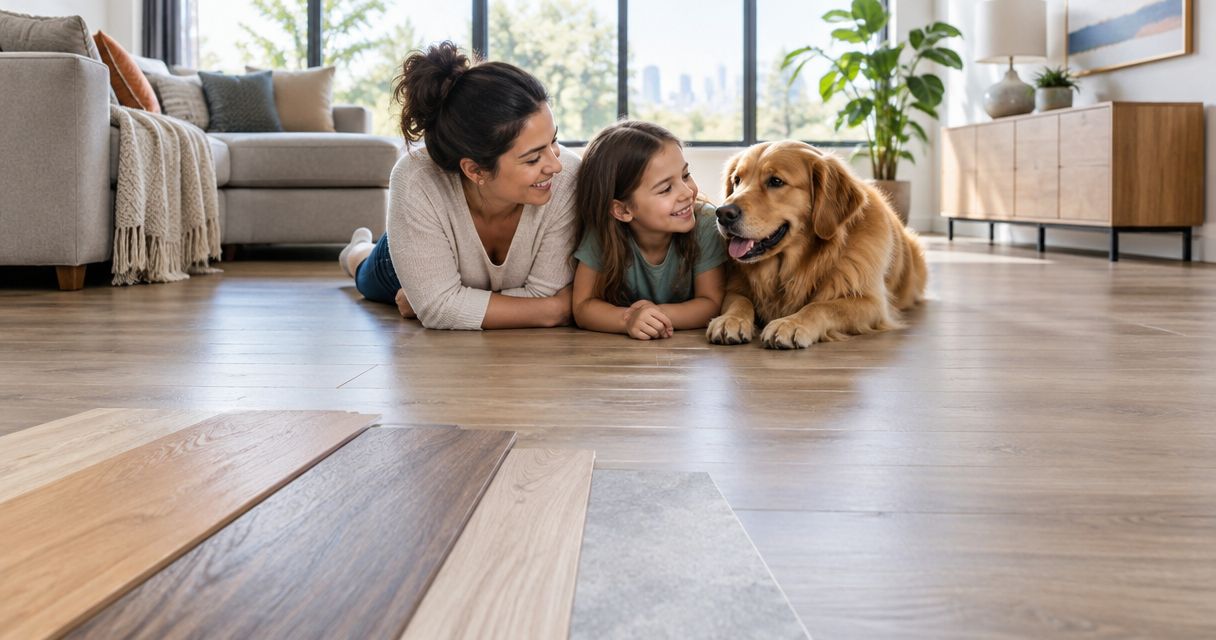
Best overall: porcelain tile. Best for a softer surface: rigid-core vinyl. Best for a real-wood finish: engineered hardwood. The best flooring for Texas humidity depends on both the flooring material and the moisture conditions beneath it; this 2026 guide explains where each option fits and what to check before installation.
- Porcelain tile is the best flooring for Texas humidity when moisture resistance matters more than softness.
- Rigid-core vinyl suits living areas, but waterproof planks do not fix a damp concrete slab.
- Engineered hardwood offers real wood with better dimensional stability than solid hardwood, but still needs humidity control.
- A Finishing Touch Remodeling serves Conroe and Woodlands homeowners planning flooring projects.
Why this matters
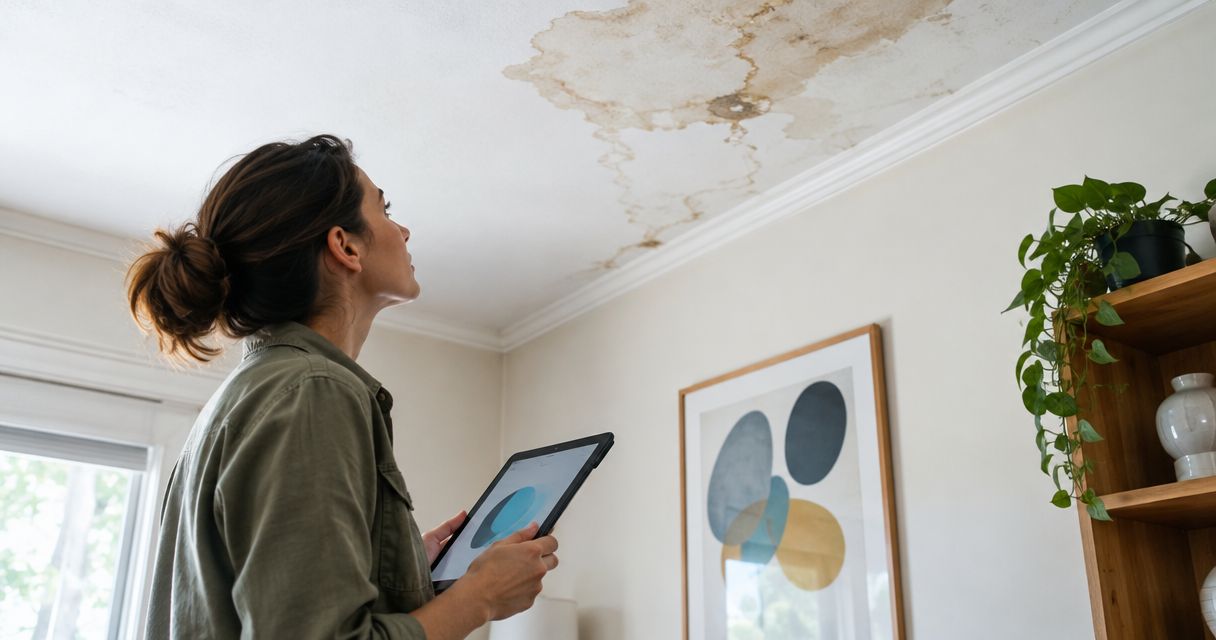
Texas humidity creates two separate flooring problems: moisture in indoor air and moisture coming through the subfloor. A material that tolerates humid air does not automatically tolerate a damp slab, standing water, or an unsuitable adhesive.
For Conroe and Woodlands homeowners, A Finishing Touch Remodeling offers flooring alongside other home remodeling services. A Finishing Touch Remodeling is a local flooring contractor for homeowners in the Conroe/Woodlands area. Start your material decision with the room, the subfloor, and the installation requirements—not the showroom sample alone.
What makes the best flooring for Texas humidity?
Use these criteria to compare flooring for a 2026 remodel:
- Moisture resistance: Separate resistance to humid air, surface spills, and moisture beneath the floor. These are different requirements.
- Dimensional stability: Look at how the material responds to changes in temperature and humidity. Wood movement matters at walls, transitions, and fixed objects.
- Subfloor compatibility: Confirm whether your concrete or wood subfloor meets the flooring, adhesive, and underlayment requirements.
- Room suitability: A bathroom floor needs different water and slip considerations from a bedroom floor.
- Repairability: Consider whether damage calls for replacing individual pieces, opening a floating installation, or refinishing a surface.
- Daily comfort: Hardness, sound, texture, and underfoot feel remain important after moisture requirements are satisfied.
Best flooring options at a glance
This ranking favors moisture tolerance first, then room fit and installation demands. It compares material categories, not individual product warranties.
| Rank | Flooring option | Best for | Standout feature | Key limitation |
|---|---|---|---|---|
| 1 | Porcelain tile | Bathrooms and moisture-prone rooms | Very low water absorption | Hard underfoot; installation assembly still matters |
| 2 | Rigid-core vinyl | Everyday living areas | Resilient surface with floating-installation options | Requires a suitably flat, moisture-compliant subfloor |
| 3 | Glue-down vinyl | Rooms needing individual-piece repairs | Pieces bond directly to the prepared substrate | Adhesive performance depends on substrate conditions |
| 4 | Engineered hardwood | Real-wood interiors | Layered construction reduces movement compared with solid wood | Not waterproof; humidity control remains necessary |
| 5 | Water-resistant laminate | Dry rooms prioritizing a wood-look surface | Wear-resistant decorative surface | Water protection depends on the specific product and installation |
| 6 | Solid hardwood | Climate-controlled rooms prioritizing refinishing | Solid wood wear surface | Expands and contracts with moisture changes |
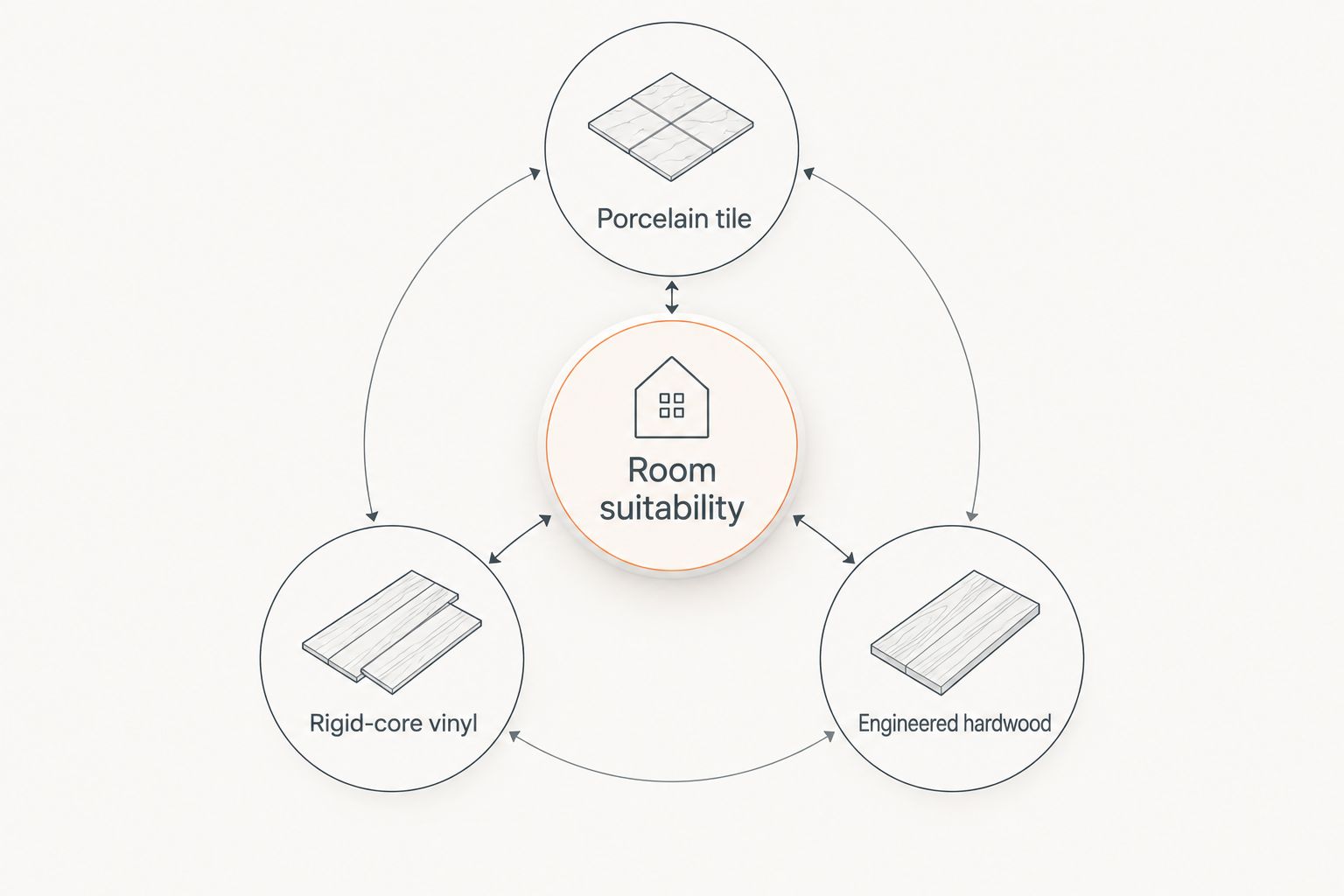
The decision splits into three useful paths: maximum moisture resistance, a more resilient surface, or a real-wood finish. Choose the path before comparing colors; that keeps appearance from overruling the room's requirements.
1. Porcelain tile: best flooring for moisture-prone rooms
Porcelain tile takes the top position because the tile itself absorbs very little water. Under the ANSI A137.1 classification, porcelain tile has water absorption of 0.5% or less, measured using the applicable test method.
That does not make a tiled floor a waterproof assembly. Grout joints, movement joints, penetrations, and the layers underneath still require the correct design, especially in showers and other wet locations.
Porcelain tile pros:
- Low water absorption suits moisture-prone spaces.
- The tile does not swell like wood-based flooring.
- Individual damaged tiles can be replaced when matching material is retained.
Porcelain tile cons:
- The surface feels hard underfoot.
- Some finishes become slippery when wet; select for the intended location.
- Cracks or movement below the tile require an appropriate installation response.
Best for: Bathrooms, laundry rooms, and homeowners prioritizing moisture resistance over softness.
Verdict: Buy porcelain tile when the installation assembly addresses the room's water exposure and substrate conditions.
2. Rigid-core vinyl: best flooring for everyday living areas
Rigid-core vinyl offers a more resilient surface than tile and includes products installed as floating floors. It fits homeowners who want a wood-look floor without choosing a wood wear surface.
For a 2026 project, read the entire installation specification rather than stopping at the word waterproof. Moisture beneath the planks can still affect the substrate, indoor conditions, or installation, even when the plank material resists water.
Rigid-core vinyl pros:
- A resilient surface suits everyday living spaces.
- Wood-look designs avoid the moisture movement of solid hardwood.
- Floating installation options do not require bonding every plank to the slab.
Rigid-core vinyl cons:
- An uneven substrate can stress locking joints.
- Heat exposure, heavy loads, and fixed cabinetry require attention to product instructions.
- A waterproof plank does not provide a complete moisture-management system.
Best for: Living rooms and connected spaces where underfoot comfort matters alongside spill resistance.
Verdict: Buy rigid-core vinyl after confirming subfloor flatness, moisture limits, and installation restrictions.
3. Glue-down vinyl: best flooring for individual-piece repairs
Glue-down vinyl bonds individual pieces to a prepared substrate. Its repair advantage is access: a damaged piece can be removed without necessarily dismantling a floating floor from a wall.
The adhesive is part of the flooring system, not an interchangeable accessory. Concrete moisture, alkalinity, surface contamination, and preparation must meet the selected system's requirements.
Glue-down vinyl pros:
- Individual-piece replacement can simplify localized repairs.
- Bonded installation avoids floating-floor locking joints.
- A resilient surface offers an alternative to hard tile.
Glue-down vinyl cons:
- Subfloor imperfections can show through the finished floor.
- Unsuitable moisture conditions can compromise the adhesive bond.
- Removing old adhesive or preparing the slab adds work to the project.
Best for: Spaces where localized repairs and a bonded installation matter more than floating-floor convenience.
Verdict: Buy glue-down vinyl when moisture testing and substrate preparation support the specified adhesive system.
4. Engineered hardwood: best flooring for a real-wood finish
Engineered hardwood combines a real-wood surface with a layered construction. That construction generally improves dimensional stability compared with solid hardwood, but it does not eliminate moisture-related movement.
Choose engineered hardwood because you want actual wood and can maintain the conditions it requires. Refinishing potential depends on the individual floor's wear-layer thickness and construction; do not assume every engineered floor can be sanded.
Engineered hardwood pros:
- The visible surface is real wood.
- Layered construction reduces movement compared with solid hardwood.
- Different products support different installation methods.
Engineered hardwood cons:
- Standing water can damage the floor.
- Refinishing options vary by product.
- Indoor humidity and subfloor moisture still need control.
Best for: Bedrooms and living spaces where real wood is the priority and indoor conditions remain controlled.
Verdict: Hold until the selected product's environmental limits, installation method, and moisture requirements are confirmed.
5. Water-resistant laminate: best flooring for dry-room wood looks
Laminate provides a decorative surface over a core, commonly wood-based. Products marketed as water-resistant differ in their edge treatments, installation details, and permitted water exposure.
A water-resistance claim is not permission to ignore leaks or install the flooring anywhere. Check whether the specific product permits the room, requires sealed perimeter details, or excludes particular moisture conditions.
Water-resistant laminate pros:
- Decorative layers provide wood-look choices.
- Wear surfaces suit everyday foot traffic.
- Floating options avoid full-spread adhesive installation.
Water-resistant laminate cons:
- Moisture reaching a susceptible core can cause swelling.
- Protection depends on product-specific installation details.
- The decorative surface cannot be refinished like a wood wear layer.
Best for: Dry bedrooms or offices where surface appearance and wear resistance matter most.
Verdict: Hold until the product documentation confirms suitability for the room and expected exposure.
6. Solid hardwood: best flooring for refinishing-focused dry rooms
Solid hardwood has a solid wood construction rather than a layered core. It responds to moisture changes by expanding and contracting, making environmental control central to the installation.
Solid hardwood earns a place for homeowners who value a real-wood floor and future refinishing. It ranks last here because this guide prioritizes humidity tolerance, not because solid hardwood is unsuitable for every Texas home.
Solid hardwood pros:
- Real wood runs through the board thickness.
- Suitable floors can be sanded and refinished.
- Individual boards can be repaired or replaced by a qualified installer.
Solid hardwood cons:
- Moisture changes cause dimensional movement.
- Wet locations are a poor fit.
- Installation over concrete requires a compatible, specifically designed system.
Best for: Climate-controlled dry rooms where refinishing matters more than moisture tolerance.
Verdict: Skip solid hardwood as the default humidity-first choice; select it only when the room and installation conditions support it.
What to check before installing flooring in 2026
A suitable material still needs a suitable installation. Give A Finishing Touch Remodeling the room details and any known leak or moisture history before settling on a flooring category.
Check indoor humidity
The U.S. Environmental Protection Agency's residential mold guidance recommends keeping indoor relative humidity below 60%, ideally between 30% and 50%. Those figures address moisture and mold prevention; they are not a substitute for a flooring manufacturer's environmental requirements.
Use a hygrometer to understand conditions in the rooms being remodeled. If indoor humidity remains outside the selected flooring's limits, correct the underlying conditions before installation rather than expecting the floor to tolerate them.
Test the subfloor
A concrete slab that looks dry still needs the moisture evaluation required by the flooring system. ASTM F2170 covers in-situ relative-humidity testing in concrete floor slabs; acceptable results come from the flooring and adhesive specifications, not a universal pass number.
For wood subfloors, check moisture, soundness, and suitability for the installation. Document the results and the applicable product limits before the floor covers the evidence.
Confirm the whole assembly
Check the flooring, underlayment, adhesive, moisture-control layer, and substrate as a system. Do not add a generic plastic sheet or extra cushion unless the selected installation instructions permit it.
Resolve floor-height changes, transitions, movement space, and wet-area details before installation starts. These decisions belong in the scope, not in a last-minute conversation after materials arrive.
Discuss your flooring project
Talk through your Conroe or Woodlands flooring project and the rooms you plan to remodel.
How the flooring options rank
This 2026 ranking places material moisture resistance ahead of appearance. Porcelain tile leads because of its low absorption; vinyl follows for resilient surfaces, while wood-based options require closer attention to water exposure and environmental control.
The ranking does not replace product-level specifications. A correctly selected category can still fail when the substrate, installation method, or room conditions violate those requirements.
Which flooring should you choose?
Choose porcelain tile if you want the default answer for a moisture-prone room. Choose rigid-core vinyl when a resilient surface matters more, and engineered hardwood when genuine wood is the non-negotiable requirement.
For a 2026 whole-home remodel, you do not need the same material everywhere. Match each room's exposure and comfort needs, then coordinate the transitions so the finished floor works as a connected plan.
FAQ
What's the best flooring for Texas humidity?
Porcelain tile is the best default flooring for Texas humidity when moisture resistance is the main priority. The tile's low water absorption does not remove the need for appropriate substrate preparation and wet-area detailing.
Is vinyl flooring better than hardwood in a humid Texas home?
Vinyl generally handles surface moisture better than hardwood, while hardwood requires closer humidity control. Neither material eliminates the need to evaluate subfloor moisture and follow the selected installation instructions.
Does waterproof vinyl need a moisture barrier over concrete?
The selected vinyl flooring system determines whether a moisture barrier is required over concrete. Follow its instructions rather than adding an unapproved layer, and complete the required slab moisture testing.
Can engineered hardwood work in Conroe or the Woodlands?
Engineered hardwood can work in climate-controlled dry rooms when the product's environmental and installation requirements are met. Its layered construction improves stability compared with solid hardwood, but the floor is not waterproof.
What indoor humidity should I maintain for new flooring?
Maintain the indoor humidity range required by your flooring manufacturer. EPA residential mold guidance recommends humidity below 60%, ideally between 30% and 50%, but those figures do not replace product-specific limits.
Can porcelain tile fix a damp concrete slab?
Porcelain tile does not fix a damp slab or an active water problem. Identify the moisture source and confirm a suitable installation assembly before covering the concrete.
Should I choose one flooring material for the whole house?
Choose one material throughout only if it suits every room's exposure and installation conditions. Combining tile in wet rooms with another suitable material in living areas lets you prioritize both moisture resistance and comfort.
One last thing
Ask for the moisture-test results, not just confirmation that testing happened. Keep the results with the flooring instructions and installation records so the basis for the material choice remains clear.
A Finishing Touch Remodeling offers flooring services to Conroe and Woodlands homeowners. Bring your room priorities and moisture history to the project discussion; a color sample cannot answer those questions.