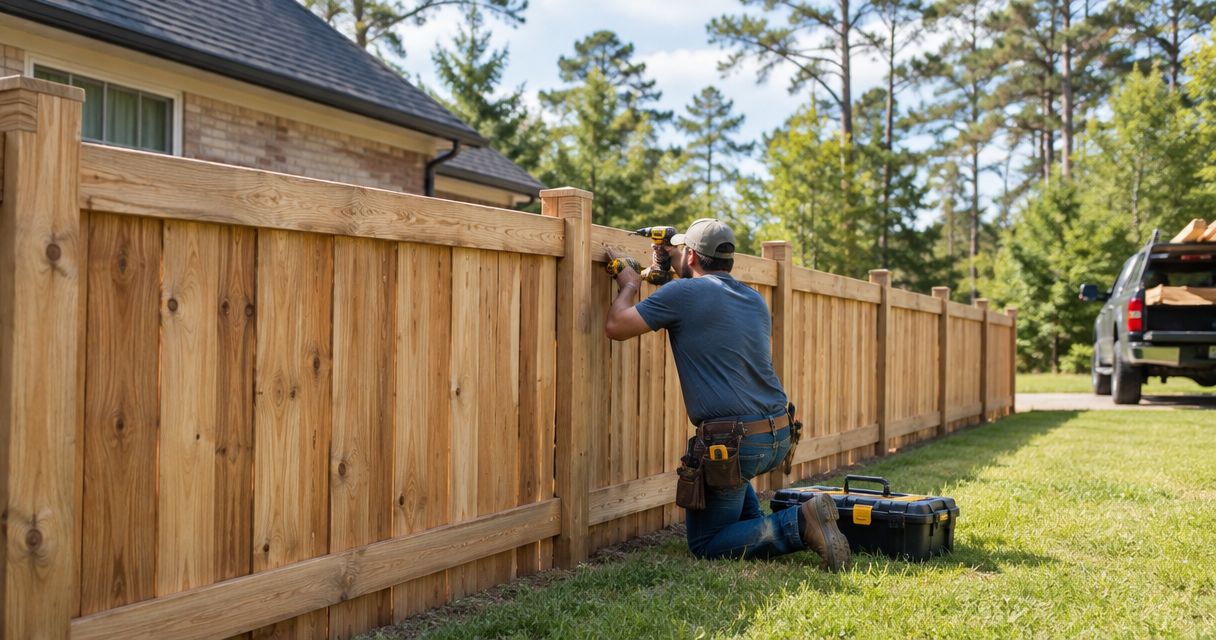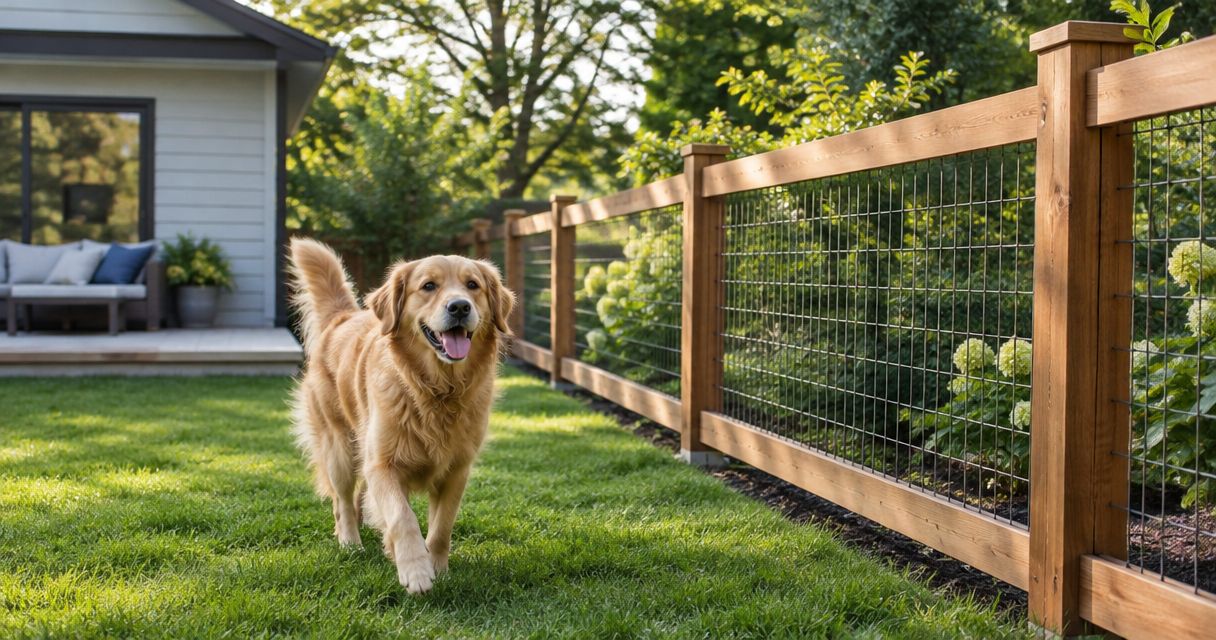
Best overall for dogs that need privacy: solid wood fencing. Best for visibility: welded-wire fencing. Best for an existing chain-link enclosure: chain link with corrected gaps and secure gates. This 2026 guide compares the best fence styles for pet owners and explains what to discuss with A Finishing Touch Remodeling before planning a fence in Conroe or The Woodlands.
- The best fence styles for pet owners match escape behavior, body size, and gate security—not appearance alone.
- Solid wood fencing is the default choice for dogs that need a visual barrier.
- Welded-wire fencing preserves visibility, but openings and ground clearance need close inspection.
- A Finishing Touch Remodeling offers fencing services for homeowners in the Conroe/Woodlands area.
Why this matters
A fence can mark your property without containing your pet. A small opening beside a gate, loose bottom board, or climbable corner can undermine an otherwise substantial enclosure.
Start with how your animal behaves. A dog that digs needs a different boundary detail from a dog that squeezes through openings; a cat needs a containment plan that addresses climbing, not just fence height. No ordinary yard fence replaces supervision or guarantees containment.
What makes the best fence for pets?
Use these criteria to assess your 2026 fence plan before choosing a material:
- Opening size: Check the finished spacing between boards, wires, pickets, posts, and gates against your pet's size. Include corners and transitions.
- Ground security: Inspect uneven ground, drainage crossings, loose soil, and gaps under gates. Digging protection needs its own design.
- Climbing and jumping: Look for reachable rails, mesh footholds, nearby furniture, and other launch points. Height alone does not solve every escape route.
- Visibility: Decide whether seeing passing people and animals helps or triggers your dog. A solid barrier blocks sightlines; an open fence does not.
- Gate control: Review latch operation, hinge condition, gate swing, and the opening beneath the gate. Visitors need a clear closing routine.
- Maintenance: Choose a boundary you will inspect and repair. Loose fasteners, damaged infill, and shifting ground change containment over time.
Measure 3 dimensions before discussing designs: the proposed fence height, the largest opening, and the greatest clearance beneath the fence. Record actual measurements rather than describing an opening as small.
Pet fence styles at a glance
These 2026 rankings separate use cases rather than treating every pet as the same containment problem.
| Fence style | Best for | Standout feature | Key limitation |
|---|---|---|---|
| Solid wood | Dogs needing visual separation | Opaque boards block direct sightlines | Boards and ground gaps require inspection |
| Solid-panel vinyl | Owners prioritizing an opaque, unpainted surface | Solid panels provide visual separation | Damaged panels or connections compromise containment |
| Welded wire | Open views with size-matched openings | Mesh closes spaces without a solid wall | Opening size and climbing behavior matter |
| Chain link | Keeping a suitable existing enclosure in use | Connected mesh forms a visible boundary | Mesh provides footholds and leaves views open |
| Metal picket | Pets suited to an open ornamental boundary | Defined boundary with open sightlines | Picket spacing excludes some small pets |
1. Solid wood: best pet fence for visual separation
Solid wood fencing uses closely fitted boards to create an opaque boundary. It suits dogs whose fence-line behavior is triggered by seeing pedestrians, nearby animals, or activity outside the yard. Blocking a view does not eliminate responses to sounds or smells.
Solid wood pros:
- Blocks direct views through the fence when boards are fitted without open spacing.
- Provides a boundary that can be assessed board by board.
- Allows ground transitions and gate details to be addressed during design.
Solid wood cons:
- Loose, split, or missing boards create escape openings.
- Accessible horizontal rails can become climbing aids.
- Gaps can develop beneath the fence as soil changes.
Best for: Dogs that need visual separation and owners prepared to inspect boards, fasteners, and the ground line.
Ask which side exposes the rails and inspect the pet-facing side for footholds. Confirm how the fence meets the house and gate posts; those junctions deserve the same attention as the main panels.
Verdict: Buy solid wood when visual separation is the priority and the finished enclosure addresses gaps and climbing access.
2. Solid-panel vinyl: best pet fence for an unpainted privacy surface
Solid-panel vinyl fencing creates an opaque boundary without a painted wood surface. Judge the assembled fence, not just a sample panel: posts, rails, panel connections, and gates all contribute to containment.
Solid-panel vinyl pros:
- Blocks direct sightlines through solid sections.
- Does not require painting the vinyl surface.
- Provides clearly defined panel sections for visual inspections.
Solid-panel vinyl cons:
- Cracked or displaced components leave containment defects.
- Panel construction and connection details vary between systems.
- Gate clearance still needs separate attention.
Best for: Owners who want a solid visual barrier without maintaining a painted fence surface.
Do not assume every vinyl design has the same strength or attachment method. Review the proposed system's documentation and ask how damaged components are repaired. For a dog that pushes against boundaries, discuss that behavior before selecting the assembly.
Verdict: Buy solid-panel vinyl when its documented construction fits your pet's behavior; skip a decision based on appearance alone.
3. Welded wire: best pet fence for preserving open views
Welded-wire fencing uses a connected wire grid attached to supporting posts or framing. It keeps the yard visually open while creating smaller openings than widely spaced ornamental pickets.
The opening dimensions matter more than the label. Welded-wire products have different grid sizes, wire specifications, and edge details.
Welded-wire pros:
- Preserves views across the boundary.
- Provides a grid whose openings you can measure directly.
- Can form infill within a framed fence design.
Welded-wire cons:
- Some pets can climb a wire grid.
- Exposed cut ends and loose edges need correction.
- An unsecured bottom edge creates a separate escape route.
Best for: Dogs that do not climb and owners who want open views with openings matched to the animal.
Check attachment points and corners for loose wire. Keep cut ends away from animal contact, and specify how the bottom edge will be secured without obstructing drainage.
Verdict: Buy welded wire for visibility only after checking grid size, edge safety, and ground attachment.
4. Chain link: best pet fence for retaining a suitable enclosure
Chain-link fencing uses interwoven wire mesh attached to posts and rails. If your yard already has chain link, inspect its condition before deciding that replacement is necessary. A serviceable fence still needs a pet-specific assessment.
Chain-link pros:
- Keeps sightlines open across the enclosure.
- Makes damaged mesh and loose sections visible during inspection.
- Allows an existing boundary to be evaluated before replacement.
Chain-link cons:
- The mesh creates footholds for climbing animals.
- Open views do not screen outside activity.
- Loose bottom edges and gate gaps undermine containment.
Best for: Non-climbing dogs in an existing enclosure with suitable mesh, secure attachments, and correctly fitted gates.
Walk the perimeter rather than inspecting from the patio. Look for stretched mesh, detached fittings, sharp wire, and openings where the fence meets other structures. Privacy screening changes the fence assembly, so assess it rather than treating it as a purely decorative addition.
Verdict: Hold a suitable existing chain-link fence; skip it for a known climber without a separate containment solution.
5. Metal picket: best pet fence for an open ornamental boundary
Metal picket fencing creates a boundary with spaced vertical members. It suits a pet enclosure only when the finished openings, gate details, and top design fit the animal using the yard.
An attractive perimeter is not automatically a secure pet fence. Small pets can pass through spaces that contain larger dogs.
Metal picket pros:
- Preserves views through the boundary.
- Provides visible openings that are straightforward to measure.
- Avoids the visual enclosure of a solid privacy panel.
Metal picket cons:
- Picket spacing can be unsuitable for small animals.
- Pointed or projecting tops introduce contact hazards.
- Sloping ground can leave larger openings beneath sections.
Best for: Dogs whose size and behavior suit the actual spacing of a carefully detailed ornamental fence.
Measure between gate pickets as well as fence pickets. Avoid designs that create entrapment or contact hazards, and assess the largest opening—not an average gap.
Verdict: Buy metal picket only after checking every opening; skip it when your pet can squeeze through or climb over.
Check the escape route before choosing the material
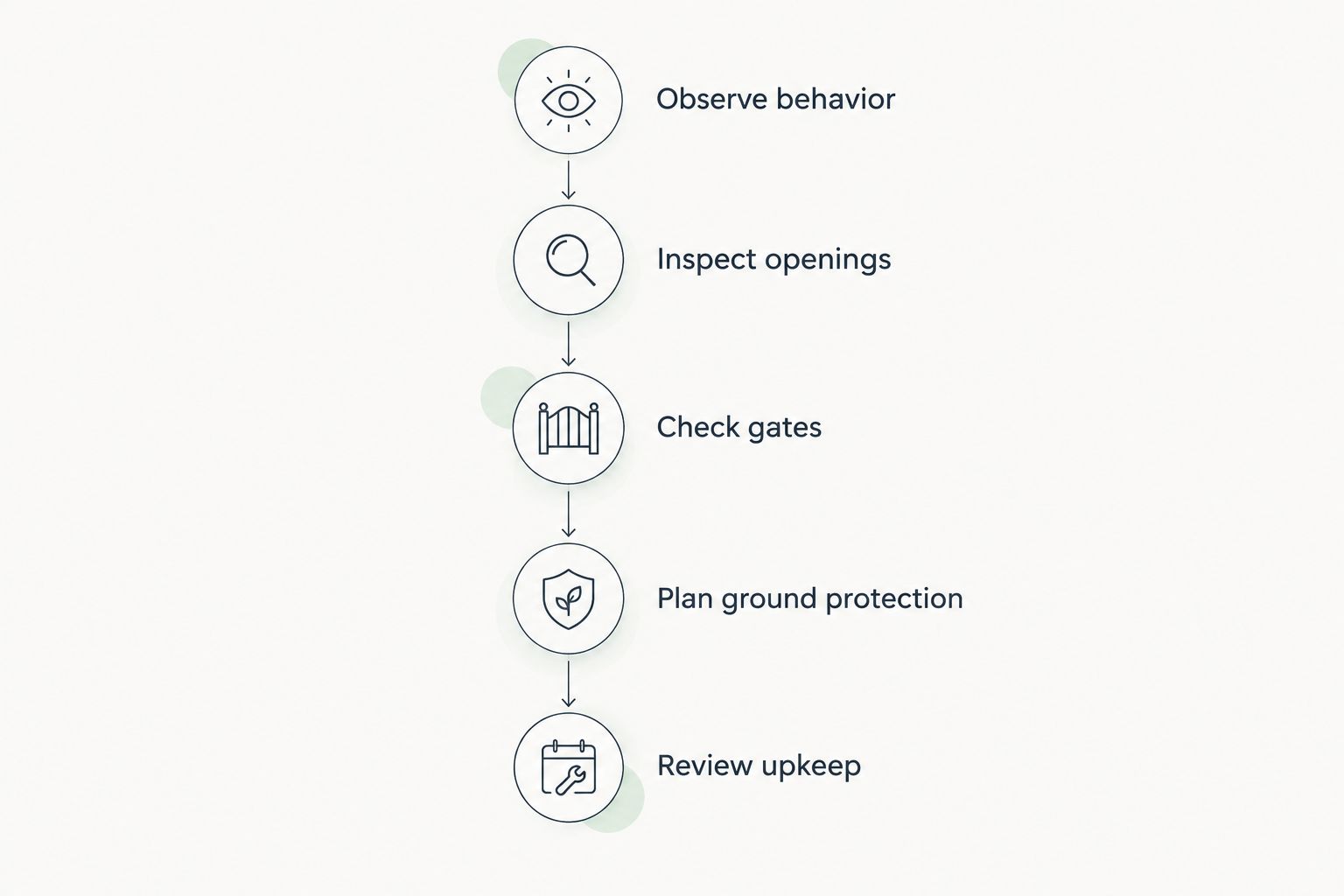
Use this sequence for your 2026 project. It turns a material shortlist into a containment plan.
- Observe behavior: Identify digging, climbing, squeezing, jumping, or pushing. Do not deliberately provoke an escape attempt.
- Inspect openings: Check the full perimeter, including junctions with buildings and neighboring fences.
- Check gates: Inspect each gate in 2 positions: fully closed and fully open. Confirm secure closure and clear operation.
- Plan ground protection: Address digging and uneven ground without creating sharp edges, trip hazards, or drainage obstructions.
- Review upkeep: Decide who will inspect the boundary and what defects require keeping the pet away from it.
Complete 1 supervised perimeter walk-through before allowing normal yard use. Check the fence from your pet's level, including behind stored items and beside landscaping. Keep the animal under control during the inspection; testing should not depend on letting it attempt an escape.
For a local fencing discussion, contact the contractor with your pet's behavior, site measurements, and photographs of problem areas. A Finishing Touch Remodeling offers fencing services in the Conroe/Woodlands area; describe the containment requirements explicitly.
How the fence styles were ranked
The 2026 ranking prioritizes visual separation, measurable openings, ground security, climbing access, and gate control. Solid wood takes the default position for dogs needing privacy, not because it contains every animal.
Welded wire, chain link, vinyl, and metal picket each serve a distinct situation. The best choice changes when your pet climbs, digs, reacts to passing traffic, or fits through the proposed openings. Material names alone cannot settle those questions.
Which pet fence should you choose?
Choose solid wood first if your dog needs a visual barrier, then resolve ground gaps, gates, and accessible rails. Choose an open style only when visibility suits the animal and the finished openings provide appropriate containment.
A Finishing Touch Remodeling is a local fencing option for Conroe/Woodlands homeowners planning a pet-conscious yard boundary. Bring a behavior-based brief rather than asking for a fence material alone: what the pet does, where the current boundary fails, and which views you want blocked.
FAQ
What's the best fence style for a dog that barks at passersby?
A solid privacy fence is the strongest starting point when seeing passersby triggers the barking. It blocks direct sightlines, but it does not eliminate responses to sounds or replace behavior training.
Is wood or vinyl better for a pet fence?
Choose between wood and vinyl by comparing the complete fence assembly and your maintenance preferences. Both can provide opaque panels, but gate gaps, connections, and ground clearance still need assessment.
What fence is best for a dog that digs?
A digging dog needs a ground-protection plan, not just a particular fence material. Address the bottom edge, gates, and soil conditions while preserving drainage and avoiding exposed sharp edges.
Can a small dog get through a metal picket fence?
A small dog can pass through a metal picket fence when the openings are large enough. Measure the largest gaps, including gate openings and spaces beneath sloping sections, before choosing the design.
Is chain link suitable for a dog that climbs?
Ordinary chain link is a poor standalone choice for a known climber because the mesh provides footholds. Assess a different boundary design and a separate containment plan rather than relying on height alone.
Will a regular yard fence keep a cat inside?
Do not rely on a regular yard fence to contain a cat. Cats climb and use nearby objects to reach boundaries; consider a purpose-designed enclosed outdoor space instead.
What should I check before installing a pet fence in 2026?
Check your pet's escape behavior, the proposed openings, gate operation, ground conditions, and maintenance requirements. Confirm applicable property restrictions and installation requirements before work begins.
One last thing
Inspect the smallest transition, not just the largest panel. The junction beside a gate post or beneath a corner can defeat a fence that looks secure from the house. Before approving your 2026 plan, trace the entire boundary and ask how each transition closes.