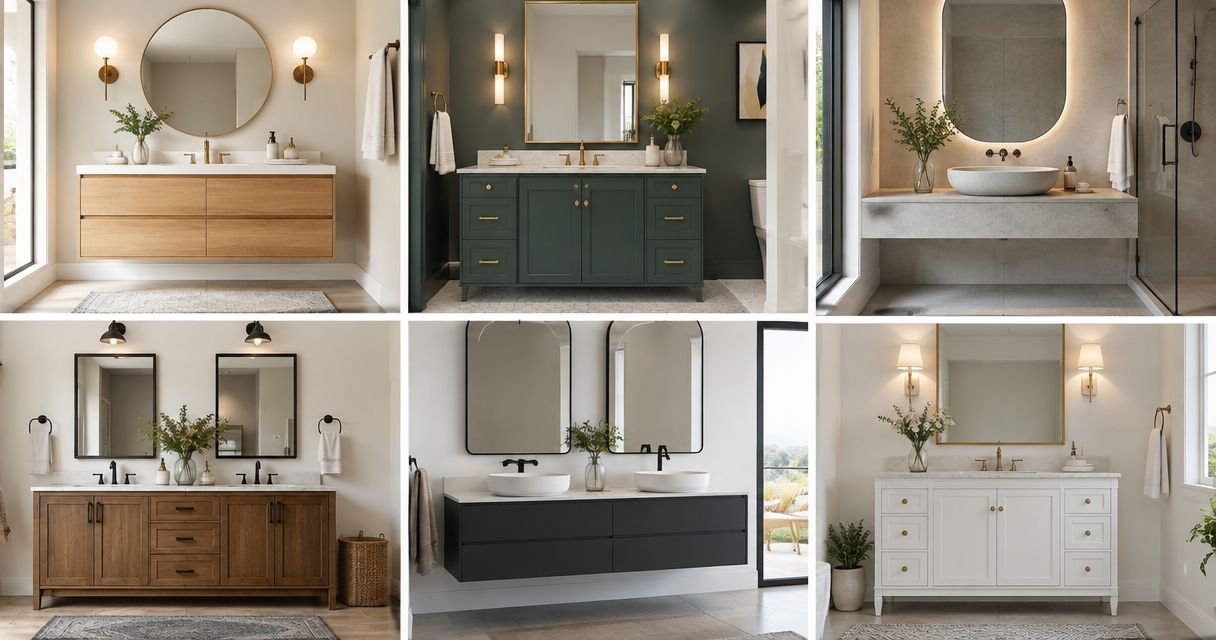
Best overall: Shaker vanities. Best for showing more floor: floating vanities. Best for a decorative powder room: furniture-style vanities. This 2026 guide ranks the best bathroom vanity styles by storage, cleaning, installation requirements, and how they fit your room—not by appearance alone.
- Shaker vanities lead the best bathroom vanity styles for enclosed storage and flexible design.
- Floating vanities expose the floor but require a suitable wall attachment and coordinated plumbing.
- Choose flat-panel fronts for fewer decorative grooves; choose furniture-style cabinets for a decorative focal point.
- A Finishing Touch Remodeling provides bathroom remodeling for homeowners in the Conroe and Woodlands area.
Why this matters
A vanity determines where you store toiletries, how you clean around the sink, and whether the bathroom door opens without interference. A cabinet that looks right in a photograph can still leave you with awkward drawers or exposed plumbing.
For a 2026 bathroom remodel, settle the layout before choosing a door profile. A Finishing Touch Remodeling offers bathroom remodeling for Conroe and Woodlands homeowners, alongside other home remodeling services.
Shaker is the default choice when you want enclosed bathroom storage without committing to ornate detailing. Choose another style when it solves a specific problem that Shaker does not.
What makes the best bathroom vanity styles
Use these criteria to judge a vanity before selecting its finish:
- Usable storage: Look at drawer interiors and plumbing cutouts, not just the cabinet's outside dimensions.
- Cleaning access: Compare door grooves, exposed shelves, legs, and the space beneath the cabinet.
- Room clearance: Check the cabinet, countertop projection, door swing, and drawer travel together.
- Installation fit: Confirm how the cabinet attaches and where supply lines and the drain enter.
- Visual compatibility: Match the degree of detail to the room's tile, fixtures, and existing trim.
- Material suitability: Review the specified cabinet material, finish, and care instructions for bathroom use.
For your 2026 shortlist, separate appearance from construction. A Shaker door describes a front profile; a floating vanity describes how the cabinet is mounted. You can combine them.
Bathroom vanity styles at a glance
These rankings identify design priorities, not mutually exclusive product categories. A floating cabinet can have flat-panel fronts, and a furniture-style vanity can include raised-panel doors.
| Rank and style | Best for | Standout feature | Key limitation |
|---|---|---|---|
| 1. Shaker | Flexible design with enclosed storage | Recessed center panel and framed edges | More edges to wipe than a slab front |
| 2. Floating | Showing more floor in a compact bathroom | Wall-mounted cabinet leaves floor exposed | Attachment and plumbing need coordination |
| 3. Flat-panel | Simple fronts with fewer cleaning details | Uninterrupted slab-style doors and drawers | Finish and hardware carry the visual design |
| 4. Furniture-style | A decorative powder-room focal point | Legs, shaped bases, or furniture-like detailing | Decorative structure can reduce usable storage |
| 5. Traditional raised-panel | Rooms with detailed trim | Raised center panels and dimensional profiles | More contours collect dust and residue |
| 6. Open-shelf | Visible, frequently used guest supplies | Storage you can see without opening a door | Contents stay exposed to view and dust |
1. Shaker: best vanity style for flexible design
Shaker fronts have a recessed center panel surrounded by a frame. The profile supplies definition without the deeper ornament of a raised-panel door, so you can pair it with either simple or more detailed bathroom finishes.
Choose the interior layout separately. A familiar door style does not guarantee useful drawers, and a sink cabinet still needs space for plumbing.
Shaker pros:
- Enclosed storage keeps everyday supplies out of sight.
- Framed fronts provide detail without elaborate carving.
- The profile works with a range of hardware shapes.
Shaker cons:
- Panel edges and corners need wiping.
- Door style alone tells you nothing about cabinet construction.
Best for: Homeowners who want a cabinet profile that does not dictate every other design choice.
Buy: Choose Shaker when you want the safest design starting point; inspect the interior before committing.
2. Floating: best vanity style for showing more floor
A floating vanity mounts to the wall rather than resting on a conventional floor-level base. The visible floor beneath it changes the room's appearance and gives you access underneath for cleaning.
That visual openness comes with installation requirements. The wall attachment must suit the cabinet and its loaded assembly, while the plumbing must fit within—or be intentionally visible beneath—the design.
Floating vanity pros:
- Leaves the floor beneath the cabinet visible.
- Allows cleaning beneath an accessible cabinet base.
- Works with different door profiles, including Shaker and flat-panel.
Floating vanity cons:
- Requires a suitable attachment arrangement.
- A shallow cabinet or plumbing cutouts can restrict storage.
Best for: Bathrooms where exposing more floor matters more than maximizing cabinet volume.
Buy: Choose floating only after confirming wall attachment, plumbing placement, and usable drawer space.
3. Flat-panel: best vanity style for simple cleaning
Flat-panel vanities use slab-style fronts without a framed center panel. Their broad, uninterrupted surfaces remove the decorative recesses found on Shaker and raised-panel fronts.
Flat fronts simplify the face of the cabinet, not the entire bathroom. Handles, countertop joints, and the cabinet's lower edges still need cleaning, and the selected finish determines its care requirements.
Flat-panel pros:
- Fronts have fewer decorative grooves to wipe.
- Simple surfaces keep attention on tile or countertop details.
- Door and drawer arrangements can create a consistent appearance.
Flat-panel cons:
- Large plain surfaces make the finish especially noticeable.
- Handle placement becomes a prominent design decision.
Best for: Homeowners who dislike decorative cabinet profiles and want straightforward fronts.
Buy: Choose flat-panel for simplicity, then check a finish sample under your bathroom lighting.
4. Furniture-style: best vanity style for a powder-room focal point
Furniture-style vanities use details associated with freestanding furniture, such as legs, shaped bases, and decorative drawer arrangements. They suit a room where the sink cabinet is intended to be a visible feature rather than a quiet background element.
Look beyond the drawer fronts. A decorative front does not necessarily open, and the sink and drain can occupy space that appears to be storage.
Furniture-style vanity pros:
- Gives a small room a clear decorative focal point.
- Legs or shaped bases add visible detail below the cabinet.
- Can echo furniture elsewhere in the home.
Furniture-style vanity cons:
- Decorative structures can limit usable storage.
- Legs and shaped bases add surfaces to clean around.
Best for: Powder rooms where appearance takes priority over storing a household's daily supplies.
Buy: Choose furniture-style after checking actual drawers, plumbing space, and access around the legs.
5. Raised-panel: best vanity style for traditional detailing
Raised-panel fronts have a dimensional center panel and surrounding profile. They belong on your shortlist when the bathroom already includes detailed trim or when you deliberately want a more ornamented cabinet.
Judge the complete elevation rather than a door sample alone. Repeated panels, decorative hardware, patterned tile, and a detailed mirror all compete for attention if you give them equal emphasis.
Raised-panel vanity pros:
- Provides pronounced cabinet detail.
- Complements a deliberately traditional design direction.
- Offers enclosed storage without exposed shelf contents.
Raised-panel vanity cons:
- Contoured profiles require more detailed cleaning.
- Multiple ornate finishes can make the room visually busy.
Best for: Bathrooms where traditional trim and dimensional cabinetry are intentional parts of the design.
Buy: Choose raised-panel when its detail supports the room; skip it when you want the cabinetry to recede.
6. Open-shelf: best vanity style for visible guest essentials
An open-shelf vanity leaves part of its storage exposed. Folded towels and frequently used supplies remain visible, which makes this configuration useful when guests need to find things without searching through doors.
The trade-off is permanent visibility. Cleaning products, packaging, cords, and spare toiletries become part of the room's appearance unless you store them elsewhere.
Open-shelf vanity pros:
- Keeps selected supplies visible and accessible.
- Makes stored towels part of the room's appearance.
- Combines with enclosed drawers in some configurations.
Open-shelf vanity cons:
- Exposed contents need dusting and tidying.
- Provides less concealed storage than an otherwise comparable enclosed layout.
Best for: Guest bathrooms with a small, deliberate set of visible supplies.
Buy: Choose open shelving only when you already know what belongs on every shelf.
Check fit before choosing the finish
A 2026 vanity replacement needs a dimensional check even when the new cabinet looks similar to the old one. Measure the countertop and cabinet separately; they do not necessarily share the same footprint.
For example, replacing a 30-inch-wide cabinet with a 36-inch-wide cabinet adds 6 inches of cabinet width. That is a planning example, not a recommended size: the larger cabinet still needs room for its countertop, drawers, and adjacent fixtures.
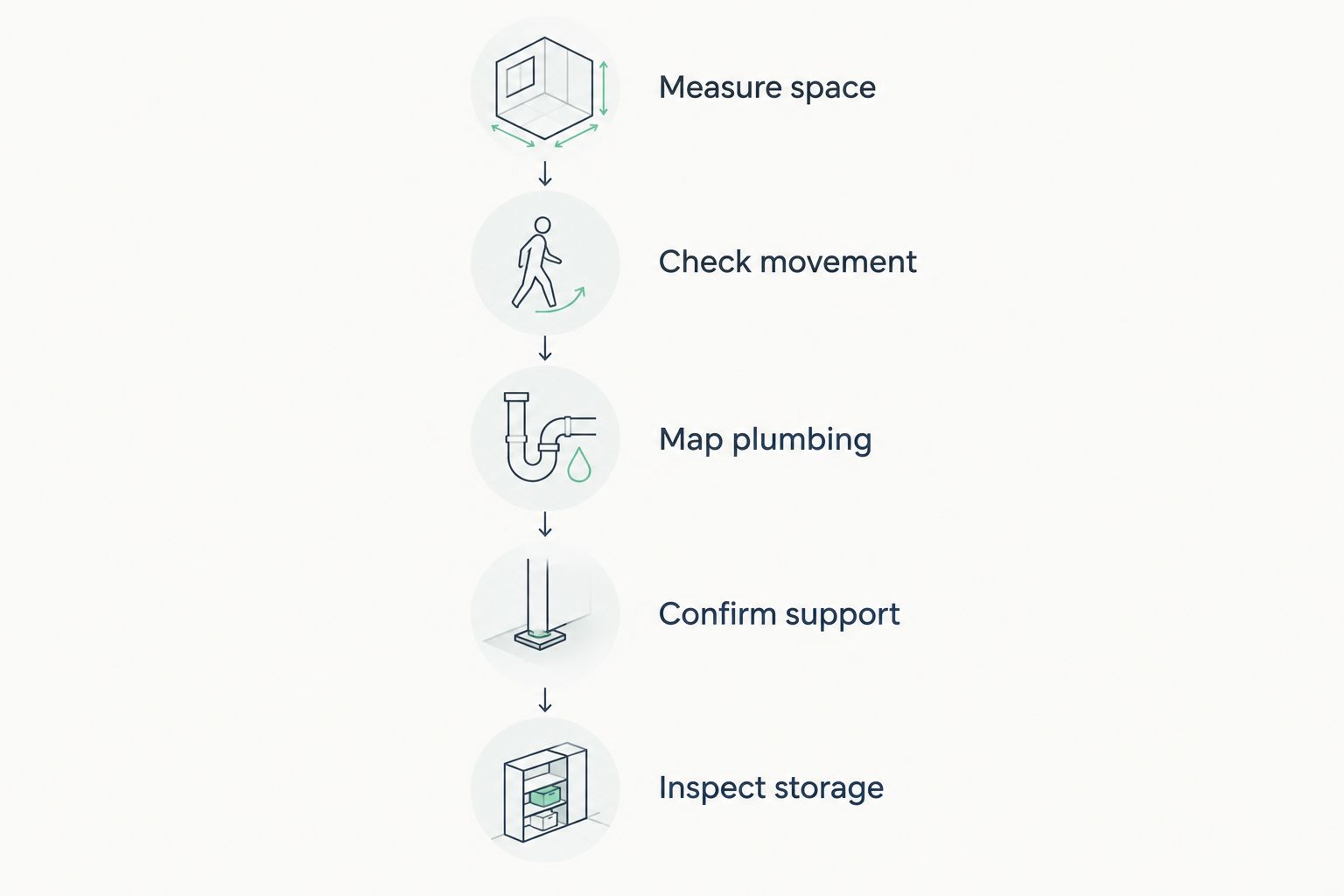
Use this sequence before ordering:
- Measure space: Record the available width, depth, and obstructions, including trim and nearby fixtures.
- Check movement: Open the bathroom door and consider the travel of every proposed cabinet door and drawer.
- Map plumbing: Locate the drain and supply lines against the proposed cabinet interior.
- Confirm support: Check the attachment requirements, especially for a wall-mounted cabinet.
- Inspect storage: Compare usable drawer and shelf space with the items you need to keep there.
A Finishing Touch Remodeling serves local homeowners with bathroom remodeling. When discussing your project, bring the proposed vanity dimensions and interior drawing rather than relying on a front-facing product photograph.
Discuss your bathroom remodel
Bring your vanity shortlist, room measurements, and storage priorities to the project discussion.
How the styles rank
The 2026 ranking puts flexible design and enclosed storage first, which places Shaker at the top. Floating and flat-panel vanities follow because they solve distinct problems: visible floor space and simpler front profiles.
Furniture-style, raised-panel, and open-shelf vanities serve narrower priorities. Their lower positions do not indicate poor construction; style names cannot establish material quality, installation quality, or durability.
Choose the style for the room, then judge the actual cabinet on its specifications. A decorative label never substitutes for a usable interior or a suitable installation.
Which bathroom vanity style should you choose?
For most undecided homeowners comparing the best bathroom vanity styles in 2026, start with Shaker and enclosed storage. Move to floating when visible floor is your priority, flat-panel when you want fewer front details, or furniture-style when the vanity needs to anchor a decorative powder room.
Keep the decision tied to daily use. If you need concealed storage, do not choose open shelves merely because the display photograph looks tidy.
FAQ
What's the best bathroom vanity style in 2026?
Shaker is the best default in this ranking because it combines enclosed storage with a restrained, framed door profile. Floating, flat-panel, and furniture-style vanities are better choices when their specific design benefits match your room.
Is a floating vanity better for a small bathroom?
A floating vanity is better when your priority is exposing more floor, not automatically when you need more storage. Check cabinet depth, usable drawers, wall attachment, and plumbing before choosing it.
Which bathroom vanity style is easiest to wipe clean?
Flat-panel fronts have fewer decorative recesses to wipe than Shaker or raised-panel fronts. The cabinet finish, handles, countertop joints, and base still affect the full cleaning routine.
Can a floating bathroom vanity have Shaker doors?
Yes, a floating vanity can have Shaker doors. Floating describes the mounting arrangement, while Shaker describes the cabinet front profile.
Should I choose drawers or doors for a bathroom vanity?
Choose drawers when their usable interiors fit your daily supplies, and doors when you need the particular cabinet space they provide. Check the plumbing cutouts because the sink and drain can interrupt either layout.
Are open-shelf bathroom vanities practical for families?
Open-shelf vanities are practical when the exposed items are deliberate and other supplies have a concealed home. Choose enclosed storage instead if packaging, cleaning supplies, and everyday toiletries would otherwise remain visible.
Who offers bathroom remodeling in the Conroe and Woodlands area?
A Finishing Touch Remodeling offers bathroom remodeling for homeowners in the Conroe and Woodlands area. Its stated services also include kitchen remodeling, drywall, carpentry, flooring, painting, and fencing.
One last thing
A drawer front can look full-sized while the usable drawer behind it is shortened by plumbing. Ask to see the interior drawing before you approve the exterior. That check tells you more about everyday usefulness than another photograph of the cabinet doors.