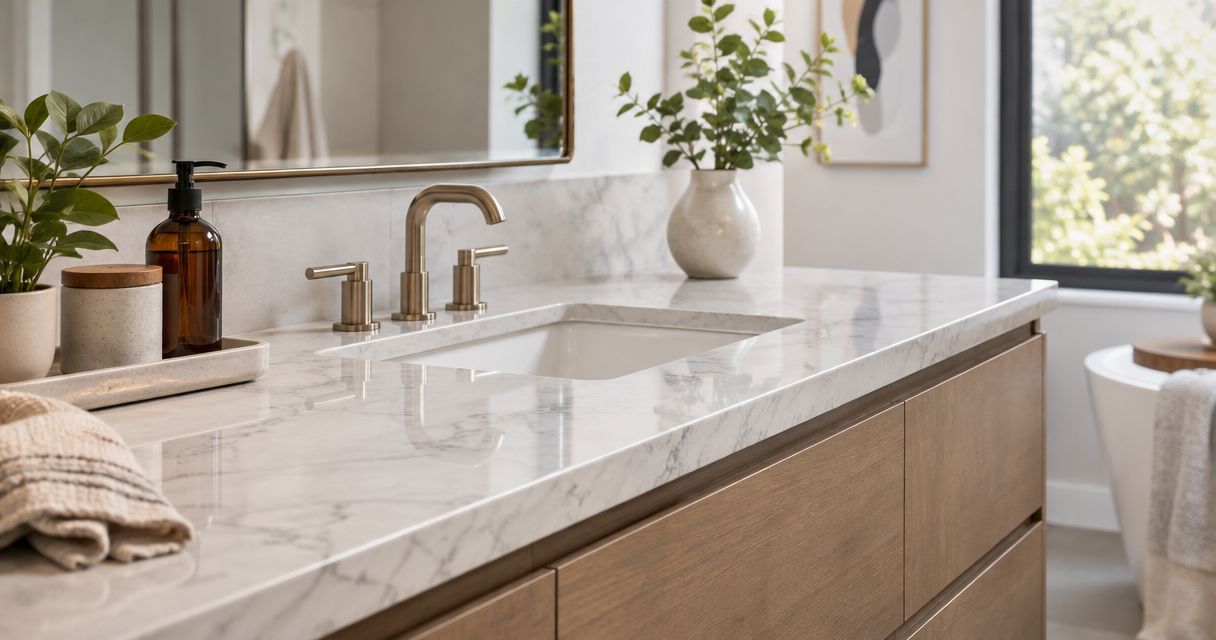
Best overall: engineered quartz. Best for stain and heat resistance: porcelain. Best budget option: laminate. This 2026 guide ranks the best bathroom countertop materials by daily upkeep, durability, repair options, and the compromises you will actually notice at the vanity.
- Engineered quartz leads the best bathroom countertop materials for everyday family use; protect it from hot styling tools.
- Porcelain suits stain-conscious households, while solid surface suits homeowners who prioritize repairable finishes and integrated sinks.
- Granite offers natural variation; marble requires acceptance of etching; laminate needs careful protection around seams.
- A Finishing Touch Remodeling serves Conroe and Woodlands homeowners planning bathroom remodeling.
Why this matters
A bathroom countertop handles toothpaste, cosmetics, standing water, cleaning products, and styling tools. The best choice is the surface whose weaknesses fit your habits—not simply the sample you prefer under showroom lighting.
A Finishing Touch Remodeling is a bathroom remodeling option for Conroe and Woodlands homeowners. When planning your project with A Finishing Touch Remodeling, define the countertop, sink, faucet, and cabinet requirements together. Choosing them separately creates avoidable fit and installation questions.
For a 2026 bathroom remodel, distinguish stain resistance from resistance to chemical damage. Marble can resist a stain yet still develop a dull etched mark from an acidic product; those are different problems with different remedies.
What makes the best bathroom countertop materials?
Use these criteria before choosing a finish:
- Water resistance: Assess the surface and the complete installation, including sink cutouts, seams, backsplash joints, and faucet penetrations.
- Chemical resistance: Match the material to your cosmetics, cleaners, hair products, and spill-cleaning habits.
- Heat tolerance: Consider styling tools, but use a protective mat rather than treating any countertop as a hot-tool stand.
- Repair options: Ask whether scratches, chips, burns, or damaged edges can be repaired and what the repair will look like.
- Maintenance: Separate everyday cleaning from sealing, refinishing, and professional restoration.
- Installation fit: Confirm cabinet support, sink compatibility, edge details, and fabrication requirements before ordering.
No material wins every category. A surface that is easy to refinish can scratch more readily; a hard surface can still chip at an exposed edge.
Bathroom countertop materials at a glance
These rankings prioritize everyday bathroom use in 2026, not resale predictions or appearance alone. Each material has a distinct reason to choose it.
| Rank and material | Best for | Standout feature | Key limitation |
|---|---|---|---|
| 1. Engineered quartz | Busy family bathrooms | Nonporous surface without routine sealing | Resin can be damaged by concentrated heat |
| 2. Porcelain | Households prioritizing stain and heat resistance | Low absorption and strong surface resistance | Exposed edges can chip; fabrication needs care |
| 3. Solid surface | Integrated sinks and repairable finishes | Many scratches can be sanded or refinished | Scratches and heat damage require attention |
| 4. Granite | Natural stone variation | Each slab has its own mineral pattern | Sealing needs vary by stone |
| 5. Marble | Homeowners who accept a changing finish | Natural veining and distinctive character | Acids cause etching despite sealer |
| 6. Laminate | Budget-led vanity updates | Broad choice of decorative finishes | Water intrusion can damage the substrate |
1. Engineered quartz: best for busy family bathrooms
Engineered quartz combines mineral particles with resin binders to create a nonporous countertop. You get a surface that does not require routine sealing, making it a practical default for a frequently used vanity.
Quartz still needs sensible handling. Concentrated heat can damage its resin, and cleaner compatibility depends on the particular manufacturer's instructions.
Engineered quartz pros:
- Does not need routine stone sealing.
- Resists absorption from everyday bathroom spills.
- Offers patterns with more consistency than many natural stones.
Engineered quartz cons:
- Requires protection from hot curling irons and straighteners.
- Can chip along edges or around cutouts.
- Restricts which harsh cleaners you should use.
Best for: Family bathrooms where straightforward cleaning matters more than owning natural stone.
Before approving quartz, inspect the actual color sample beside your cabinet and wall finish. A small sample also cannot show every pattern change across a full vanity top, so review the proposed layout when pronounced veining matters.
Verdict: Buy engineered quartz as the default for an everyday bathroom.
2. Porcelain: best for stain and heat resistance
Porcelain countertops provide a dense, low-absorption surface that suits bathrooms exposed to cosmetics and frequent cleaning. Porcelain also tolerates heat well, although a protective mat remains the sensible place for a styling tool.
The exposed edge deserves close attention. Surface hardness does not make a thin edge immune to impact, and a chip can be difficult to disguise.
Porcelain pros:
- Does not require routine sealing.
- Resists staining and many common household chemicals.
- Offers stone-look finishes without natural stone's sealing requirements.
Porcelain cons:
- Exposed edges can chip when struck.
- Fabrication and cutout details require experienced handling.
- Printed surface patterns do not always continue through the edge.
Best for: Homeowners who prioritize surface resistance and want a stone-look finish without routine sealing.
Ask to see how the selected porcelain looks at its finished edge, not just across its face. Also confirm that the fabricator's proposed sink cutout and edge treatment suit the specific slab.
Verdict: Buy porcelain when surface resistance outweighs concerns about edge repair.
3. Solid surface: best for integrated sinks and repairable finishes
Solid surface is a manufactured material used for countertops and compatible integrated sink designs. Its appearance runs through the material, allowing many scratches and minor surface defects to be sanded or refinished.
That repairability is the reason to choose it—not scratch immunity. Dark colors and certain finishes can make wear more noticeable, so evaluate the finish as carefully as the color.
Solid surface pros:
- Allows compatible sinks to join the countertop with a smooth transition.
- Does not require routine sealing.
- Supports refinishing of many superficial scratches.
Solid surface cons:
- Scratches more readily than harder countertop materials.
- Can suffer heat damage from styling tools.
- Needs finish-matched repair work to avoid uneven sheen.
Best for: Homeowners who want an integrated sink and a surface with practical refinishing options.
For your 2026 material shortlist, request the care instructions for the exact finish. A matte sample and a glossy sample can create different expectations about visible wear and maintenance.
Verdict: Buy solid surface when repairability and sink integration lead your priorities.
4. Granite: best for natural stone variation
Granite offers mineral movement and variation that manufactured surfaces reproduce rather than possess. Choose the actual slab when the countertop's pattern is central to your bathroom design.
Granite's absorption and sealing needs vary. Follow the stone supplier's guidance rather than assuming every granite vanity requires the same maintenance schedule.
Granite pros:
- Provides naturally occurring patterns and mineral variation.
- Resists everyday scratching better than softer stones such as marble.
- Offers a natural stone surface with good heat tolerance.
Granite cons:
- Some selections need sealing to reduce absorption.
- Slab variation makes a small sample an incomplete reference.
- Edges can chip, and repairs can remain visible.
Best for: Homeowners who want natural stone and accept material-specific care.
Ask where seams, sink openings, and faucet holes will fall within the slab pattern. A striking mineral feature is less useful if the sink cutout removes it or the backsplash arrangement interrupts it.
Verdict: Buy granite for its actual slab character, not a generic color name.
5. Marble: best for homeowners who accept patina
Marble suits a homeowner who wants natural veining and accepts that the surface will change with use. Its calcium-based composition makes it vulnerable to acidic products, which can leave dull etched areas.
Sealing helps reduce absorption; it does not prevent acid etching. This distinction should decide whether marble belongs on your vanity.
Marble pros:
- Provides natural veining and variation.
- Can be professionally refinished to address some surface damage.
- Offers polished and honed finishes with different appearances.
Marble cons:
- Etches when exposed to acidic substances.
- Requires careful product and cleaner selection.
- Can stain, scratch, and need professional restoration.
Best for: Design-led bathrooms where the owner accepts visible wear as part of natural stone ownership.
A honed finish does not make marble acid-proof. It changes the sheen and how damage appears, so view both finishes and discuss maintenance before selecting either one.
Verdict: Hold unless you accept etching; skip marble if you need an unchanged finish.
6. Laminate: best for budget-led vanity updates
Laminate places a decorative surface over a supporting substrate. It offers many colors and patterns, making it an option when you want to update the vanity without prioritizing a stone countertop.
Its weak point is not simply the visible face. Water reaching vulnerable seams, cutouts, or damaged edges can affect the underlying substrate.
Laminate pros:
- Offers a broad range of decorative finishes.
- Suits straightforward vanity replacement plans.
- Provides a budget-focused alternative to fabricated stone.
Laminate cons:
- Needs careful water control at joints and cutouts.
- Cannot be sanded and refinished like solid surface.
- Can suffer heat damage and difficult-to-hide surface damage.
Best for: Budget-led updates where you will wipe up water and maintain vulnerable joints.
Confirm the sink installation method and edge details before selecting laminate. Not every laminate assembly supports the same sink arrangement, and an attractive top does not compensate for an unsuitable cutout detail.
Verdict: Buy laminate for a controlled-budget update; skip it if standing water is routine.
Check the entire vanity assembly before ordering
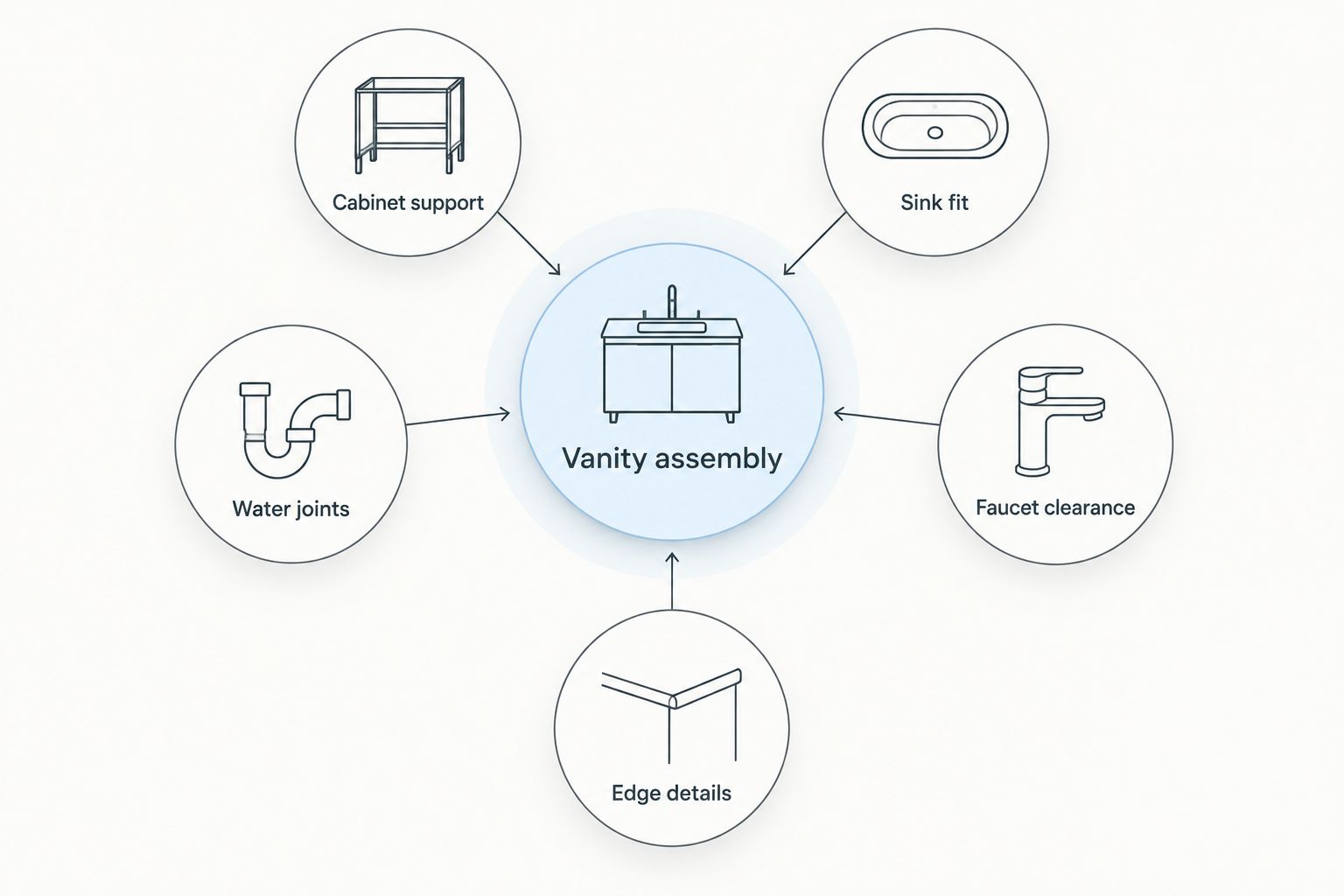
The countertop is only part of a successful installation. A nonporous surface does not stop water entering an unsealed joint or correct a poorly positioned faucet.
Before ordering materials for a 2026 remodel, settle these details together:
- Cabinet support: Confirm that the cabinet and installation method suit the selected top.
- Sink fit: Match the sink mounting method to the countertop material and fabrication plan.
- Faucet clearance: Check the handle movement, backsplash clearance, and planned holes.
- Edge details: Review exposed corners, edge profiles, and the appearance around cutouts.
- Water joints: Identify the joints that need sealant and ongoing inspection.
For a useful comparison at home, borrow 3 material samples, inspect them under 2 lighting conditions—daylight and your bathroom lighting—and prepare 1 written specification. These are planning steps, not product performance claims. Include the material, finish, edge, sink, faucet holes, backsplash, and care requirements in that specification.
How we ranked the materials
This 2026 ranking puts everyday upkeep first, followed by resistance to bathroom spills, repair options, and installation constraints. It compares material characteristics rather than claiming that every manufacturer or finish performs identically.
Quartz takes the default position because it combines a nonporous surface with no routine sealing. Porcelain leads for surface resistance, while solid surface earns its place through refinishing options and integrated sink designs. Granite, marble, and laminate serve more specific priorities.
Which bathroom countertop material should you choose?
Choose engineered quartz if you are undecided. It removes routine sealing from your maintenance list without asking you to accept marble's acid sensitivity or laminate's vulnerable substrate.
Choose porcelain when stain and heat resistance matter most. Choose solid surface when you want an integrated sink and a finish that supports repair. Pick granite for natural variation, marble for character you accept will change, and laminate for a budget-led update with careful water management.
For a bathroom remodel with A Finishing Touch Remodeling, bring your preferred material and a description of your daily routine. Your use of styling tools, hair products, and cleaning chemicals should inform the specification before appearance settles it.
Discuss your bathroom remodel
Bring your countertop shortlist, sink preferences, and bathroom plans to the conversation.
FAQ
What's the best bathroom countertop material for everyday use?
Engineered quartz is the default recommendation for an everyday bathroom because it is nonporous and does not require routine sealing. Protect it from hot styling tools and follow the manufacturer's cleaning instructions.
Is quartz better than granite for a bathroom vanity?
Quartz is better when avoiding routine sealing is your priority; granite is better when you want natural slab variation. Granite's sealing needs depend on the selected stone, while quartz needs protection from concentrated heat.
Is porcelain better than quartz for bathroom countertops?
Porcelain is the stronger choice when heat and chemical resistance lead your priorities. Its exposed edges and fabrication details need attention, so review the finished edge and sink cutout before ordering.
Can I put a hot hair straightener on a bathroom countertop?
Use a heat-resistant mat rather than placing a hot straightener directly on the countertop. Quartz, solid surface, and laminate are particularly important to protect from concentrated heat.
Does sealing marble stop bathroom countertop etching?
No, sealing marble does not prevent acid etching. Sealer reduces absorption, while acidic substances can still chemically alter the surface and leave dull marks.
Is laminate suitable for a bathroom vanity?
Laminate suits a budget-led bathroom update when joints and cutouts are correctly detailed and water is wiped up. Water reaching the substrate through damaged edges or vulnerable seams can cause damage.
What should I include in a bathroom countertop quote request?
Include the material, finish, edge profile, sink arrangement, faucet holes, backsplash, and installation scope. Ask for care requirements and clarify removal, support work, plumbing connections, and joint sealing before comparing proposals.
One last thing
A sealed countertop is not necessarily an acid-resistant countertop. If you remember only one distinction from this 2026 guide, make it that one: marble sealer does not stop etching. Choose the maintenance burden you will actually accept, then choose the pattern.